India-Canada Foreign Office Consultations 2025: Bilateral ties gain momentum
Synopsis
India and Canada held structured Foreign Office Consultations in New Delhi on 2 September, with both sides pushing toward a year-end CEPA deadline and a ₹4.65 lakh crore bilateral trade target by 2030 — a striking diplomatic reset after one of the most turbulent periods in the two countries' modern relationship.
Key Takeaways
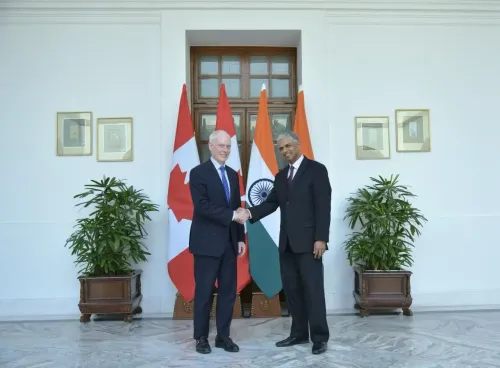
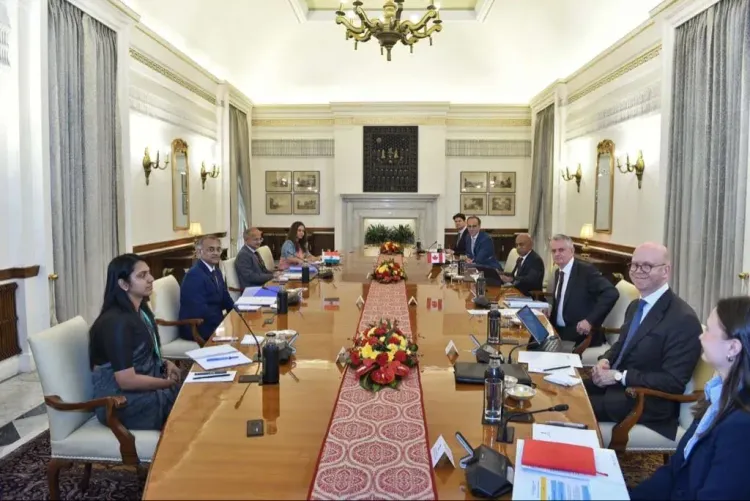
India and Canada held annual Foreign Office Consultations on 2 September at Hyderabad House, New Delhi .
The Indian side was led by Rudrendra Tandon (MEA Secretary, East); Canada was represented by Arun Thangaraj , Deputy Minister of Foreign Affairs.
Both sides committed to concluding CEPA negotiations before end of 2025 , targeting bilateral trade of CAD 70 billion (₹4.65 lakh crore) by 2030 .
Discussions covered energy, critical minerals, science and technology, education, defence, and consular matters .
Finance Minister Nirmala Sitharaman addressed an India-Canada Business Roundtable in Toronto , calling for deeper financial-sector cooperation and digital payment linkages.
The consultations reflect sustained diplomatic momentum since June 2025 , following a period of significant bilateral strain.
India and Canada held their annual Foreign Office Consultations (FOC) on Wednesday, 2 September at Hyderabad House, New Delhi, with both sides affirming that the talks carried forward the sustained momentum in bilateral ties that has been building since June 2025. The Ministry of External Affairs (MEA) described the consultations as a reaffirmation of the importance of the India-Canada relationship, anchored in shared democratic values and a joint commitment to the rule of law.
Who Led the Delegations
The Indian side was represented by Rudrendra Tandon, Secretary (East) at the MEA, while the Canadian delegation was headed by Arun Thangaraj, Deputy Minister of Foreign Affairs at Global Affairs Canada. The structured dialogue covered a broad range of institutional mechanisms, reflecting the breadth of the two countries' engagement.
Key Areas of Discussion
According to the MEA statement, both delegations reviewed progress across several areas of bilateral cooperation, including energy and critical minerals, science and technology, education, security and defence cooperation, culture, people-to-people ties, and consular matters. The two sides welcomed the strengthening of institutional engagement and dialogue between the two governments.
Notably, both sides reiterated their shared commitment to conclude negotiations on the Comprehensive Economic Partnership Agreement (CEPA) before the end of the year. The shared objective is to more than double bilateral trade to CAD 70 billion — equivalent to approximately ₹4.65 lakh crore — by 2030. This trade target underscores the scale of ambition driving the current diplomatic reset.
Finance Minister Sitharaman's Push for Deeper Economic Ties
The diplomatic consultations came on the heels of a high-profile economic engagement. Finance Minister Nirmala Sitharaman, addressing a high-level India-Canada Business Roundtable in Toronto, said India and Canada have a significant opportunity to deepen financial-sector cooperation and build long-term investment partnerships. She was speaking in the presence of Canadian Finance and National Revenue Minister François-Philippe Champagne.
The Ministry of Finance quoted Sitharaman as saying that India brings 'scale, growth and opportunities', while Canada offers 'long-term capital, institutional depth and expertise' — a framing that positions the two economies as structurally complementary rather than competitive.
Sitharaman also outlined India's reform-led transformation over the past decade, citing the Asset Quality Review, the Insolvency and Bankruptcy Code, the 4R approach, and EASE reforms as measures that have materially strengthened India's banking system. She added that both countries are exploring how digital technologies — including easier payments, cross-border remittances, and greater digital payment choices — can further deepen financial cooperation.
Context and What Comes Next
This comes amid a broader diplomatic recalibration between the two nations following a period of significant strain in 2023 and 2024, when bilateral ties were tested by serious diplomatic disputes. The pace of high-level exchanges since June 2025 has been cited by both governments as evidence of a meaningful reset. The FOC, a structured annual mechanism, provides institutional continuity to that recovery. With CEPA negotiations now carrying a year-end deadline and a ₹4.65 lakh crore trade target on the horizon, the coming months will be a critical test of whether the current momentum translates into durable economic outcomes.
Point of View
And a year-end deadline, while politically useful, has been implicit before. The real signal to watch is whether the ₹4.65 lakh crore trade target comes with a credible sectoral roadmap or remains an aspirational headline. Sitharaman's Toronto remarks on digital payments and cross-border remittances suggest India is eyeing Canada's large diaspora as a strategic economic lever — a dimension that mainstream coverage of the FOC has largely underreported.
NationPress
18 Oct 2026
Frequently Asked Questions
What are the India-Canada Foreign Office Consultations?
The Foreign Office Consultations (FOC) are an annual structured diplomatic dialogue between India and Canada, covering bilateral cooperation across trade, energy, defence, education, and consular matters. The 2025 edition was held on 2 September at Hyderabad House in New Delhi.
What is the India-Canada trade target announced at the FOC?
Both sides reiterated their shared objective of more than doubling bilateral trade to CAD 70 billion — approximately ₹4.65 lakh crore — by 2030. This is linked to their commitment to conclude Comprehensive Economic Partnership Agreement (CEPA) negotiations before the end of 2025.
Who represented India and Canada at the 2025 FOC?
India was represented by Rudrendra Tandon, Secretary (East) at the Ministry of External Affairs. Canada's delegation was led by Arun Thangaraj, Deputy Minister of Foreign Affairs at Global Affairs Canada.
What did Finance Minister Nirmala Sitharaman say about India-Canada ties?
Finance Minister Nirmala Sitharaman, speaking at an India-Canada Business Roundtable in Toronto, said India brings 'scale, growth and opportunities' while Canada offers 'long-term capital, institutional depth and expertise.' She also called for deeper cooperation in digital payments and cross-border remittances.
Why is the 2025 India-Canada diplomatic engagement significant?
The consultations mark a meaningful diplomatic reset after a period of serious bilateral strain in 2023 and 2024. Both governments have cited the pace of high-level exchanges since June 2025 as evidence of a sustained recovery, with the FOC providing institutional continuity to that momentum.