Celebrating Two Years of India-EFTA TEPA: A New Era for Trade and Investment
Synopsis
The Trade and Economic Partnership Agreement (TEPA) between India and the EFTA celebrates its second anniversary, reinforcing trade, investment, and technological collaboration. This agreement is set to unlock significant economic opportunities for India.
Key Takeaways
TEPA marks two years of enhanced trade relations.
Strengthens cooperation in investment and technology .
Expected to unlock $100 billion in investments.
Tariff reductions on 92.2% of EFTA imports from India.
Protection for sensitive sectors like dairy and certain agricultural products.
New Delhi, March 10 (NationPress) The Trade and Economic Partnership Agreement (TEPA) between India and the European Free Trade Association (EFTA) has reached the two-year milestone since its signing. On Tuesday, the government emphasized that this agreement is enhancing collaboration in trade, investment, services, and technology.
This agreement, effective from October 1, 2025, is poised to fortify India’s economic relationships with EFTA member nations—namely Iceland, Liechtenstein, Norway, and Switzerland—while promoting industrial growth and export enhancement, as stated by the Ministry of Commerce & Industry.
Prime Minister Narendra Modi remarked that India has progressively established a robust network of trade alliances recently.
“The fact that India has entered into Free Trade Agreements (FTAs) with 38 nations signifies a significant transformation in the country's trade strategy,” PM Modi noted.
“These agreements link India with economies across various continents, providing Indian manufacturers the chance to tap into diverse global markets,” he added.
The Prime Minister also highlighted that India’s service sector has already positioned the nation as a center for Global Capability Centres.
With improved regulations and enhanced mobility provisions under these trade agreements, Indian professionals are anticipated to encounter increased opportunities abroad.
“India’s manufacturing sector has witnessed remarkable advancements in recent years, and FTAs will facilitate the deeper integration of Indian products into global supply chains,” PM Modi elaborated.
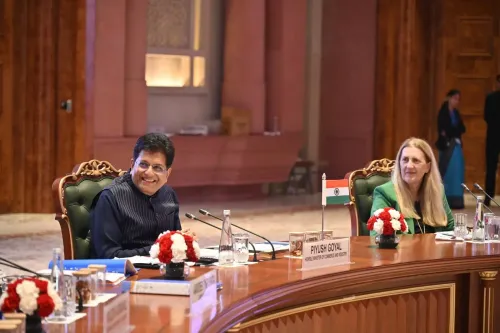
Union Commerce and Industry Minister Piyush Goyal indicated that the India-EFTA TEPA has been crafted with long-term economic aspirations in mind.
“The agreement will provide Indian exporters with enhanced access to high-income markets in Europe and pave the way for an investment influx worth $100 billion over the next 15 years,” Goyal remarked.
He added that the pact will enable Indian industries to access advanced machinery, quality inputs, and technology collaborations necessary for bolstering manufacturing.
Under this agreement, EFTA nations will reduce or eliminate tariffs on 92.2% of tariff lines, covering nearly 99.6% of India’s exports to the region.
In reciprocity, India will extend tariff concessions on 82.7% of tariff lines, which accounts for about 95.3% of EFTA exports.
However, sensitive sectors such as dairy, soya, coal, and certain agricultural products will remain protected, and the effective duty on gold will stay unchanged.
Point of View
The two-year mark of the India-EFTA TEPA represents a pivotal moment in India's economic strategy. This agreement not only enhances trade relations but also signals a commitment to fostering long-term growth and collaboration with European nations.
NationPress
29 Sept 2026
Frequently Asked Questions
What is the India-EFTA TEPA?
The India-EFTA TEPA is a Trade and Economic Partnership Agreement aimed at strengthening trade, investment, and technology cooperation between India and the European Free Trade Association.
Which countries are part of the EFTA?
The EFTA consists of Iceland, Liechtenstein, Norway, and Switzerland.
When did the agreement come into effect?
The TEPA came into effect on October 1, 2025.
What benefits does the agreement provide to Indian exporters?
The agreement offers better access to high-income markets in Europe and is expected to facilitate $100 billion in investment over the next 15 years.
Are any sectors protected under this agreement?
Yes, sensitive sectors such as dairy, soya, coal, and certain agricultural products remain protected under the agreement.