Has India Achieved a Record 31.25 GW Non-Fossil Addition in FY26?

Synopsis
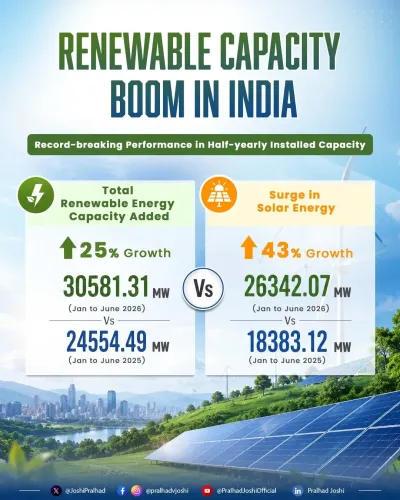
India has achieved a record-breaking **31.25 GW** of non-fossil capacity in FY26, including **24.28 GW** of solar energy. This achievement highlights the nation's dedication to clean energy and the empowerment of millions through new initiatives in Odisha.
Key Takeaways
India achieved a record 31.25 GW non-fossil capacity addition.
24.28 GW of this capacity is from solar energy.
New initiatives in Odisha aim to empower millions.
India's solar capacity has grown over 4,500% in 11 years.
Government initiatives play a crucial role in renewable energy growth.
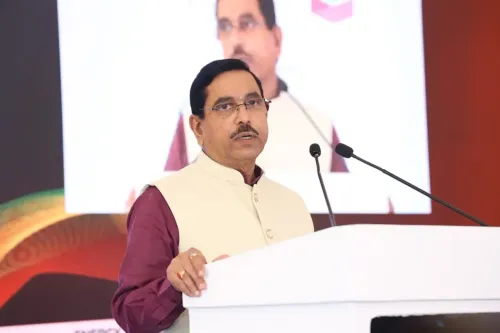
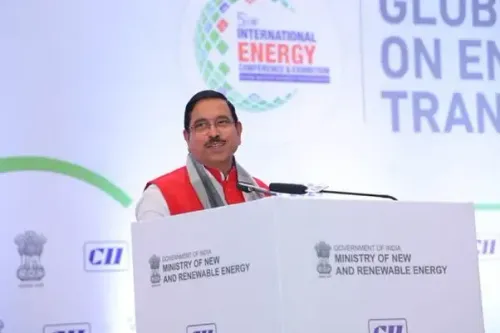
New Delhi, Dec 6 (NationPress) India has achieved a remarkable milestone, recording its highest-ever non-fossil capacity addition of 31.25 GW in the current financial year. This milestone includes an impressive 24.28 GW of solar energy, as reported by Pralhad Joshi, the Union Minister of New and Renewable Energy, on Saturday, marking India’s significant clean energy journey.
During his address at the Global Energy Leaders’ Summit 2025 in Puri, the Minister introduced a 1.5 lakh rooftop solar ULA model for Odisha, aimed at benefiting 7-8 lakh individuals throughout the state.
Pralhad Joshi highlighted that it took nearly 70 years for the world to reach 1 TW of renewable energy capacity in 2022, but just two years later, the global capacity surged to 2 TW. This rapid growth underscores India's vital role in the global renewable energy landscape.
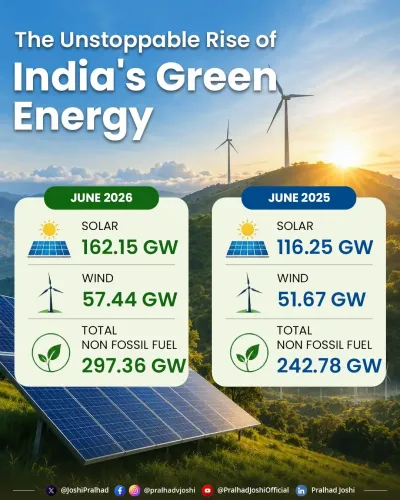
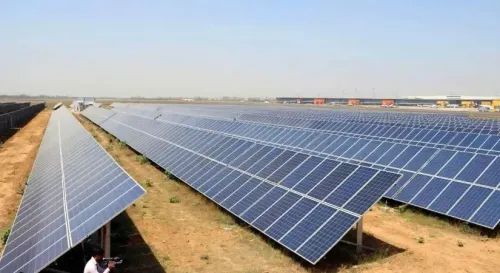
Over the past 11 years, India's solar capacity has skyrocketed from 2.8 GW to approximately 130 GW, marking an astounding increase of over 4,500 percent. Between 2022 and 2024, India alone contributed 46 GW to global solar capacity additions, making it the third-largest contributor worldwide.
Despite holding the fifth-largest coal reserves globally and being the second-largest coal consumer, the Minister noted that India is effectively balancing its coal usage with the growth of renewable energy.
With evolving global standards influencing industrial competitiveness, India's transition to renewable energy has become increasingly urgent and strategically significant.
In his remarks regarding Odisha’s initiatives, the Minister announced the approval of a consumer-owned Utility-Led Aggregation (ULA) model under PM Surya Ghar, which will facilitate the installation of 1.5 lakh rooftop solar systems of 1 kW each, benefiting nearly 7-8 lakh individuals, particularly from economically weaker backgrounds.
Odisha is already showcasing strong clean energy adoption, with over 3.1 GW of installed renewable capacity, representing more than 34 percent of the state's total power capacity.
Under the PM Surya Ghar Yojana, 1.6 lakh households have applied for rooftop solar systems, resulting in over 23,000 installations, and more than 19,200 families have received subsidies exceeding Rs 147 crore directly into their bank accounts.
Joshi emphasized that the comprehensive ecosystem fostered by Prime Minister Narendra Modi, alongside favorable business conditions, increased investor confidence, robust infrastructure, demand-driven initiatives, and strong Centre–State cooperation, has propelled India's renewable energy growth.
He expressed optimism that the upcoming years will be pivotal for Odisha, commending the leadership of Chief Minister Mohan Charan Majhi, Deputy Chief Minister Kanak Vardhan Singh Deo, and the state's populace in advancing renewable energy and green technology.
Point of View
It is clear that India is positioning itself as a leader in renewable energy. The recent record in non-fossil capacity addition not only reflects the nation's commitment to sustainable practices but also signifies a shift in energy strategy that could inspire global change. The initiatives in Odisha are commendable, showcasing how localized efforts can have a broad impact.
NationPress
20 Sept 2026
Frequently Asked Questions
What is the significance of the 31.25 GW addition?
The **31.25 GW** addition marks India's highest-ever non-fossil capacity growth, reflecting its commitment to renewable energy and clean technology.
How much solar capacity was added this year?
This year, **24.28 GW** of solar capacity was added as part of the overall **31.25 GW** non-fossil capacity.
What initiatives are planned for Odisha?
A **1.5 lakh rooftop solar ULA model** is planned for Odisha, aimed at benefiting **7-8 lakh** people, particularly from economically weaker households.
How has India's solar capacity changed over the years?
India's solar capacity has increased from **2.8 GW to around 130 GW** in the last **11 years**, showcasing a growth of over **4,500 percent**.
What role does the government play in renewable energy expansion?
The Indian government's initiatives, including the **PM Surya Ghar Yojana**, have been pivotal in driving renewable energy expansion and increasing investor confidence.