India's iron ore surge opens export window for South African producers

Synopsis
India's iron ore output jumped 43.9% year-on-year in June 2026, and a new report says South African producers are uniquely placed to capitalise — if they can fix their logistics. The demand signal is real, the supply-side bottleneck is self-inflicted, and the window may not stay open indefinitely.
Key Takeaways
India's Index of Core Industries (ICI) grew 5% year-on-year in June 2026 , up from 3.2% in May 2026.
Iron ore production surged 43.9% year-on-year in June 2026, leading all core sectors.
South Africa is among India's major suppliers of iron ore and coal, making India's demand surge directly relevant to its export earnings.
A new report warns that South Africa's ability to benefit depends on resolving logistics and policy consistency gaps — particularly coastal access for ore.
Natural gas, crude oil, refinery products, and fertilisers recorded negative growth in India's ICI during June 2026.
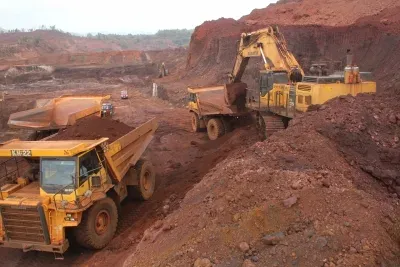
India's 43.9% year-on-year surge in iron ore production in June 2026 is the single most consequential data point for South African mining exporters, according to a new report, as New Delhi accelerates steelmaking capacity to meet surging domestic infrastructure and construction demand.
Why the India Growth Signal Matters
India's Index of Core Industries (ICI) recorded 5% growth in June 2026 compared with the same month of the previous year — an improvement over the 3.2% registered in May 2026. Iron ore led the charge, clocking 43.9% year-on-year growth, followed by electricity and cement at 9.8% each, steel at 4.6%, and coal at 1.4%. Natural gas, crude oil, refinery products, and fertilisers recorded negative growth during the same period.
Iron ore and electricity have been the primary engines of ICI's overall expansion in recent months, reflecting India's sustained public capital expenditure push and rising private investment in core sectors.
South Africa's Commercial Opportunity
South Africa is among India's major suppliers of iron ore and coal, and in certain segments holds a leading position. The mining sector remains a cornerstone of South Africa's export earnings, making India's demand trajectory directly relevant to its economic planning.
The report notes that South Africa, as a higher-grade ore supplier, is 'well positioned to benefit provided the ore can actually reach the coast' — a pointed reference to persistent logistics bottlenecks that have historically constrained export volumes. Addressing port efficiency and rail connectivity to coastal terminals is, by implication, as urgent as capturing the demand signal itself.
The Cautionary Message on Logistics and Policy
Alongside the commercial opportunity, the report carries a direct warning. 'For South Africa, whose mining sector remains a cornerstone of export earnings, the data carry both commercial opportunity and a cautionary message about logistics and policy consistency,' it stated. The implicit benchmark is India's own model: a combination of public capital expenditure, private investment, and clearer regulatory signals that has driven the ICI rebound.
The report cautions, however, that 'observing how India has combined public capital expenditure with private investment and clearer regulatory signals can inform local planning without implying that every Indian approach is directly transferable.' The lesson is structural, not prescriptive.
What South African Exporters Must Do Next
India's infrastructure rebound, driven by mining and construction inputs, is described in the report as 'more than a domestic story' — it is a demand signal that South African exporters and project developers 'would do well to monitor closely while simultaneously addressing the domestic constraints that prevent full participation in that demand.'
South Africa's opportunity, the report concludes, lies in ensuring that its producers and logistics systems are ready when India's expansion cycle continues. The window is open, but it will not wait for supply-side reform to catch up.
Point of View
But the report's real message is directed inward at South Africa: the opportunity exists, and the barrier is self-made. Logistics dysfunction and policy inconsistency have long capped South Africa's mining export potential, and no amount of Indian demand can compensate for ore that cannot reach a port. The India model — linking public capex with private investment and regulatory clarity — is instructive, but South Africa's structural constraints are distinct enough that copying the playbook wholesale would be a mistake. The more urgent task is fixing the domestic supply chain before the demand window narrows.
NationPress
16 Sept 2026
Frequently Asked Questions
Why is India's iron ore surge significant for South Africa?
India's 43.9% year-on-year jump in iron ore production in June 2026 signals rapidly expanding steelmaking and infrastructure demand. South Africa is one of India's major iron ore and coal suppliers, so sustained Indian demand directly affects South African mining export revenues.
What is India's Index of Core Industries and how did it perform in June 2026?
The Index of Core Industries (ICI) tracks output across eight key sectors including iron ore, electricity, cement, steel, and coal. It grew 5% year-on-year in June 2026, improving from 3.2% in May 2026, with iron ore and electricity as the primary drivers.
What is the main obstacle preventing South Africa from fully benefiting?
According to the report, logistics and policy consistency are the critical barriers. South Africa's higher-grade ore is commercially competitive, but supply chain bottlenecks — particularly in getting ore to coastal ports — limit the country's ability to capitalise on India's demand surge.
Which sectors recorded negative growth in India's ICI in June 2026?
Natural gas, crude oil, refinery products, and fertilisers all recorded negative year-on-year growth in India's Index of Core Industries in June 2026, even as iron ore, electricity, cement, steel, and coal posted gains.
Can South Africa replicate India's industrial policy approach?
The report says India's combination of public capital expenditure, private investment, and clearer regulatory signals can inform South African planning, but explicitly cautions that not every Indian approach is directly transferable given differing structural conditions.