India July 2026 exports hit record $44.24 bn, up 19% year-on-year
Synopsis
India's July 2026 merchandise exports crossed $44.24 billion — a monthly record — even as global supply chains remained fractured. With non-petroleum exports up nearly 13% and new markets from Tanzania to Singapore absorbing Indian goods, this is a structural story, not a commodity windfall. The catch: imports are growing faster, and the widening trade deficit is the number mainstream coverage is underplaying.
Key Takeaways
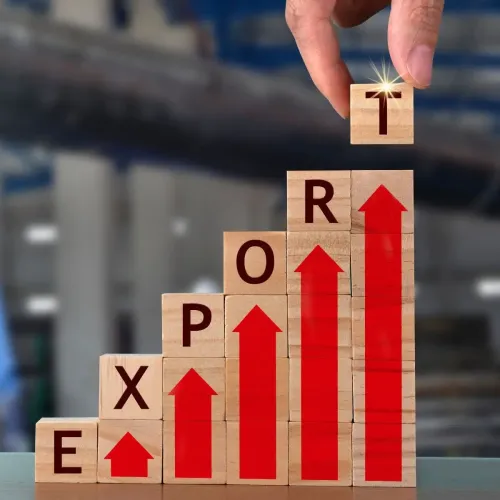
India's merchandise exports reached a record $44.24 billion in July 2026 , up 19 per cent year-on-year.
Overall exports of merchandise and services during April–July 2026-27 grew 13.16 per cent to $316.42 billion .
Non-petroleum exports rose 12.79 per cent , signalling broad-based, manufacturing-led growth.
Merchandise imports grew faster at 19.27 per cent during April–July, widening the trade deficit.
FIEO President SC Ralhan called for stronger focus on MSMEs , export credit, logistics, and market diversification to sustain momentum.
India's merchandise exports surged 19 per cent in July 2026 to a record $44.24 billion — the highest-ever export value recorded for any July — even as global supply chain disruptions continued to weigh on international trade. The milestone, announced on 13 August 2026, signals the growing resilience and competitiveness of Indian exporters navigating an increasingly volatile global environment.
Record Numbers in Context
The July figure is not an isolated spike. During April–July 2026-27, merchandise exports rose 17.04 per cent to $173.78 billion. When services are included, India's overall exports grew 13.16 per cent to $316.42 billion over the same period. The breadth of the expansion underscores that the growth is structural rather than commodity-driven.
Notably, non-petroleum exports grew 12.79 per cent — a figure that Federation of Indian Export Organisations (FIEO) President SC Ralhan called 'particularly encouraging', adding that it indicates 'export momentum is broad-based and increasingly supported by manufacturing and value-added sectors.'
Sectors and Markets Driving Growth
Engineering goods, electronics, pharmaceuticals, chemicals, and textiles were among the key contributors to the export surge. On the market side, India's leading destinations during April–July 2026 included the US, UAE, Singapore, China, Netherlands, UK, Germany, South Africa, Bangladesh, and Tanzania.
Ralhan highlighted the growing footprint in non-traditional markets: 'While resilience in major markets such as the US, EU and China is encouraging, the growing presence of Indian products in the UAE, Singapore, Africa and other emerging markets reflects the conscious efforts of exporters to diversify,' the FIEO statement said. This deliberate market diversification reduces India's exposure to any single trade corridor — a strategic buffer as geopolitical tensions reshape global supply chains.
Trade Deficit and Import Pressures
The record export performance comes with a caveat. Merchandise imports grew at a faster clip — 19.27 per cent during April–July — compared with the 17.04 per cent rise in exports, widening the trade deficit. FIEO cautioned that while imports of energy, capital goods, and intermediates are linked to domestic economic activity, India must simultaneously build domestic manufacturing capacity in electronics, machinery, and other high-import-dependence sectors to correct the structural imbalance.
What Industry Is Asking For
Ralhan called for a responsive trade policy framework to sustain the momentum, specifically emphasising adequate and competitive export credit, easier access to working capital for exporters, faster trade facilitation at ports, and urgent resolution of shipping and logistics bottlenecks. A sharper focus on MSMEs and labour-intensive sectors was also flagged as critical to converting export growth into broader employment gains.
With India's export trajectory now firmly in record territory, the policy and execution choices over the next two quarters will determine whether the current momentum can be sustained through a globally uncertain second half of 2026.
Point of View
But the faster growth in imports is the more consequential data point — and it is getting far less attention. A widening trade deficit, if sustained, will pressure the current account and the rupee. More structurally, India's export basket still leans heavily on engineering and pharma while electronics — the sector that defines twenty-first-century trade competitiveness — remains an area of high import dependence. The FIEO's call for MSME focus is well-placed: export growth that does not translate into jobs in labour-intensive sectors will struggle to generate the political durability needed for consistent trade policy. Record headlines are welcome; the deficit arithmetic demands equal scrutiny.
NationPress
28 Sept 2026
Frequently Asked Questions
What is India's merchandise export figure for July 2026?
India's merchandise exports reached a record $44.24 billion in July 2026, a 19 per cent increase over the same month in the previous year and the highest export value ever recorded for the month of July.
Which sectors drove India's export growth in July 2026?
Engineering goods, electronics, pharmaceuticals, chemicals, and textiles were the primary contributors. FIEO noted that non-petroleum exports grew 12.79 per cent, indicating broad-based momentum across manufacturing and value-added sectors.
What is India's trade deficit situation for April–July 2026?
Merchandise imports grew 19.27 per cent during April–July 2026, outpacing the 17.04 per cent growth in merchandise exports, which widened the trade deficit. FIEO has cautioned that India needs to strengthen domestic manufacturing in high-import-dependence areas to address this gap.
Which countries are India's top export destinations in 2026?
During April–July 2026, India's leading export destinations included the US, UAE, Singapore, China, Netherlands, UK, Germany, South Africa, Bangladesh, and Tanzania — reflecting both traditional market strength and growing diversification into emerging economies.
What policy measures has FIEO recommended to sustain export growth?
FIEO President SC Ralhan called for a responsive trade policy framework, competitive export credit, easier working capital access, faster trade facilitation, and urgent attention to shipping and logistics challenges, along with a sharper focus on MSMEs and labour-intensive sectors.