India needs 'strategic agency' in AI, not just autonomy: Report

Synopsis
A new report argues India is asking the wrong question on AI — not 'how do we avoid dependence?' but 'how do we become indispensable?' With over 38,000 GPUs provisioned and a vast tech workforce, India has the raw material. The harder task, as former Foreign Secretary Nirupama Rao frames it, is converting that into genuine power to shape global AI standards and choices.
Key Takeaways
A new India Narrative report argues India should pursue 'strategic agency' in AI — not mere autonomy — to shape global standards and options.
Former Indian Foreign Secretary Nirupama Rao describes AI as the 'ground zero on which the future distribution of global power may be decided.' The report recommends managed interdependence through diversified partnerships with Europe, Singapore, and the Gulf states.
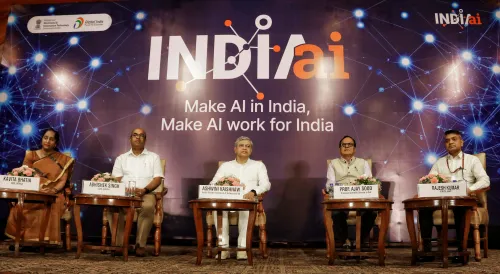
The India AI Mission has provisioned over 38,000 GPUs , with plans to add 20,000 more , announced at the 2026 India AI Impact Summit .
The report identifies India's scale, tech workforce, entrepreneurial sector, and digital public infrastructure as core strengths to leverage.
India must transform its scale, talent pool, and digital public infrastructure into durable technological leverage in artificial intelligence (AI), rather than pursuing the illusion of self-sufficiency, according to a new report by India Narrative released on 5 August.
The report describes AI as a 'deeply interconnected technological system' that will inevitably carry dependencies — and argues that chasing pure autonomy is both unrealistic and strategically counterproductive.
The Case for Strategic Agency
'The objective must be strategic agency: the ability to shape options, influence standards and make choices that others must take seriously,' wrote Nirupama Rao, former Indian Foreign Secretary, in a piece for the publication.
The report frames AI not merely as an economic opportunity or a threat to employment, but as an emerging organising principle of international power. Countries that dominate advanced computing, semiconductor design, data infrastructure, frontier models, and the scientific talent behind them, it argues, will hold advantages that extend well beyond the technology sector.
'AI will shape military capability, industrial competitiveness and diplomatic influence,' Rao wrote, calling it the 'ground zero on which the future distribution of global power may be decided.'
Managed Interdependence Over Isolation
Rather than retreating into technological nationalism, the report calls on Indian policymakers to pursue managed interdependence — built on diversified partnerships, stronger domestic research and manufacturing, and sustained investment in energy and computing infrastructure.
It identifies a range of potential partners: France, Germany, the Netherlands, and the Nordic countries for research, manufacturing, energy-efficient computing, and governance; Singapore for regulatory and technological sophistication; and the Gulf states for capital, energy, and ambitions to become major centres of computing infrastructure.
Notably, the report cautions against the assumption that access to global markets makes domestic capability unnecessary. Strong indigenous competence in critical areas, diversified supply chains, trusted international partnerships, and enough domestic knowledge to innovate and replace imported systems are all identified as essential.
India's Existing Strengths
The report highlights several advantages India can build on: its demographic scale, a large technology workforce, a robust entrepreneurial ecosystem, extensive digital public infrastructure, and established ties with both advanced and developing economies.
The India AI Mission is identified as a vehicle for converting some of these strengths into national capability. At the 2026 India AI Impact Summit, the government announced that over 38,000 GPUs had already been provisioned under the mission, with plans to add another 20,000.
What the Report Recommends
In practical terms, the report urges India to prioritise three pillars: diversified strategic partnerships rather than dependence on any single technology bloc; domestic research and manufacturing capacity in semiconductors and frontier AI; and infrastructure investment in energy and high-performance computing.
The underlying argument is that influence in the AI era will belong not to countries that achieve impossible self-reliance, but to those that are indispensable enough — and capable enough — that their choices cannot be ignored. Whether India's current policy trajectory matches that ambition remains the open question.
Point of View
But it sidesteps the harder question of execution. India has announced AI ambitions before without the institutional follow-through to match. The GPU provisioning numbers are encouraging, but compute alone does not produce frontier models or semiconductor independence. The partnerships the report recommends with Europe and the Gulf are sensible, yet India's track record of converting diplomatic goodwill into deep technology transfer is uneven. Strategic agency requires not just the ability to be at the table, but enough domestic capability to walk away from a bad deal — and that threshold is still some distance away.
NationPress
20 Sept 2026
Frequently Asked Questions
What does 'strategic agency' in AI mean for India?
Strategic agency refers to India's ability to shape AI standards, influence global choices, and make decisions that other nations must take seriously — rather than simply avoiding technological dependence. The India Narrative report argues this is a more realistic and powerful goal than full autonomy.
Who authored the key piece in the India Narrative AI report?
Former Indian Foreign Secretary Nirupama Rao wrote the central opinion piece in the report, arguing that AI is becoming the organising principle of international power and that India must position itself as an indispensable actor.
How many GPUs has India provisioned under the India AI Mission?
As of the 2026 India AI Impact Summit, the government announced that over 38,000 GPUs had been provisioned under the India AI Mission, with plans to add another 20,000.
Which countries does the report recommend as AI partners for India?
The report identifies France, Germany, the Netherlands, and the Nordic countries for research and energy-efficient computing; Singapore for regulatory sophistication; and the Gulf states for capital and computing infrastructure ambitions.
Why does the report say pure AI autonomy is an illusion?
Because AI is a deeply interconnected technological system that will always carry some dependencies. The report argues that targeting full autonomy distracts from the more achievable and strategically valuable goal of building leverage through diversified partnerships and strong domestic competence.