Viksit Bharat 2047 needs $10 trillion GDP, says former diplomat
Synopsis
A former Indian diplomat has put a hard number on Viksit Bharat 2047: India's GDP must reach at least $10 trillion — more than double its current $4.5 trillion — or the vision risks remaining aspirational. The report flags inclusive growth, AI skilling, FDI, and healthcare as the four pillars that will determine whether the target is met.
Key Takeaways
Former diplomat Mohan Kumar argues India needs a $10 trillion GDP to genuinely achieve Viksit Bharat 2047 , against a current size of $4.5 trillion .
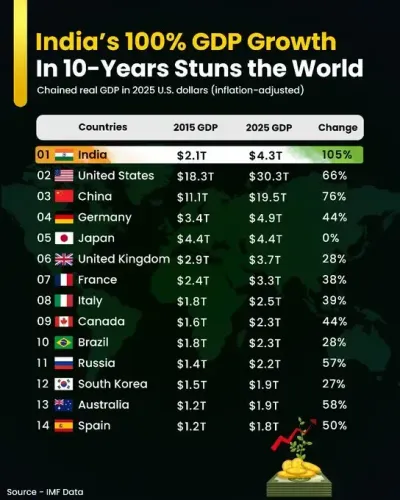
India is currently the world's fourth-largest economy but its per-capita economic weight remains low for a population of nearly 1.5 billion .
Key levers identified include expanding global trade share , attracting higher FDI , and deep structural economic reforms.
PM Modi announced AI skill training for one crore youth in his Independence Day address, aligned with the report's skilling recommendations.
India's startup ecosystem has crossed 2.5 lakh registered startups , supported by a ₹1 lakh crore Innovation Fund .
The report calls for a whole-of-government, mission-mode approach across healthcare, entrepreneurship, and technology to meet the 2047 deadline.
India will need to at least double its current economic size to genuinely realise the vision of Viksit Bharat 2047, with the country's Gross Domestic Product (GDP) required to reach a minimum of $10 trillion, according to an opinion piece published in The Jerusalem Post by former diplomat Mohan Kumar.
The GDP Gap India Must Close
Kumar argued that while India has legitimate cause to celebrate becoming the world's fourth-largest economy, a $4.5 trillion GDP falls short of what a nation of nearly 1.5 billion people truly requires. 'While India can be legitimately proud of being the fourth-largest economy in terms of Gross Domestic Product (GDP) in the world, the fact remains that for a population approaching 1.5 billion, the present GDP of $4.5 trillion is a little below par,' he wrote.
To bridge this gap, the article identifies several structural levers: expanding India's share in global foreign trade, attracting larger volumes of Foreign Direct Investment (FDI), and pushing through deep economic reforms that go beyond incremental policy adjustments.
Growth Must Be Inclusive, Not Just Fast
Kumar was explicit that raw GDP acceleration alone would be insufficient. The gains of growth, he stressed, must percolate to the most marginalised sections of society. 'While there is no question that the GDP must accelerate, that alone is not enough. Growth must be inclusive; it must percolate to the downtrodden people at the bottom of the pyramid,' he wrote.
This emphasis on equity sits at the heart of the Viksit Bharat framework, which envisions a developed India not merely by economic size but by the quality of life of its citizens. The article pointed to healthcare as a critical area, acknowledging the Centre's Ayushman Bharat Yojana while arguing that large-scale transformation of public health infrastructure must continue. Healthcare, Kumar argued, must become more affordable and accessible to the majority of Indians.
Entrepreneurship and AI Skills as Growth Engines
The piece also highlighted the need to cultivate an economic ecosystem where India's large and young population transitions from job-seekers to job-creators. This aligns with Prime Minister Narendra Modi's repeated framing of youth entrepreneurship as a core pillar of Viksit Bharat. Under the current government, India's startup ecosystem has grown to over 2.5 lakh registered startups, backed by a ₹1 lakh crore Innovation Fund.
On skills, the article flagged the urgency of reskilling graduates for a technology-driven economy, with Artificial Intelligence (AI) identified as a priority domain. This connects directly to Modi's Independence Day 2025 announcement of AI skill training for one crore youth over the next year — a push he linked to India's ambition to lead globally in AI, referencing the country's recent AI Summit.
Mission Mode and a Whole-of-Government Push
Kumar concluded that achieving Viksit Bharat by 2047 demands coordinated, cross-sectoral urgency rather than siloed policy efforts. 'India is well positioned to become Viksit Bharat by 2047, but the country needs to be in mission mode, and a whole-of-government approach is required to make sure that no stone is left unturned in this national endeavour,' he wrote.
With just over two decades remaining until the centenary of India's independence, the report serves as a structured checklist of what must accelerate — and what must change — if the $10 trillion milestone is to be more than an aspirational headline.
Point of View
And the Viksit Bharat framing risks the same fate if headline growth is treated as the finish line. The AI skilling push and Ayushman Bharat are steps in the right direction, yet India's public health spending as a share of GDP and its skilling programme completion rates have historically lagged targets. The 2047 deadline creates urgency, but urgency without accountability mechanisms has produced ambitious announcements before. The real question is whether the 'whole-of-government approach' Kumar calls for will come with verifiable milestones — or remain a rallying cry.
NationPress
1 Oct 2026
Frequently Asked Questions
What is the Viksit Bharat 2047 vision and why does it require a $10 trillion GDP?
Viksit Bharat 2047 is India's goal of becoming a fully developed nation by the centenary of its independence. According to former diplomat Mohan Kumar, achieving this in a meaningful sense requires India's GDP to reach at least $10 trillion — more than double the current $4.5 trillion — to adequately serve a population of nearly 1.5 billion people.
Who is Mohan Kumar and where was this report published?
Mohan Kumar is a former Indian diplomat who authored an opinion piece published in The Jerusalem Post analysing the economic conditions required for India to achieve Viksit Bharat 2047. The article outlines structural reforms across trade, FDI, skilling, and healthcare.
What are the key steps India must take to reach the $10 trillion GDP target?
The article identifies expanding India's share in global foreign trade, attracting greater Foreign Direct Investment, implementing deep structural economic reforms, investing in AI and technology skilling, and transforming public healthcare infrastructure as the primary drivers toward the $10 trillion goal.
How does PM Modi's Independence Day AI announcement connect to the Viksit Bharat report?
Prime Minister Narendra Modi announced during his Independence Day address that the government will provide AI skill training to one crore youth over the next year. This directly aligns with the report's call for reskilling graduates in emerging technologies like AI to meet the demands of a rapidly changing economy.
Why is inclusive growth emphasised alongside GDP acceleration?
The report stresses that simply growing GDP is insufficient if the benefits do not reach people at the bottom of the economic pyramid. Kumar argues that growth must be inclusive and percolate to marginalised communities, and that healthcare must become more affordable and accessible for India to achieve genuine development by 2047.