CM Himanta hails IMF's 7% GDP forecast for India
Synopsis
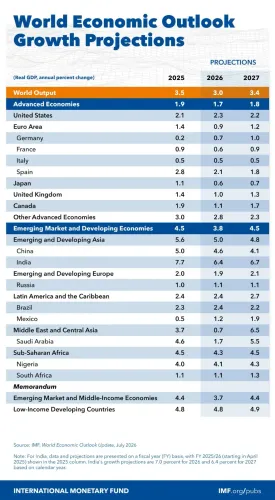
Assam Chief Minister Himanta Biswa Sarma cited the IMF's 7% GDP growth forecast for India in both 2026–27 and 2027–28 to argue that India is redefining the global economic order, framing the projection as momentum toward Prime Minister Modi's Viksit Bharat 2047 goal.
Key Takeaways
The IMF has raised India's GDP growth forecast to 7% for both 2026–27 and 2027–28 , per Assam CM Himanta Biswa Sarma's post.
India overtook the United Kingdom in 2023 to become the fifth-largest economy globally according to IMF data.
India has ranked as the fastest-growing major economy in successive IMF assessments since the mid-2010s.
The Viksit Bharat 2047 vision — making India a developed economy by the centenary of independence — was first outlined in PM Modi's Independence Day address in 2022 .
CM Sarma, as convenor of NEDA , amplifies central government economic messaging across the strategically significant North-East region.
The next IMF World Economic Outlook and India's annual Economic Survey are the key upcoming checkpoints for medium-term growth projections.
Seven percent. Two years in a row. When the International Monetary Fund raises India's growth forecast to that figure for both 2026–27 and 2027–28, it is not a footnote in a spreadsheet — it is a verdict on the world's most consequential economic story. Assam Chief Minister Himanta Biswa Sarma made that point emphatically on Wednesday, October 14, taking to X to declare that India is not merely rising but 'redefining the global economic order.'
What the IMF numbers actually say about India's trajectory
The IMF's World Economic Outlook is the closest thing multilateral finance has to a scorecard, and successive editions have placed India at the top of the major-economy growth table. India overtook the United Kingdom in 2023 to become the fifth-largest economy in the world by IMF data — a milestone that arrived years ahead of earlier estimates. A sustained 7% growth rate for two consecutive fiscal years, if realised, would widen that gap against every peer and keep India firmly in a league of one among large economies.
The broader pattern is consistent: since the mid-2010s, structural reforms, a muscular infrastructure push, and the scaling of digital public infrastructure have combined to make India's growth story the one global investors watch most closely. A positive multilateral forecast of this magnitude provides institutional validation that domestic data points alone cannot always deliver.
Viksit Bharat 2047 and the road from fifth to first
Prime Minister Narendra Modi first articulated the Viksit Bharat — Developed India — vision in his Independence Day address in 2022, setting 2047, the centenary of independence, as the horizon for India to achieve developed-economy status. Every favourable IMF projection feeds directly into that narrative: compound the growth, hold the reforms, and the arithmetic of convergence starts to look less like ambition and more like inevitability.
Chief Minister Sarma's post frames the IMF forecast explicitly within this arc, describing India's march toward Viksit Bharat as gathering 'unprecedented momentum.' The language is deliberate — 2047 is not a distant abstraction but an organising principle that the central government and its state-level allies invoke consistently to give the growth story a destination, not just a speed.
Why a BJP convenor's economic signalling matters beyond Assam
Himanta Biswa Sarma carries a dual authority here: as Chief Minister of Assam and as convenor of the North-East Democratic Alliance (NEDA), he is one of the BJP's primary amplifiers across a strategically sensitive eight-state region. When he frames a multilateral economic forecast in the language of civilisational resurgence, the message is aimed at audiences well beyond Dispur — it travels to investors eyeing the North-East's connectivity corridors and to voters in states where development velocity is the central electoral promise.
Global investors and domestic businesses watching India's medium-term fundamentals will note that the next IMF World Economic Outlook update and the government's annual Economic Survey will be the next major checkpoints for whether the 7% headline holds or shifts.
India has been the fastest-growing major economy for nearly a decade. The real question now is whether it can sustain that speed long enough to change the league table permanently — and the IMF, for the moment, is betting it can.
Point of View
Not just a snapshot. For CM Sarma specifically, amplifying IMF projections reinforces the party's economic credibility in the North-East, where infrastructure deficits have historically defined development conversations. The consistency of this messaging across central and state BJP leaders signals a coordinated pre-electoral narrative build ahead of state cycles. Analysts will note, however, that the gap between IMF projections and ground-level income convergence remains the most scrutinised tension in India's growth story.
NationPress
14 Oct 2026
Frequently Asked Questions
What is the IMF's GDP growth forecast for India in 2026-27 and 2027-28?
According to Assam Chief Minister Himanta Biswa Sarma's post, the IMF has raised India's GDP growth forecast to 7% for both 2026–27 and 2027–28, though this specific figure is drawn from the post itself and should be confirmed against the IMF's latest World Economic Outlook publication.
What is Viksit Bharat 2047?
Viksit Bharat — meaning 'Developed India' — is a national vision articulated by Prime Minister Narendra Modi in his Independence Day address in 2022, targeting developed-economy status for India by 2047, the centenary of independence.
When did India become the fifth-largest economy in the world?
India overtook the United Kingdom to become the fifth-largest economy globally in 2023, according to IMF data.
Who is Himanta Biswa Sarma and why does his comment on the economy matter?
Himanta Biswa Sarma is the Chief Minister of Assam and convenor of the North-East Democratic Alliance (NEDA), making him a key BJP voice across eight north-eastern states; his economic messaging carries political weight in a strategically sensitive region.
Is India the fastest-growing major economy right now?
Yes, India has consistently ranked as the fastest-growing major economy in successive IMF assessments since the mid-2010s, a position supported by structural reforms, infrastructure investment, and the expansion of digital public infrastructure.