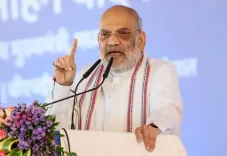
Smriti Irani Hails India's 7% IMF Growth Forecast
Synopsis
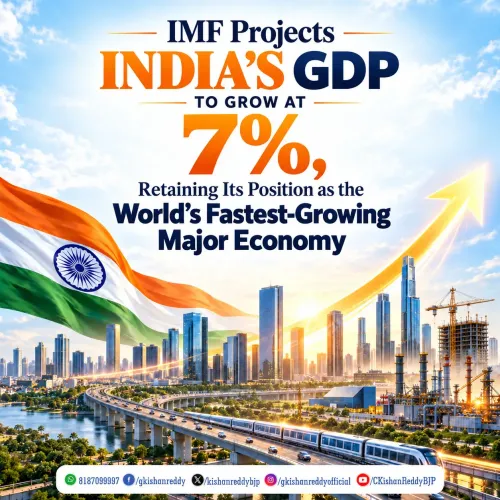
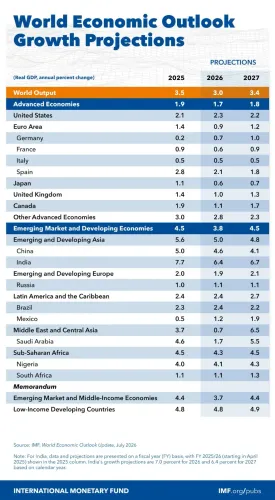
BJP leader Smriti Irani cited the latest IMF World Economic Outlook on October 13, 2026, highlighting India's projected 7.0% GDP growth for 2026 and 2027, reaffirming its status as the world's fastest-growing major economy amid global headwinds.
Key Takeaways
The IMF World Economic Outlook projects India's GDP growth at 7.0% for both 2026 and 2027 .
Smriti Irani attributed the performance to decisive policy leadership, structural reforms, and strong domestic momentum.
India has sustained above-average growth versus major economies across multiple successive IMF outlook cycles.
Key reform pillars include the Goods and Services Tax (2017) , the Insolvency and Bankruptcy Code (2016) , and the Make in India initiative launched in 2014 .
Strong domestic demand, digital public infrastructure, and production-linked incentives continue to underpin India's growth story.
The next IMF World Economic Outlook update is the critical near-term marker for any revision to the 7.0% baseline.
While much of the world braces for economic turbulence, India is holding a different conversation entirely. BJP leader and former Union Minister Smriti Irani on Tuesday, October 13, 2026, pointed to the latest IMF World Economic Outlook to underscore that India remains the world's fastest-growing major economy — with a projected 7.0% GDP growth for both 2026 and 2027.
What the IMF Numbers Actually Say
The International Monetary Fund's World Economic Outlook — its flagship biannual publication — serves as the global benchmark for country-level economic forecasting. Irani's post cites its latest edition to argue that India's trajectory is not just resilient but categorically ahead of other major economies. A 7.0% projection at a time when advanced economies are navigating tightening credit, sticky inflation, and sluggish trade is not merely a statistic — it is a structural argument.
Irani framed the momentum around three pillars: 'decisive policy leadership, structural reforms, and strong domestic momentum.' The domestic demand story has been a recurring anchor in IMF assessments of India over recent years, with private consumption and capital formation doing the heavy lifting even when exports face headwinds.
The Reform Architecture Behind the Number
India's growth story did not emerge in a vacuum. The Goods and Services Tax, implemented in 2017, unified a fragmented indirect-tax architecture across states, progressively improving compliance and formalising the economy. The Insolvency and Bankruptcy Code of 2016 sharpened the resolution framework for stressed assets, sending a clear signal to global capital. Both reforms, alongside the Make in India push launched in 2014, form the policy bedrock that successive IMF outlooks have pointed to when explaining India's resilience.
Production-linked incentive schemes have further attracted manufacturing investment across electronics, pharmaceuticals, and auto components — diversifying the growth base beyond services. Digital public infrastructure, from payments to identity to credit delivery, has added a velocity multiplier to domestic economic activity that most peer economies simply do not have.
Why Global Investors Are Watching New Delhi
For global investors recalibrating exposure away from slower-growing markets, India's consistent above-average growth rate is more than a headline. It is a reallocation signal. Supply chain diversification accelerated by geopolitical realignments has positioned India as a credible manufacturing alternative, reinforcing what the growth numbers already suggest.
The pattern across successive IMF reports has been consistent: India outpaces major-economy peers. The current projection, if realised, would extend that streak through the second half of the decade. The next IMF World Economic Outlook update will be the key moment to watch for any revision — upward or downward — to that 7.0% baseline.
India is no longer just the world's most-watched growth story. At 7.0%, it is the growth story — and that distinction is harder to borrow than any reform the competition can copy in a hurry.
Point of View
If it holds, would be the most powerful electoral-season data point available to the BJP, effectively outsourcing the growth endorsement to the IMF rather than a domestic agency. The move fits a broader pattern where the government has consistently cited multilateral rankings — from the World Bank's Ease of Doing Business to IMF growth tables — as third-party validation of reform outcomes. The real test, however, lies in whether the growth translates visibly into employment quality and household income, the metrics that determine whether macro headlines become votes.
NationPress
13 Oct 2026
Frequently Asked Questions
What did the IMF say about India's GDP growth in the latest World Economic Outlook?
The latest IMF World Economic Outlook projects India's GDP growth at 7.0% for both 2026 and 2027, maintaining its position as the fastest-growing major economy in the world.
Why is India growing faster than other major economies?
India's growth is underpinned by strong domestic demand, structural reforms such as the GST and Insolvency and Bankruptcy Code, production-linked incentive schemes, and digital public infrastructure that has accelerated economic formalisation.
What did Smriti Irani say about India's economy?
BJP leader Smriti Irani posted on X citing the IMF World Economic Outlook to highlight India's 7.0% projected GDP growth for 2026 and 2027, attributing it to decisive policy leadership, structural reforms, and strong domestic momentum.
What is the IMF World Economic Outlook?
The IMF World Economic Outlook is the International Monetary Fund's flagship biannual publication providing economic growth forecasts and analysis for countries and regions worldwide.
Which structural reforms have supported India's economic growth?
Key reforms include the Goods and Services Tax implemented in 2017, the Insolvency and Bankruptcy Code of 2016, the Make in India initiative from 2014, and production-linked incentive schemes across multiple manufacturing sectors.