IMF raises India growth forecast to 7% for FY27 and FY28: CM Dhami
Synopsis
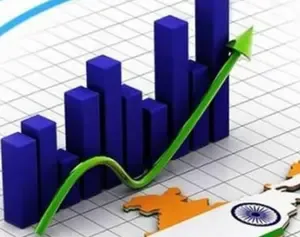
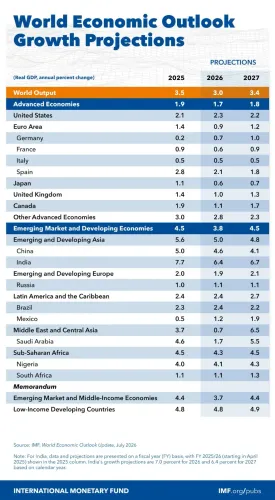
The IMF has projected India's economy will grow at 7% in FY2026-27 and FY2027-28, more than double the global average of 3.1%. Uttarakhand CM Pushkar Singh Dhami credited PM Modi's structural reforms, rising domestic demand, and a strong services sector for the upgrade.
Key Takeaways
The IMF has raised India's growth forecast to 7% for both FY 2026-27 and FY 2027-28 .
The global growth rate is projected at just 3.1% in 2026 , making India's number more than double the world average.
CM Pushkar Singh Dhami cited structural reforms, domestic demand, and the services sector as drivers of the upgrade.
Key post-2014 reforms — GST (2017) and the Insolvency and Bankruptcy Code (2016) — are credited with building India's macro-resilience.
India recorded above- 7% growth in FY 2021-22 and FY 2022-23 , establishing the resilience narrative underpinning current IMF confidence.
The forecast aligns with India's Viksit Bharat 2047 development vision championed by the Modi government.
While much of the world braces for slower growth, the International Monetary Fund (IMF) has lifted its projection for India — pegging the country's expansion at 7% for both FY 2026-27 and FY 2027-28, even as the global growth rate is estimated at just 3.1% in 2026. Uttarakhand Chief Minister Pushkar Singh Dhami took note of the landmark forecast on Tuesday, 13 October 2026, calling it a reflection of the world's growing confidence in India's economic fundamentals.
IMF's 7% call — and what it means for India's global standing
The IMF's biannual World Economic Outlook is the gold standard for sovereign growth assessments, and a 7% forecast for two consecutive fiscal years places India decisively above every other major economy in the fund's projections. With global growth expected at a tepid 3.1% — weighed down by high crude oil prices and geopolitical uncertainty — India's number is not just strong; it is more than double the world average.
CM Dhami framed the upgrade as evidence of 'strengthened economic foundations, continuous structural reforms, rising domestic demand and a robust services sector' — crediting the trajectory to the leadership of Prime Minister Narendra Modi. The post explicitly situates the IMF's confidence within India's broader Viksit Bharat (Developed India) ambition, the government's overarching vision for 2047.
The reform decade that built the runway
India's current macro-resilience did not arrive overnight. The post-2014 reform agenda — anchored by the Goods and Services Tax (GST) rollout in 2017 and the Insolvency and Bankruptcy Code (IBC) of 2016 — restructured the country's tax architecture and corporate credit markets, respectively. Those institutional overhauls made India a more legible, investable economy for global capital.
The resilience narrative was stress-tested after the pandemic: India clocked above-7% growth in both FY 2021-22 and FY 2022-23, recovering faster than almost every peer. Each successive IMF upgrade has built on that track record, making the latest 7% projection less a surprise than a confirmation.
Services, domestic demand, and why this cycle looks durable
The IMF's optimism rests on two engines that have proven remarkably steady: a services sector powering software, finance and professional exports, and a domestic consumption base of more than a billion people whose spending is rising alongside incomes. Unlike export-dependent economies exposed to trade shocks, India's demand story is substantially homegrown — which is precisely why global headwinds that are denting growth elsewhere matter less here.
For Indian businesses and consumers, a 7% growth environment means tighter labour markets, stronger corporate earnings, and continued fiscal headroom for infrastructure investment — the kind of compounding cycle that gives the Viksit Bharat 2047 target a credible arithmetic foundation.
The next IMF World Economic Outlook update and India's own FY 2025-26 Economic Survey will be the next tests of whether the 7% trajectory holds — but for now, India's growth story is the one the world is watching most closely.
Point of View
Allowing state-level leaders like CM Dhami to amplify a central government success story ahead of an election-heavy calendar. The upgrade also reinforces the 'fastest-growing major economy' branding that has become a cornerstone of India's international diplomatic pitch. Critically, the durability of the services and domestic-demand engines means the growth story is structurally grounded — not purely a political narrative — which gives it unusual cross-party credibility. The real test will be whether fiscal consolidation and job creation keep pace with the headline GDP number.
NationPress
13 Oct 2026
Frequently Asked Questions
What is the IMF's growth forecast for India in FY 2026-27?
The IMF has projected India's economy will grow at 7% in FY 2026-27 , which is more than double the global average growth estimate of 3.1% for 2026.
Why did the IMF raise India's growth forecast?
The IMF upgrade reflects India's strengthened macroeconomic foundations, continuous structural reforms such as GST and IBC, rising domestic consumption, and a robust services export sector.
How does India's projected growth compare to the global average?
India's projected growth of 7% is more than double the IMF's global growth estimate of 3.1% for 2026 , reinforcing India's status as the fastest-growing major economy.
What is Viksit Bharat and how does it relate to the IMF forecast?
Viksit Bharat (Developed India) is the Indian government's vision to make India a fully developed nation by 2047 . The IMF's 7% growth projection is seen as validation of the economic policies driving that long-term goal.
Why is Uttarakhand CM Dhami commenting on IMF's India growth forecast?
State-level BJP leaders routinely amplify positive central government economic milestones as part of coordinated political messaging. CM Dhami's post credits PM Modi's leadership for the IMF upgrade.