CM Dhami Hails India's 7.7% GDP Growth Under PM Modi

Synopsis
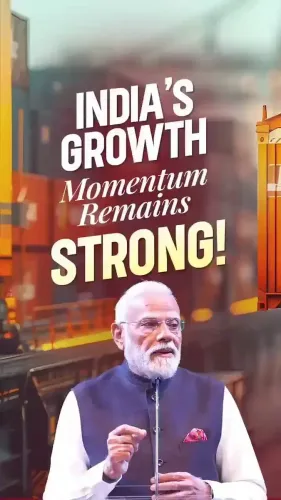
Uttarakhand Chief Minister Pushkar Singh Dhami credited PM Narendra Modi's leadership for India's 7.7% GDP growth in FY 2025-26 and 7.8% in Q4, calling it proof of strong reforms and the hard work of 140 crore Indians, as the country advances toward its Viksit Bharat 2047 goal.
Key Takeaways
CM Pushkar Singh Dhami attributed India's GDP growth to PM Narendra Modi's 'visionary and skilled' leadership.
India recorded a 7.7% GDP growth rate for financial year 2025-26 and 7.8% in the fourth quarter, according to the post.
The statement frames the figures as proof of 'effective reforms and the tireless hard work of 140 crore Indians.' The remarks connect to the Viksit Bharat 2047 vision targeting developed-economy status by India's centenary of independence.
Policy lineage cited includes Make in India (2014) and Atmanirbhar Bharat (2020) as structural pillars of the growth story.
The next Union Budget and Economic Survey will be key for revised forecasts and new reform measures.
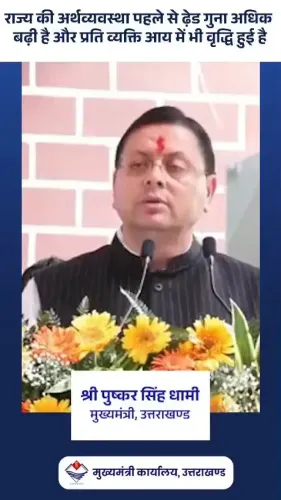
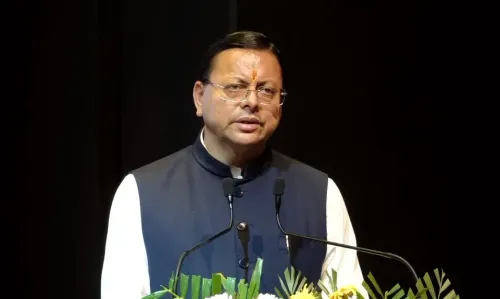
Uttarakhand Chief Minister Pushkar Singh Dhami on Friday, June 5, 2026, credited Prime Minister Narendra Modi's leadership for India's strong economic performance, citing a 7.7% GDP growth rate for financial year 2025-26 and 7.8% growth in the fourth quarter as evidence of the country's robust economic foundation.
Context
In his post, CM Dhami wrote: 'वित्तीय वर्ष 2025-26 में 7.7% तथा चौथी तिमाही में 7.8% की जीडीपी वृद्धि दर' ['A GDP growth rate of 7.7% in financial year 2025-26 and 7.8% in the fourth quarter'], describing the figures as 'direct proof of the country's strong economic foundation, effective reforms, and the tireless hard work of 140 crore Indians.' He also praised Modi as a 'visionary and skilled' leader under whose stewardship India is consolidating its position among the world's fastest-growing major economies.
The Chief Minister further stated that India is 'rapidly advancing towards becoming a developed nation, touching new dimensions of self-reliance, prosperity, and development.'
Policy Backdrop
The remarks align closely with the Viksit Bharat 2047 vision — articulated since the 2023 Union Budget — which targets developed-economy status for India by the centenary of independence. The vision draws on a decade-long policy lineage that includes the Make in India initiative launched in 2014 to raise manufacturing's share of GDP and attract foreign direct investment.
The Atmanirbhar Bharat campaign, launched in 2020, combined fiscal stimulus with production-linked incentive schemes to accelerate domestic manufacturing and reduce import dependence. Official statements from the central government have consistently cited structural reforms and India's demographic dividend as the twin engines of growth since 2014.
Stakeholders and Impact
The GDP figures, if confirmed by official data releases, would reinforce India's standing as one of the fastest-growing major economies globally at a time when many large economies face sluggish expansion. Domestic investors and Indian citizens are the primary stakeholders in any sustained growth narrative, as higher GDP growth typically correlates with job creation, improved public finances, and greater capacity for social spending.
For the BJP and state governments aligned with the central leadership, strong macroeconomic data serves as a key plank in political messaging ahead of budget cycles and electoral contests. CM Dhami's post reflects the party's broader effort to consolidate public confidence in the economic reform agenda.
What's Next
The next Union Budget and the accompanying Economic Survey will be closely watched for any revised growth forecasts and new reform measures that could sustain or accelerate the current trajectory. Analysts will also track whether the Q4 2025-26 growth figure of 7.8% is corroborated by the full official national accounts data. India's ability to maintain this pace amid global uncertainties — including trade headwinds and commodity price volatility — will determine whether the Viksit Bharat 2047 targets remain on track.
Point of View
Anchoring it to verifiable (or soon-to-be-verified) official statistics. This fits a broader pattern since 2014 of framing macroeconomic performance as a direct outcome of leadership quality rather than structural or global tailwinds. As the Viksit Bharat 2047 deadline approaches in political discourse, such messaging is likely to intensify across BJP-governed states ahead of budget and electoral cycles.
NationPress
21 Oct 2026
Frequently Asked Questions
What is India's GDP growth rate for FY 2025-26?
According to a post by Uttarakhand Chief Minister Pushkar Singh Dhami, India's GDP growth rate for financial year 2025-26 is 7.7% , with the fourth quarter recording 7.8% growth.
What is Viksit Bharat 2047?
Viksit Bharat 2047 is the Indian government's vision to achieve developed-economy status by 2047 , the centenary of India's independence, as articulated in budget speeches since 2023 .
What is Atmanirbhar Bharat?
Atmanirbhar Bharat is a self-reliance campaign launched in 2020 that combined fiscal stimulus with production-linked incentive schemes to boost domestic manufacturing and reduce import dependence.
Why is CM Dhami commenting on India's GDP figures?
As a BJP chief minister, Pushkar Singh Dhami is amplifying the central government's economic messaging, crediting PM Narendra Modi's reforms for India's strong growth performance.
Is India the fastest-growing major economy?
India has consistently been cited among the fastest-growing major economies in official government statements and international assessments, a position the current GDP growth figures are being used to reinforce.