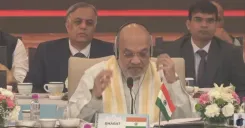
Bihar CM Samrat Choudhary Hails IMF's 7% GDP Forecast
Synopsis
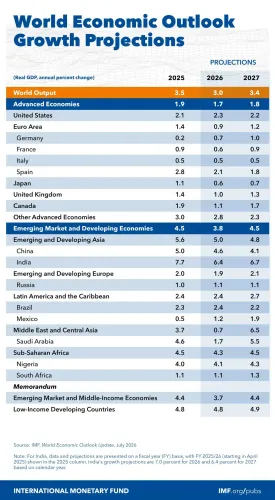
Bihar Chief Minister Samrat Choudhary on October 13 cited the IMF's projection of 7% GDP growth for India in 2026-27, calling it proof that India remains the world's fastest-growing major economy and invoking PM Modi's 'We Will Do It' mantra.
Key Takeaways
The IMF has projected India's GDP growth at 7.0% for the fiscal year 2026-27 .
Bihar CM Samrat Choudhary highlighted the forecast on X, calling India's economic momentum a story of strength amid global uncertainty.
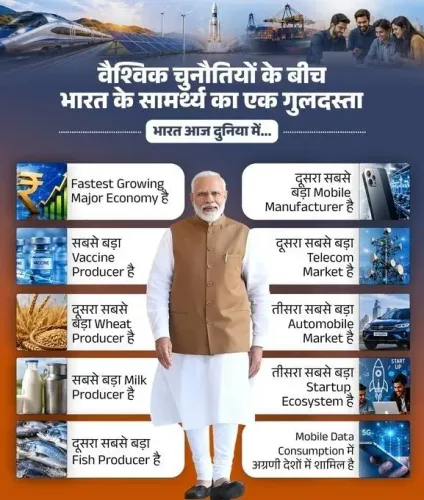
At 7%, India retains its status as the world's fastest-growing major economy per the IMF ranking.
Choudhary invoked PM Narendra Modi 's 'We Will Do It' mantra, linking the forecast to the BJP's governance narrative.
The projection feeds into India's long-term 'Viksit Bharat 2047' ambition, which requires sustained high growth over two decades.
Amid a turbulent global economy, India is holding its line — and the numbers are backing it up. Bihar Chief Minister Samrat Choudhary took to X on Tuesday, October 13, 2026, to highlight a landmark projection: the International Monetary Fund (IMF) has forecast India's GDP growth rate at 7.0% for 2026-2027, cementing its position as the world's fastest-growing major economy.
In his post, CM Choudhary wrote: 'वैश्विक अनिश्चितताओं और चुनौतियों के बीच भारत की अर्थव्यवस्था निरंतर सुदृढ़ता और आत्मविश्वास के साथ आगे बढ़ रही है' — 'Even amid global uncertainties and challenges, India's economy continues to advance with strength and confidence.' He invoked Prime Minister Narendra Modi's rallying mantra 'We Will Do It', framing the IMF projection as a validation of India's resolve to convert every challenge into an opportunity.
IMF's 7% Call and What It Means for India
A 7.0% GDP growth rate at a time when global headwinds — from geopolitical tensions to shifting trade flows — have dragged down growth forecasts across major economies is not a routine number. It places India meaningfully ahead of other large economies in the IMF's growth rankings. The projection signals that domestic consumption, capital expenditure, and structural reforms are collectively doing enough to outpace the drag from external volatility.
The IMF has consistently flagged India as a 'bright spot' in its global economic assessments over recent years, and a 7% forecast for 2026-27 sustains that narrative. For a country that crossed the milestone of becoming the world's fifth-largest economy, each consecutive year of top-tier growth adds strategic and geopolitical weight to India's standing in multilateral forums.
'We Will Do It' — Modi's Mantra as a Policy Signal
CM Choudhary's explicit invocation of Prime Minister Modi's 'We Will Do It' phrase does more than offer a slogan — it anchors the GDP forecast within a broader BJP political and governance narrative. The mantra, frequently deployed by the Prime Minister to project can-do nationalism in the face of scepticism, has become a shorthand for the ruling dispensation's self-assessment of India's economic trajectory.
By tying an IMF number to that phrase, the Bihar Chief Minister is signalling alignment between state leadership and the Centre's economic messaging — a pattern common among BJP chief ministers who use global validation to reinforce domestic political confidence.
India's ambition to become a developed nation — 'Viksit Bharat' — by 2047 depends heavily on sustaining growth rates above 7% for an extended period. A single year's IMF endorsement is one data point; the compounding of such forecasts over successive years is what transforms ambition into arithmetic.
Point of View
If realised, would sustain India's claim to being the world's fastest-growing large economy for yet another year, a streak with real geopolitical consequence. Tying the forecast explicitly to PM Modi's 'We Will Do It' mantra signals tight ideological coordination between Patna and Delhi ahead of what remains a high-stakes period for economic delivery. The deeper question the number raises is whether growth at this pace is broadening enough — reaching Bihar and other lower-income states — to translate macro momentum into ground-level change.
NationPress
13 Oct 2026
Frequently Asked Questions
What is the IMF's GDP growth forecast for India in 2026-27?
The IMF has projected India's GDP growth rate at 7.0% for the year 2026-27 , according to Bihar CM Samrat Choudhary's post citing the projection.
Why is India called the fastest-growing major economy?
At a projected 7% growth rate , India is expected to outpace all other major economies in the IMF's rankings for 2026-27, a distinction it has held for several consecutive years.
Who is Samrat Choudhary?
Samrat Choudhary is the Chief Minister of Bihar and a senior leader of the Bharatiya Janata Party (BJP).
What is the 'We Will Do It' mantra by PM Modi?
'We Will Do It' is a phrase used by Prime Minister Narendra Modi to project India's determination and confidence in meeting economic and developmental goals despite global challenges.
What is Viksit Bharat 2047?
Viksit Bharat 2047 is India's stated national ambition to become a fully developed nation by the centenary of its independence in 2047, requiring sustained high GDP growth over the next two decades.