Maharashtra forms Kakodkar-led panel to assess data centre environmental impact

Synopsis
Maharashtra has quietly assembled one of India's most high-powered committees to scrutinise the data centre boom — bringing together nuclear scientists, IIT professors, AWS executives, and top state bureaucrats under former Atomic Energy Commission chief Dr Anil Kakodkar. With a three-month deadline to deliver a report, the panel's findings could reshape how the country's largest data centre hub regulates power, water, and land use.
Key Takeaways
The Maharashtra government issued a Government Resolution on 13 October 2026 forming a high-level data centre impact committee.
The panel is chaired by Dr Anil Kakodkar , former Chairman of the Atomic Energy Commission .
The committee was triggered by a calling attention motion in the Maharashtra Legislative Council during the 2026 Monsoon Session .
Members include representatives from Amazon Web Services , IIT Bombay , CSIR-NEERI , and senior state bureaucrats.
The panel must submit its final report within three months , covering environment, water, energy, noise, employment, and public communication.
It will also recommend a standardised SOP for data centres and propose CSR and skill development frameworks.
The Maharashtra government has constituted a high-level committee chaired by former Atomic Energy Commission Chairman Dr Anil Kakodkar to conduct a comprehensive study of the environmental, infrastructural, and socio-economic impacts of data centres across the state. The government issued a Government Resolution (GR) late on Monday, 13 October 2026, formalising the panel's formation amid mounting concerns over the strain data centres place on electricity, water, and land resources.
Why the Committee Was Formed
The move follows a calling attention motion raised by members of the Maharashtra Legislative Council under Rule 101 during the 2026 Monsoon Session. Lawmakers flagged significant concerns over the demands data centres impose on power grids, water bodies, and existing infrastructure. Issues highlighted included temperature rises, noise pollution, environmental degradation, and adverse effects on residents' daily lives.
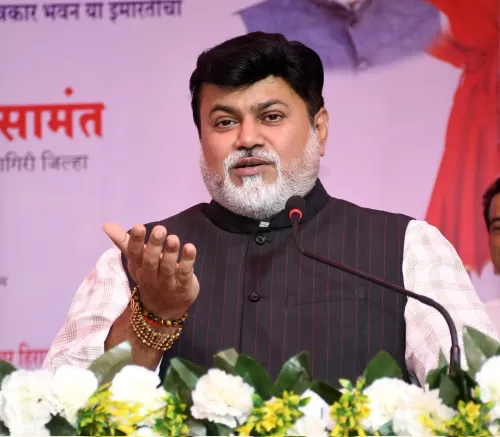
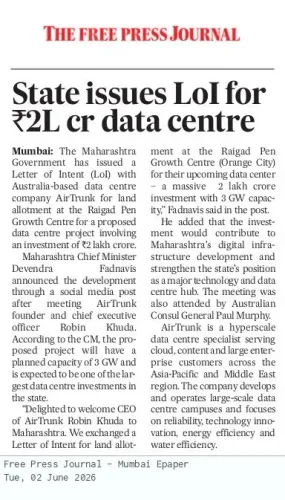
In response, Industries Minister Uday Samant had assured the legislature that a committee of domain experts would be constituted — a commitment now fulfilled through the GR. This comes amid Maharashtra's aggressive push to establish itself as India's premier data centre destination, a drive that has attracted large-scale investments but also sparked localised opposition near proposed project sites.
Committee Composition
Headed by Dr Anil Kakodkar, the panel brings together senior state bureaucrats, public utility chiefs, and technical specialists. Members include the Additional Chief Secretary, Energy Department; Principal Secretaries of the Water Resources, Industries-Energy-Labour, and Environment and Climate Change departments; and the Chief Executive Officer of Maharashtra Industrial Development Corporation (MIDC).
Industry representation comes from Srinivasa P., Senior Vice President, Data Center Design at Yotta Data Services, and Prasad Kalyanraman, Vice President, Infrastructure Services at Amazon Web Services. Academic and research expertise is provided by Dr S. Venkat Mohan, Director of CSIR-National Environmental Engineering Research Institute (NEERI), Nagpur; Prof M.V. Rane of IIT Bombay's Mechanical Engineering department; Prof Dr Shamita Kumar of Bharati Vidyapeeth, Pune; and Prof Dr Shyam R. Asolekar, Managing Director of Preventive Environmental Management Techno-Legal Consultants Pvt. Ltd., Mumbai. The Commissioner (Services), Directorate of Services, will serve as Member Secretary.
Scope of the Mandate
The committee's mandate is broad and scientific in character. It is tasked with conducting objective assessments of data centre impacts on water, energy, air quality, noise, and local ecosystems. It will also study domestic and international best practices to frame guidelines for energy-efficient, green, and sustainable data centre operations.
Notably, the panel has been specifically directed to investigate and address public misconceptions surrounding data centres — an unusual inclusion that signals the government's awareness of the communication gap between industry, administration, and affected communities. Additional mandates include recommending water conservation and recycling measures, proposing alternative cooling technologies, and formulating public awareness frameworks for local villagers and self-government bodies.
Employment, CSR, and Administrative Reforms
Beyond environmental concerns, the committee is also expected to propose measures to enhance local employment, skill development, and Corporate Social Responsibility (CSR) initiatives linked to data centre operations. It will recommend a standardised Standard Operating Procedure (SOP) for data centres in Maharashtra alongside cross-departmental administrative improvements.
Timeline and Next Steps
The committee is mandated to submit its final report to the state government within three months of the GR's issuance. Administrative, technical, and financial support will be provided by MIDC, the Directorate of Services, and the Directorate of Industries. The panel may also invite additional government officials and domain specialists as required. Its recommendations are expected to shape a long-term policy framework governing one of Maharashtra's fastest-growing infrastructure sectors.
Point of View
But it also raises the question of whether industry voices on the panel will soften recommendations on water and energy consumption limits. The mandate to 'address public misconceptions' is particularly telling: it suggests the government is as concerned with managing the optics of opposition as it is with resolving genuine grievances. The real measure of this exercise will be whether the SOP that emerges carries enforceable limits — or remains advisory.
NationPress
13 Oct 2026
Frequently Asked Questions
Why has Maharashtra formed a committee on data centres?
Maharashtra constituted the committee in response to concerns raised by lawmakers during the 2026 Monsoon Session about data centres' heavy demands on electricity, water, and land, as well as issues of noise pollution and environmental degradation. Industries Minister Uday Samant had promised a panel of domain experts, and the Government Resolution issued on 13 October 2026 fulfils that commitment.
Who is heading the Maharashtra data centre impact committee?
The committee is chaired by Dr Anil Kakodkar, former Chairman of the Atomic Energy Commission of India. The panel also includes senior state bureaucrats, representatives from Amazon Web Services and Yotta Data Services, and academics from IIT Bombay and CSIR-NEERI.
What will the Kakodkar committee study?
The committee will assess data centres' impact on water, energy, air quality, noise, and local ecosystems, and will review domestic and international best practices for green and sustainable operations. It will also recommend a standardised SOP for Maharashtra's data centres, propose water conservation and alternative cooling measures, and suggest frameworks for local employment, skill development, and CSR.
When must the committee submit its report?
The committee is mandated to submit its final report to the Maharashtra state government within three months of the Government Resolution issued on 13 October 2026. Administrative and financial support will be provided by MIDC, the Directorate of Services, and the Directorate of Industries.
How does this affect Maharashtra's data centre ambitions?
Maharashtra is currently India's largest data centre market, and the state has actively courted hyperscaler investments. The committee's recommendations could result in new regulatory conditions around power consumption, water usage, and land allocation, potentially influencing the pace and nature of future data centre approvals in the state.