CM Samrat Choudhary Hails IMF Report on India's Growth
Synopsis
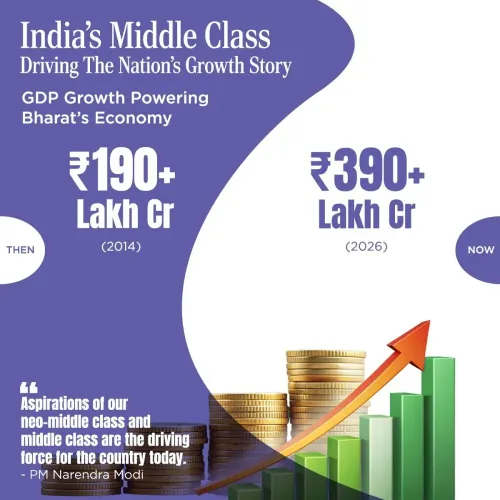
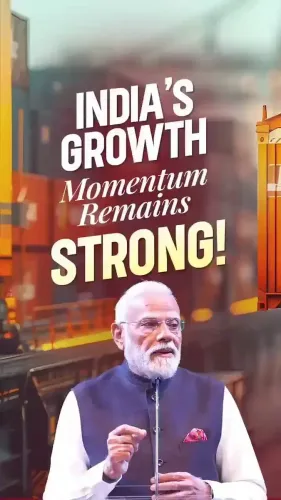
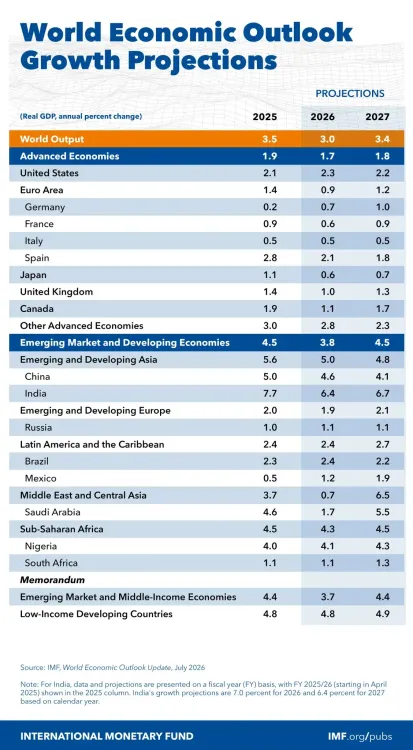
Bihar Chief Minister Samrat Choudhary on 9 July 2026 invoked the latest IMF report to describe India as the world's fastest-growing major economy, attributing the performance to PM Narendra Modi's policies on investment and people-centric development.
Key Takeaways
Bihar CM Samrat Choudhary cited the latest IMF report on 9 July 2026 as global validation of India's economic strength.
He credited PM Narendra Modi 's leadership, strong policies, rising investments, and people-centric development for India's growth trajectory.
The IMF World Economic Outlook has consistently ranked India among the fastest-growing large economies since 2015 .
Key policy milestones cited in past IMF assessments include the 2017 GST rollout and the 2020 Atmanirbhar Bharat package.
State-level BJP leaders routinely amplify multilateral growth endorsements to link national performance with local governance narratives.
Markets and investors will watch the detailed IMF projections and India's official GDP data releases for corroboration.
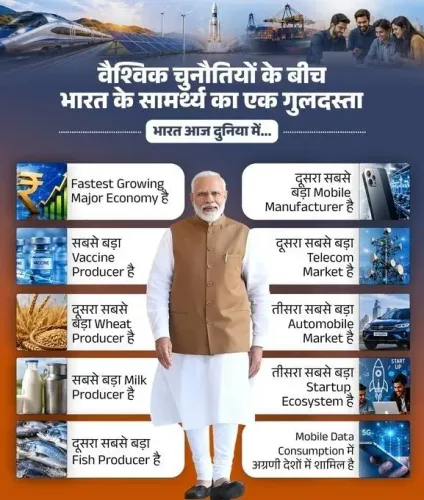
Bihar Chief Minister Samrat Choudhary on Thursday, 9 July 2026, cited the latest International Monetary Fund (IMF) report to affirm India's standing as the world's fastest-growing major economy, crediting the performance to the leadership of Prime Minister Narendra Modi.
Posting on X, the Bihar CM wrote: 'IMF ki taaza report Bharat ki aarthik shakti aur sthir vikas yatra ka vaishvik praman hai' — ('The latest IMF report is global proof of India's economic strength and steady development journey'). He added that under PM Modi's leadership, strong policies, rising investments, and people-centric development have enabled India to scale new heights as the world's fastest-growing economy.
Context
The IMF publishes its flagship World Economic Outlook twice a year, assessing growth trajectories of major economies. Since 2015, successive editions have consistently ranked India among the fastest-growing large economies globally, a distinction that successive administrations have highlighted as evidence of policy effectiveness.
Choudhary's post reflects a well-established pattern among state-level BJP leaders of amplifying multilateral endorsements of India's macroeconomic performance to reinforce the national government's credibility.
Policy Backdrop
The Modi government's economic narrative has rested on several structural pillars: the 2017 rollout of the Goods and Services Tax (GST), the 2020 Atmanirbhar Bharat package, and a sustained push for infrastructure investment and foreign direct investment inflows. These measures have been referenced in past IMF assessments as drivers of India's relative outperformance among large economies.
The emphasis on 'people-centric development' (jan-kendrित vikas) in Choudhary's post aligns with the government's positioning of welfare schemes — including direct benefit transfers and rural infrastructure — as complementary to macroeconomic expansion.
Stakeholders and Impact
Indian businesses and global investors closely track IMF assessments as a benchmark for allocating capital. An IMF endorsement of India's growth trajectory carries signalling value for sovereign ratings, foreign portfolio investment, and bilateral trade negotiations.
For Bihar specifically, a state that has historically lagged national per-capita income averages, the Chief Minister's invocation of India's growth story also serves a local political purpose — linking the state's development ambitions to a broader national momentum.
What's Next
Attention will now turn to the fine print of the latest IMF World Economic Outlook update, including specific GDP growth projections for India in 2026 and 2027, and whether they represent an upward revision relative to earlier forecasts. India's own official GDP data releases will be watched for alignment with the fund's projections.
If the IMF report carries an upward revision for India — as has occurred in several recent cycles — it is likely to prompt further commentary from both the central government and state-level leaders across the ruling alliance, reinforcing the economic growth narrative ahead of upcoming electoral cycles.
Point of View
Two constituencies the party courts simultaneously. Bihar's own growth story remains incomplete without the national tailwind, so the CM's framing serves a dual purpose — national solidarity and local aspiration. The broader pattern suggests that as India's electoral calendar fills up, economic multilateralism will increasingly become a domestic political instrument.
NationPress
8 Oct 2026
Frequently Asked Questions
What did Bihar CM Samrat Choudhary say about the IMF report?
Bihar CM Samrat Choudhary said the latest IMF report is 'global proof of India's economic strength and steady development journey,' crediting PM Narendra Modi's leadership, strong policies, and people-centric development for India's position as the world's fastest-growing major economy.
What is the IMF World Economic Outlook?
The IMF World Economic Outlook is a biannual report published by the International Monetary Fund that assesses growth trajectories of major economies worldwide. Since 2015, it has consistently ranked India among the fastest-growing large economies.
Why is India called the fastest-growing major economy?
Multilateral bodies including the IMF have repeatedly projected India as the fastest-growing large economy, citing structural reforms such as the 2017 GST rollout, the Atmanirbhar Bharat package, rising investment inflows, and consumption-led expansion.
What is Samrat Choudhary's role in Bihar?
Samrat Choudhary is the Chief Minister of Bihar and a senior leader of the Bharatiya Janata Party (BJP). He frequently comments on national economic and policy developments from a state perspective.
What should we watch after this IMF report statement?
Key things to watch include the specific GDP growth projections in the latest IMF World Economic Outlook update for India in 2026 and 2027, any upward revisions compared to earlier forecasts, and India's official GDP data releases for alignment with IMF projections.