CM Samrat Choudhary Hails India as World's Largest Rice Producer
Synopsis
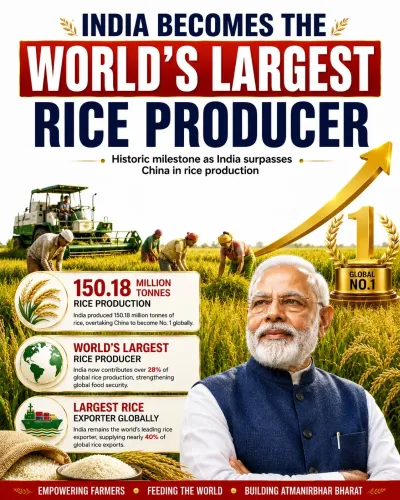
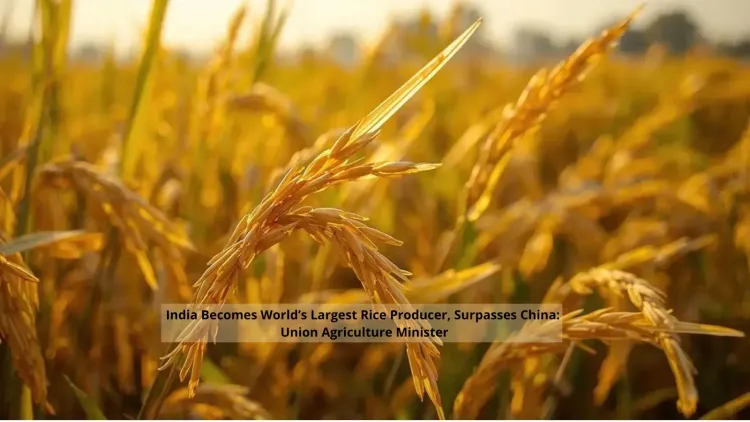
Bihar Chief Minister Samrat Choudhary has hailed India's reported rise to become the world's largest rice producer, overtaking China. Posting on 30 May 2026, he attributed the milestone to farmers' hard work and PM Narendra Modi's agricultural reform agenda, framing it as a step toward a self-reliant, developed India.
Key Takeaways
Bihar CM Samrat Choudhary posted on 30 May 2026 claiming India has surpassed China to become the world's largest rice producer.
He credited the milestone to Indian farmers and agricultural reforms under PM Narendra Modi .
The PM-KISAN scheme provides ₹6,000 annually to eligible farmer families and forms a key pillar of the central government's farm support framework.
The National Food Security Mission (2007) and Agricultural Export Policy (2018) are among the policy instruments cited as contributing to production gains.
Final confirmation of India's ranking awaits the Ministry of Agriculture's official 2025-26 production estimates.
The development strengthens India's positioning as a pillar of global food security under the Atmanirbhar Bharat framework.
Bihar Chief Minister Samrat Choudhary on Saturday, 30 May 2026, took to X to celebrate what he described as a landmark agricultural milestone — India surpassing China to become the world's largest rice-producing nation. He credited the achievement to the hard work of Indian farmers and the agricultural reforms pursued under Prime Minister Narendra Modi.
Posting in Hindi, CM Choudhary wrote: 'अन्नदाता का परिश्रम, भारत का गौरव' ('The toil of the food-giver, the pride of India'). He stated that India has now left China behind to become the world's biggest rice producer, calling it the result of farmers' labour and sweeping agricultural reforms under PM Modi's leadership. He further noted that India is no longer merely self-sufficient in foodgrain production but is emerging as a strong pillar of global food security — a significant milestone on the path to a developed, prosperous, and self-reliant India.
Context
India and China have long competed for the top position in global rice output, with both nations accounting for a combined majority of the world's rice production. India is the second-most populous nation and has historically ranked among the top global rice producers and exporters. A shift in this ranking, if confirmed by final official estimates, would mark a significant moment in the global agricultural order.
The Ministry of Agriculture is expected to release final production estimates for 2025-26, which will provide the authoritative data underpinning such claims. Any confirmed shift would carry major implications for global grain trade and food security diplomacy.
Policy Backdrop
The agricultural gains referenced by CM Choudhary trace back to a series of central government interventions over the past decade. The Pradhan Mantri Kisan Samman Nidhi (PM-KISAN) scheme, launched in 2019, provides annual income support of ₹6,000 to landholding farmer families, directly boosting rural agricultural investment capacity.
Earlier, the National Food Security Mission, launched in 2007, aimed to raise productivity of rice, wheat, and pulses through improved seed distribution and technology. The Agricultural Export Policy of 2018 further sought to double farm exports by targeting value-added products and diversified markets. Together, these programmes form the backbone of the Atmanirbhar Bharat agricultural framework, which has prioritised expanded irrigation, higher minimum support prices, and area under high-yielding varieties.
Stakeholders and Impact
The primary beneficiaries of this milestone, as highlighted by CM Choudhary, are India's rice farmers — a constituency of immense political and economic significance in states like Bihar, West Bengal, Uttar Pradesh, Punjab, and Andhra Pradesh. For Bihar in particular, where agriculture is the backbone of the rural economy, such recognition carries direct resonance.
For foodgrain exporters, a confirmed top-producer status strengthens India's negotiating position in global grain markets and could support new trade agreements. It also reinforces India's stated ambition to serve as a reliable food supplier to the Global South, particularly nations facing food insecurity.
What's Next
The immediate focus will be on the release of the Ministry of Agriculture's final production estimates for 2025-26, which will either confirm or qualify the ranking cited by CM Choudhary. Separately, a forthcoming trade policy review is expected to examine new rice export facilitation measures that could capitalise on India's enhanced production capacity.
If the data is officially confirmed, it is likely to feature prominently in the ruling coalition's political messaging ahead of state and national electoral cycles, reinforcing the Atmanirbhar Bharat narrative on food sovereignty and farmer welfare.
Point of View
Ahead of what are likely to be electorally significant cycles in Bihar and nationally. By foregrounding the farmer — the 'annadata' — he anchors a geopolitical-scale achievement in the lived reality of rural voters, a demographic the BJP has invested heavily in through PM-KISAN and MSP hikes. The framing of India as not just self-sufficient but a 'strong foundation of global food security' also signals an emerging foreign-policy dimension to agricultural diplomacy. However, the claim's political potency will depend on whether official production data fully corroborates the China-overtaking narrative.
NationPress
19 Sept 2026
Frequently Asked Questions
Has India really become the world's largest rice producer, overtaking China?
Bihar CM Samrat Choudhary has claimed on 30 May 2026 that India has surpassed China to become the world's largest rice producer. Final confirmation depends on the official 2025-26 production estimates to be released by India's Ministry of Agriculture.
What government schemes have helped increase India's rice production?
Key schemes include the National Food Security Mission (launched 2007) for productivity improvement, the PM-KISAN scheme (2019) providing ₹6,000 annual income support to farmers, and the Agricultural Export Policy (2018) aimed at doubling farm exports.
What is Atmanirbhar Bharat and how does it relate to agriculture?
Atmanirbhar Bharat, meaning 'Self-Reliant India', is a policy framework championed by PM Narendra Modi. In agriculture, it encompasses expanded irrigation, higher minimum support prices, and export promotion to achieve food self-sufficiency and global competitiveness.
Why is Bihar CM Samrat Choudhary commenting on national rice production data?
As Bihar Chief Minister and a senior BJP leader, Choudhary regularly amplifies central government achievements, particularly those relevant to Bihar's large farming population. Agriculture is central to Bihar's rural economy, making rice production milestones politically significant in the state.
What is PM-KISAN and who benefits from it?
PM-KISAN (Pradhan Mantri Kisan Samman Nidhi) is a central government scheme launched in 2019 that provides ₹6,000 per year in direct income support to landholding farmer families across India, disbursed in three equal instalments.