CM Samrat Choudhary hails middle-class rise under PM Modi
Synopsis
Bihar Chief Minister Samrat Choudhary on June 15, 2026 credited PM Modi's decade of leadership for expanding India's middle class, framing it as the primary driver of economic growth and the backbone of the Viksit Bharat vision for 2047.
Key Takeaways
Bihar CM Samrat Choudhary posted on June 15, 2026 crediting PM Narendra Modi 's leadership for the middle class's rise over the last decade.
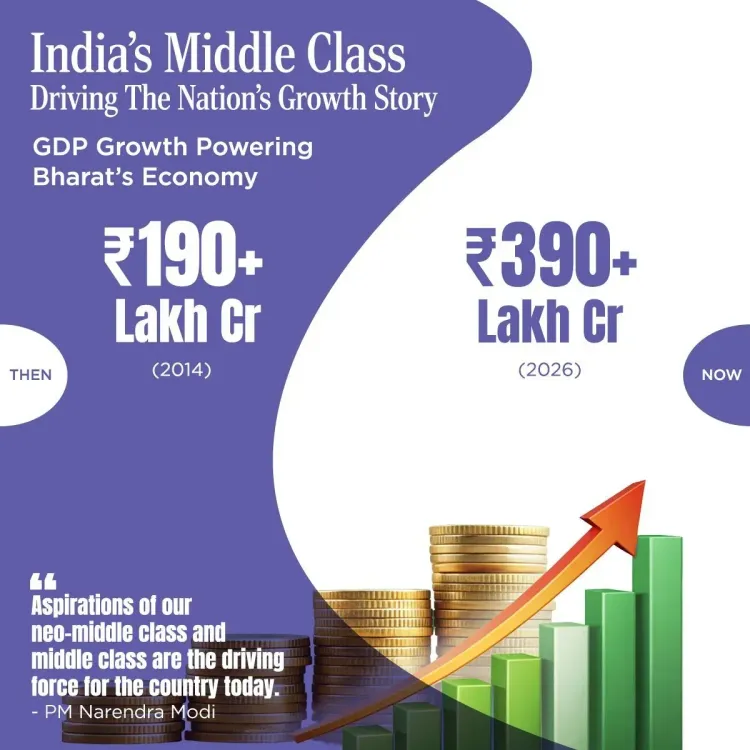
He described the middle class as a 'key driver of economic growth and national progress,' fuelling both consumption and innovation.
The post explicitly links middle-class empowerment to the Viksit Bharat (Developed India by 2047) national vision.
Key policy milestones cited in context include Make in India (2014) , GST (2017) and Atmanirbhar Bharat (2020) .
The statement reflects a consistent BJP strategy of aligning state-level political messaging with the central government's long-term economic narrative.
Upcoming Union Budget provisions on direct-tax slabs and consumption incentives will be a key test of this narrative.
Bihar Chief Minister Samrat Choudhary on Monday, June 15, 2026, credited Prime Minister Narendra Modi's decade-long leadership for expanding and empowering India's middle class, calling it the central force behind the country's economic ascent and progress toward a developed nation.
Context
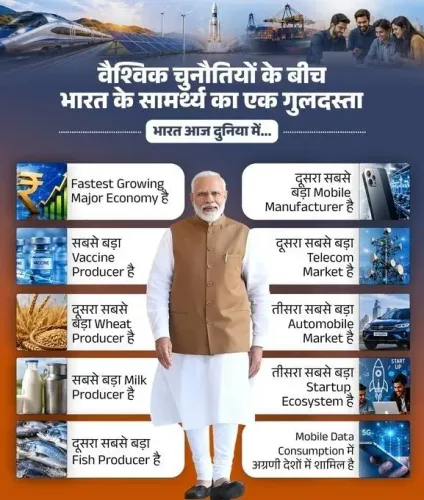
Posting on X, CM Choudhary wrote: 'The story of India's rise is the story of its middle class.' He described the middle class as having grown in 'strength, confidence and aspiration' over the last decade under PM Modi, and positioned it as a 'key driver of economic growth and national progress.' The post was accompanied by two images and drew attention to the twin roles the middle class plays — fuelling consumption and shaping innovation — as engines of the Viksit Bharat (Developed India) vision.
The statement is consistent with a broader BJP messaging arc that frames middle-class expansion as both the result of sound governance and the fuel for future growth. State-level leaders have increasingly echoed this narrative to align regional political discourse with New Delhi's national policy priorities.
Policy Backdrop
The Modi government's economic agenda since 2014 has included several landmark reforms aimed at integrating the middle class into a formalised, consumption-driven economy. The Make in India programme, launched in September 2014, sought to boost manufacturing and create employment avenues for aspirational households. The rollout of the Goods and Services Tax (GST) from July 2017 unified the national market, reducing cascading taxes and broadening the formal consumption base.
The Atmanirbhar Bharat package, announced in May 2020 in response to the pandemic, further reinforced domestic production and supply-chain resilience — measures that directly affected middle-class livelihoods and employment. Successive Union Budgets and Economic Surveys have consistently linked household income growth with the government's 2047 developed-economy target, branded as Viksit Bharat.
Stakeholders and Impact
Middle-class households and urban consumers stand at the centre of the narrative CM Choudhary is amplifying. As a demographic, they are simultaneously the primary beneficiaries of formalisation drives — gaining access to digital banking, formal credit and social security — and the largest contributors to domestic consumption, which underpins GDP growth.
For Bihar, a state with a large aspirational workforce and significant migration to urban economic centres, the politics of middle-class empowerment carry particular resonance. Aligning state-level messaging with the national Viksit Bharat vision allows the BJP to connect local development ambitions to a pan-India growth story, reinforcing party coherence ahead of future electoral cycles.
What's Next
The political salience of the middle-class narrative is expected to intensify as the next Union Budget approaches. Provisions on direct-tax slabs, consumption incentives and fresh household-income data will be closely watched to see whether policy delivery matches the rhetoric. Any significant revision to income-tax thresholds or targeted relief measures for salaried and self-employed segments would directly validate — or test — the claims being made by leaders like CM Choudhary.
As India tracks its trajectory toward the 2047 centenary of independence, the middle class's role as both beneficiary and engine of that journey is likely to remain a defining political and economic theme for the BJP at both the national and state levels.
Point of View
He is reinforcing a narrative architecture that the party has built systematically since 2014 — one that ties household aspiration to state capacity and electoral legitimacy. The Viksit Bharat framing is particularly strategic: it sets a long-horizon benchmark (2047) that is difficult to contest in the short term while keeping voters emotionally invested in a national project. For a state like Bihar, where upward mobility and migration are lived realities, this messaging has both political utility and genuine resonance.
NationPress
15 Sept 2026
Frequently Asked Questions
What did Bihar CM Samrat Choudhary say about India's middle class?
On June 15, 2026, Bihar CM Samrat Choudhary posted on X that India's middle class has grown in strength, confidence and aspiration over the last decade under PM Narendra Modi, calling it a key driver of economic growth and the force powering India's march toward Viksit Bharat.
What is Viksit Bharat and how does it relate to the middle class?
Viksit Bharat is the Indian government's long-term vision to make India a developed nation by 2047, the centenary of independence. Leaders like CM Choudhary have framed the middle class as both a beneficiary of this vision and its primary economic engine through consumption and innovation.
What economic reforms has PM Modi introduced that benefit the middle class?
Key reforms under PM Modi include the Make in India programme launched in September 2014, the Goods and Services Tax implemented in July 2017 which unified the national market, and the Atmanirbhar Bharat package announced in May 2020 to strengthen domestic production after the pandemic.
Why is Samrat Choudhary talking about national economic themes as Bihar CM?
State-level BJP leaders increasingly echo the central government's economic messaging to align regional political discourse with national policy priorities, helping the party maintain a coherent narrative from Delhi to state capitals like Patna.
What should we watch for next on India's middle-class policy?
The next Union Budget's provisions on direct-tax slab revisions, consumption incentives and any fresh government data on household income distribution will be the clearest indicators of whether policy action matches the political rhetoric around middle-class empowerment.