CM Nayab Saini pays tribute to Arya Samaj founder Dayanand Saraswati
Synopsis
Haryana Chief Minister Nayab Singh Saini marked the death anniversary of Arya Samaj founder Maharshi Swami Dayanand Saraswati on 30 October 2026, paying tribute to his 19th-century crusade against superstition, caste discrimination and inequality, and his enduring push for education and women's empowerment.
Key Takeaways
Haryana CM Nayab Singh Saini paid tribute to Maharshi Swami Dayanand Saraswati on his death anniversary on 30 October 2026 .
Swami Dayanand Saraswati founded the Arya Samaj in 1875 , advocating Vedic monotheism, abolition of caste discrimination, child marriage, and superstition.
CM Saini highlighted Swami Dayanand's work toward education, equality and women's empowerment as an enduring guide for society.
The Arya Samaj has maintained a historically significant presence in Haryana and northern India .
BJP leaders in Arya Samaj-influenced states regularly mark this anniversary to align with reformist, Vedic-nationalist traditions.
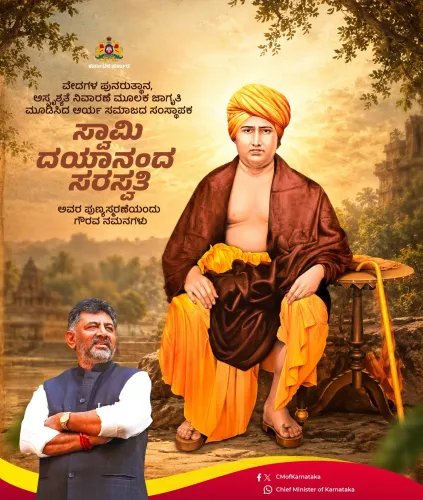
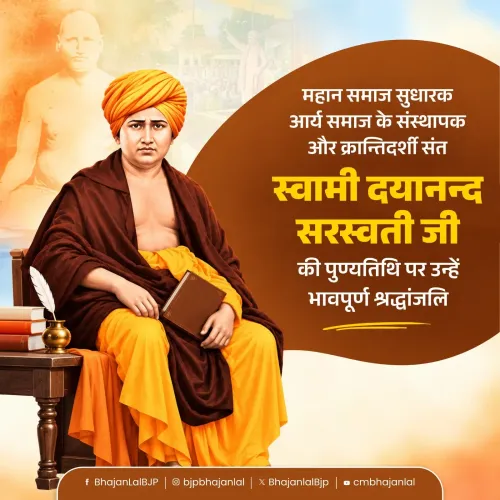
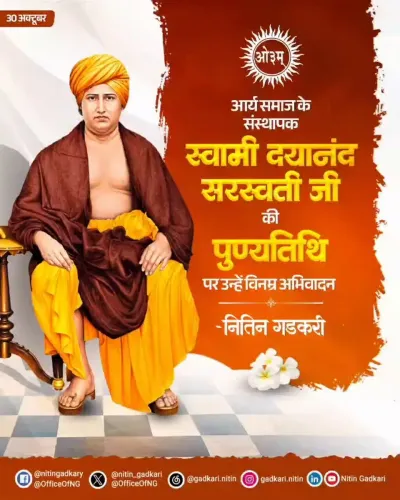
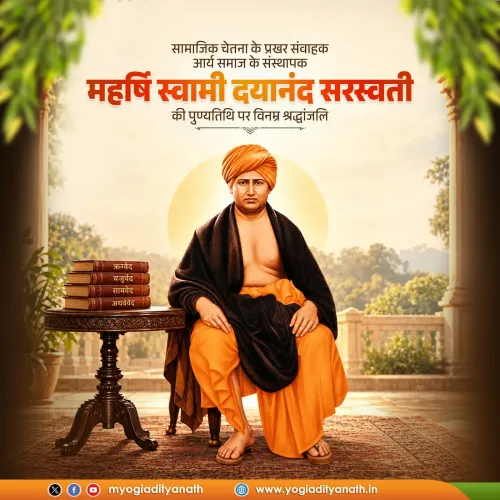
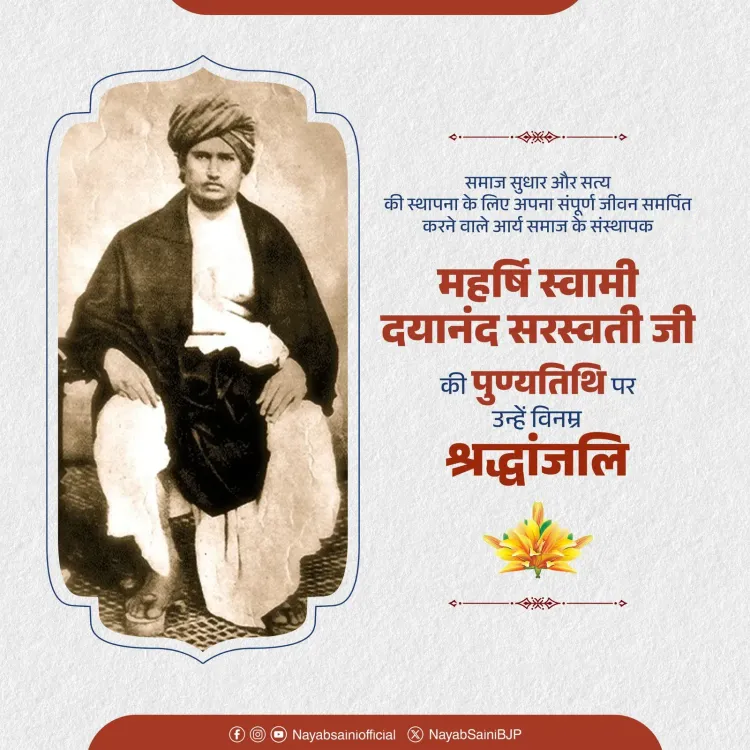
On the death anniversary of one of India's most consequential social reformers, Haryana Chief Minister Nayab Singh Saini offered a respectful tribute on Friday, 30 October 2026 to Maharshi Swami Dayanand Saraswati, founder of the Arya Samaj, honouring a life devoted entirely to the restoration of Vedic values and the dismantling of social injustice.
In his post, CM Saini wrote — 'Samaj sudhar aur Vaidik mulyon ki punarsthapana ke liye apna sampurn jeevan samarpit karne wale Arya Samaj ke sansthapak Maharshi Swami Dayanand Saraswati ji ki punyatithi par unhen vinamra shraddhanjali' — offering humble homage to the reformer who gave his entire life to social reform and the restoration of Vedic principles. He further noted that Swami Dayanand's struggle against social evils, superstition and discrimination, and his work toward education, equality and women's empowerment, 'will always give society a new direction.'
The man who shook 19th-century India
Swami Dayanand Saraswati founded the Arya Samaj in 1875, building an institutional home for a reform vision that challenged idol worship, caste discrimination, child marriage, and the superstitions that had calcified within Hindu society. His clarion call — Back to the Vedas — was not a retreat into ritual but a rallying cry for reason, equality and universal education. He died in 1883, but the organisation he built endured, becoming one of the most influential reform movements in northern India.
The Arya Samaj carved especially deep roots in Haryana and across the Punjab plains, shaping generations of educators, freedom fighters and social activists. Its emphasis on the equal spiritual worth of every individual — cutting across gender and caste — placed it well ahead of its century on questions that India still wrestles with today.
Why BJP leaders in Haryana invoke this anniversary
CM Saini's tribute fits a recognisable political grammar: BJP leaders in states with strong Arya Samaj historical influence have consistently marked Dayanand Saraswati's death anniversary as a way to signal alignment with reformist, Vedic-nationalist traditions. The gesture is simultaneously cultural, electoral and ideological — framing the party's social agenda within a continuum of indigenous reform rather than imported ideology.
For Haryana specifically, invoking Swami Dayanand's legacy on girls' education and anti-discrimination carries weight in a state that has grappled publicly with gender-ratio challenges and education access in rural areas. The tribute, however ceremonial in form, implicitly points toward that unfinished work.
Over 150 years after the Arya Samaj was founded, the questions Swami Dayanand raised — who gets an education, who is seen as equal, what superstitions still govern life choices — remain alive. The anniversary is a reminder that reform is not a single event. It is a direction.
Point of View
Gender equality and anti-superstition, Saini is quietly anchoring his government's social agenda to an indigenous reform lineage rather than a purely partisan one. For the BJP in Haryana, this serves a dual purpose: consolidating Arya Samaj-influenced communities while projecting a progressive, reformist face. The real test will be whether the tribute translates into measurable state action on girls' education and social awareness — areas where Haryana has room to improve.
NationPress
30 Oct 2026
Frequently Asked Questions
Who was Swami Dayanand Saraswati?
Swami Dayanand Saraswati was a 19th-century Indian social reformer who founded the Arya Samaj in 1875. He campaigned against idol worship, caste discrimination, child marriage and superstition while championing Vedic principles, universal education and women's rights. He died in 1883.
When was the Arya Samaj founded?
The Arya Samaj was founded in 1875 by Swami Dayanand Saraswati. It became one of the most influential Hindu reform movements, with a strong presence in Haryana and across northern India.
Why did Haryana CM Nayab Singh Saini pay tribute to Dayanand Saraswati?
CM Saini marked Swami Dayanand Saraswati's death anniversary on 30 October 2026, honouring his legacy of social reform, Vedic values, and work toward education and women's empowerment. The tribute also reflects the BJP's political alignment with Arya Samaj traditions in Haryana.
What did the Arya Samaj stand for?
The Arya Samaj stood for Vedic monotheism, abolition of caste and gender discrimination, opposition to child marriage and superstition, and the promotion of universal education and social equality.
What is Swami Dayanand Saraswati's connection to Haryana?
The Arya Samaj, which Swami Dayanand Saraswati founded, took deep root in Haryana and Punjab, shaping generations of educators and social reformers in the region. His legacy remains a significant part of Haryana's cultural and social identity.