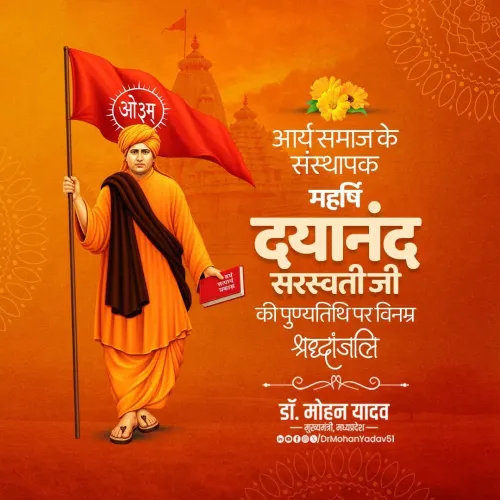
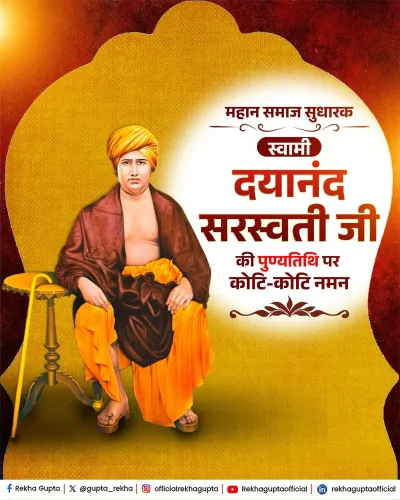
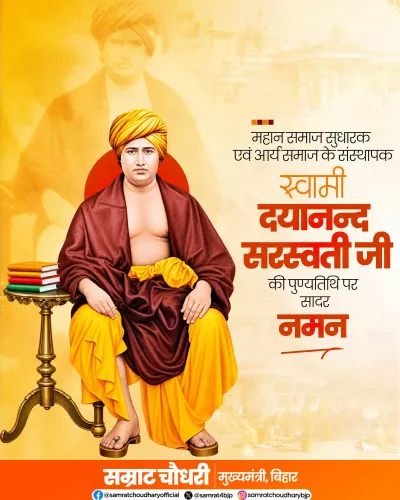
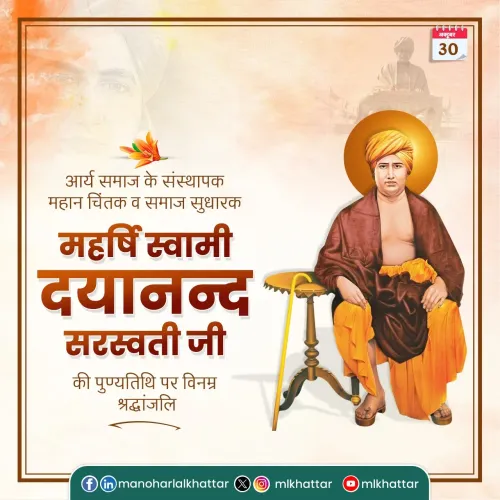
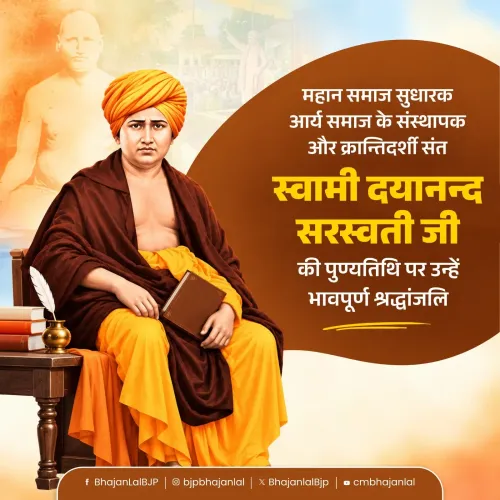
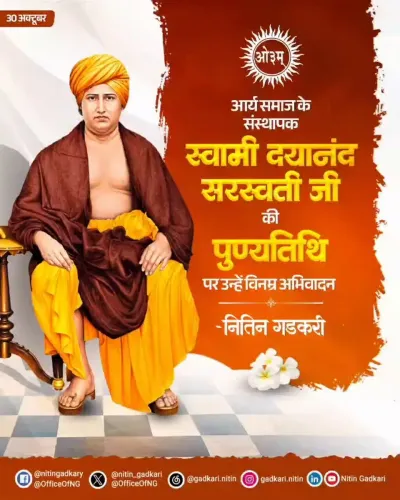
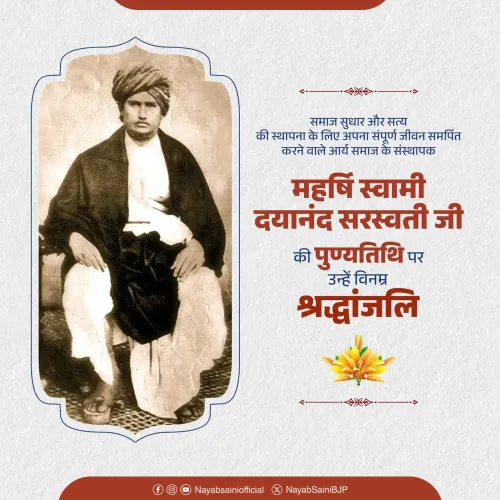
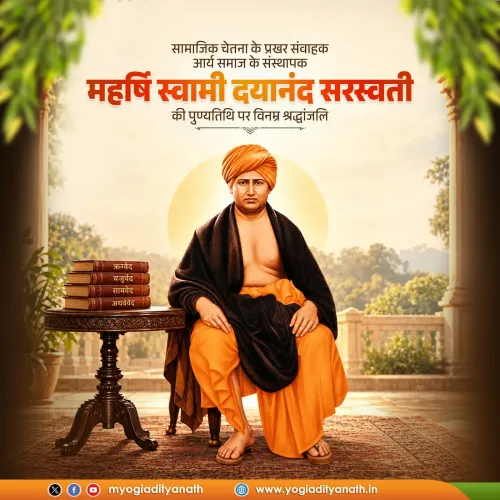
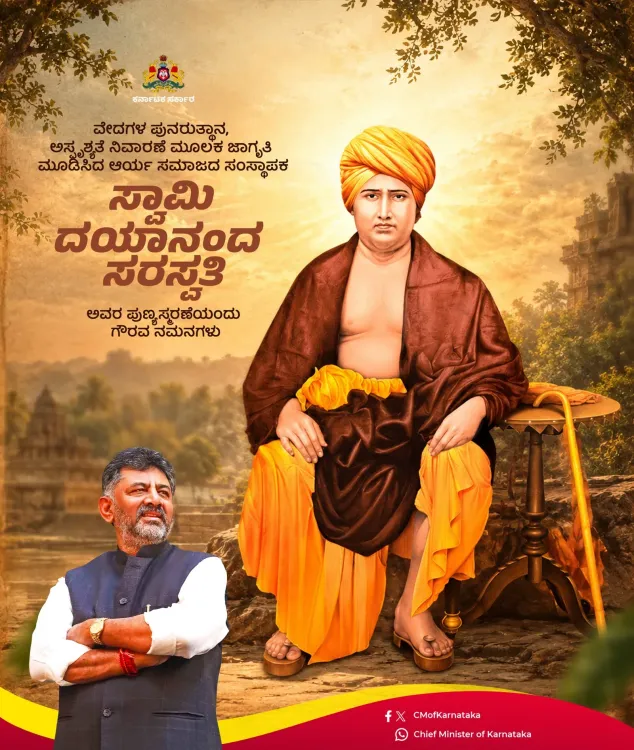
CM Karnataka Office pays tribute to Swami Dayananda Saraswati
Synopsis
The Chief Minister's Office of Karnataka honoured Swami Dayananda Saraswati on his death anniversary, citing the Arya Samaj founder's principles on women's education, untouchability eradication, and social equality as an enduring guide for building a just society.
Key Takeaways
The Chief Minister's Office of Karnataka posted a formal tribute to Swami Dayananda Saraswati on 30 October 2026 , his death anniversary.
Dayananda Saraswati founded the Arya Samaj in 1875 , championing monotheism, social equality, and rejection of superstition.
The tribute specifically highlighted his contributions to women's education and the eradication of untouchability .
The Arya Samaj's early school networks were among the first to extend modern education to marginalised communities in India.
The Karnataka government described his founding principles as a 'guiding light' for building a new, equitable society.
On the death anniversary of one of modern India's most consequential social reformers, the Chief Minister's Office of Karnataka paid solemn tribute to Swami Dayananda Saraswati on Friday, 30 October 2026, honouring the Arya Samaj founder's lifelong battle against superstition and caste inequality.
The official post, in Kannada, offered 'reverential salutations on the death anniversary of Swami Dayananda Saraswati, founder of Arya Samaj, who fought to uproot the superstition and inequality that existed in society.' It went on to describe his foundational principles — on women's education, eradication of untouchability, and the path of truth — as an 'ದಾರಿದೀಪ' (guiding light) for the construction of a new society.
The reformer who rewired 19th-century India
Swami Dayananda Saraswati founded the Arya Samaj in 1875, at a moment when colonial India was wrestling with deep social fault lines. His movement rejected idolatry, attacked the rigid caste hierarchy, and — strikingly for the era — championed formal education for women. Where many reformers of his generation worked at the margins, Dayananda went straight for the root: he argued that distorted social custom, not Vedic scripture itself, was responsible for India's inequality.
The Arya Samaj's early network of Dayananda Anglo-Vedic schools became one of the first institutional pipelines for modern education in north and western India, reaching communities that orthodox establishments had long shut out. His opposition to untouchability, decades before it became a mainstream national conversation, placed him ahead of his time in the arc of Indian social reform.
Why Karnataka's official voice invokes him today
State governments across India routinely mark the death anniversaries of 19th-century reformers through formal statements, a practice that does dual work: it honours historical legacy and signals present-day commitments to social equity. For Karnataka — a state with a pronounced history of social reform movements, from the Lingayat tradition to the Basavanna legacy — invoking Dayananda Saraswati reinforces a continuity of progressive values.
The tribute's specific mention of women's education and untouchability eradication is not incidental. Both remain live policy arenas: Karnataka has active schemes targeting girls' education and Scheduled Caste welfare, and official commemorations such as this one frame those efforts within a longer moral tradition.
Swami Dayananda Saraswati's principles, the post reminds us, were not relics of the 1800s. They are, as Karnataka's government put it, a lamp still burning on the road ahead.
Point of View
Lending historical depth to present-day policy choices. In a state with multiple competing social reform inheritances, choosing Dayananda Saraswati signals a pan-Indian, Vedic-reform register rather than a narrowly regional one.
NationPress
30 Oct 2026
Frequently Asked Questions
Who was Swami Dayananda Saraswati?
Swami Dayananda Saraswati was a 19th-century Hindu reformer who founded the Arya Samaj in 1875. He campaigned against superstition, caste discrimination, and untouchability while advocating strongly for women's education and a return to Vedic principles.
When was the Arya Samaj founded?
The Arya Samaj was founded in 1875 by Swami Dayananda Saraswati. The movement promoted monotheism, social equality, and the rejection of idolatry and rigid caste hierarchy.
Why is Karnataka's Chief Minister's Office paying tribute to Dayananda Saraswati?
The Chief Minister's Office of Karnataka paid tribute on Swami Dayananda Saraswati's death anniversary, honouring his legacy of social reform. Such official commemorations are common in Indian state governments and are used to signal commitments to social equality and education.
What did Swami Dayananda Saraswati do for women's education?
Swami Dayananda Saraswati was a strong advocate for formal education for women at a time when it was largely denied to them. The Arya Samaj movement he founded established schools — including the Dayananda Anglo-Vedic school network — that extended education to previously excluded communities.
What is Swami Dayananda Saraswati's death anniversary date?
Swami Dayananda Saraswati's death anniversary falls on 30 October , the date on which the Karnataka Chief Minister's Office posted this official tribute in 2026.