Gadkari pays tribute to Rashtrasant Tukadoji Maharaj on anniversary
Synopsis
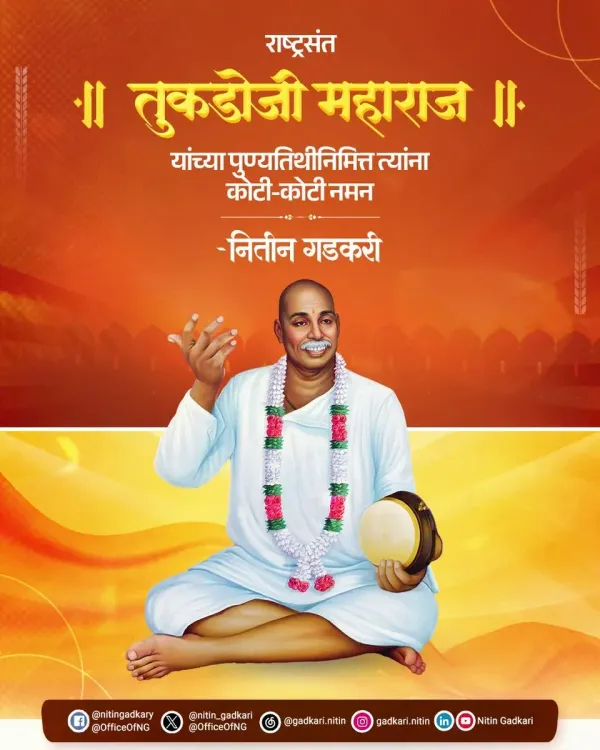
Union Minister Nitin Gadkari marked the tithi-based death anniversary of Rashtrasant Tukadoji Maharaj, honouring the Vidarbha saint's Gramgeeta teachings on village upliftment and his use of bhajan-kirtan for social reform across Maharashtra.
Key Takeaways
Union Minister Nitin Gadkari paid tribute to Rashtrasant Tukadoji Maharaj on his tithi-based Smriti Din on 30 October 2026 .
Tukadoji Maharaj ( 1909–1968 ) was a Vidarbha-born saint and social reformer whose Gramgeeta is a foundational text on village self-reliance.
He used bhajan-kirtan as a vehicle for anti-caste messaging and rural community organising across Maharashtra.
Gadkari's tribute, posted in Marathi, offered a 'crore-fold salutation' to the saint's memory.
Annual observances are centred around Amravati district , the saint's heartland in Vidarbha.
A saint who turned bhajans into blueprints for village revival — Union Road Transport and Highways Minister Nitin Gadkari marked the tithi-based death anniversary of Rashtrasant Tukadoji Maharaj on Friday, 30 October 2026, offering a heartfelt tribute to the Vidarbha-born mystic whose teachings on rural self-reliance remain deeply resonant across Maharashtra.
Posting in Marathi, Gadkari wrote: 'राष्ट्रसंत तुकडोजी महाराजांनी ग्रामगीतेच्या माध्यमातून ग्रामउन्नतीचा परिपाठ दिला' — 'Rashtrasant Tukadoji Maharaj set a practice of village upliftment through the Gramgeeta. Through bhajans and kirtans, he guided society in a new direction.' He concluded with a salutation: 'On his Smriti Din today (as per tithi), I bow a crore-fold to his sacred memory.'
Who was Rashtrasant Tukadoji Maharaj and why the Gramgeeta still matters
Rashtrasant Tukadoji Maharaj (1909–1968) was a Maharashtrian saint and social reformer from the Vidarbha region whose life's work bridged spirituality and practical rural reform. His landmark text, the Gramgeeta, served as a comprehensive guide to village self-reliance — addressing sanitation, cooperative farming, social harmony, and the eradication of caste prejudice, all woven through the accessible idiom of devotional verse. At a time when rural India was searching for a post-independence identity, Tukadoji Maharaj used bhajan-kirtan gatherings not merely as acts of worship but as community organising tools, drawing crowds across Maharashtra and beyond. His title 'Rashtrasant' — 'saint of the nation' — reflects the breadth of his appeal, which transcended regional and caste boundaries. Amravati district, his heartland, remains a centre of annual observances at his ashram and memorials, where state and central leaders alike pay their respects on his tithi-based anniversary each year.Why Maharashtra's leaders keep invoking this legacy
Gadkari's tribute fits a well-established pattern: senior leaders from Maharashtra, across parties, publicly mark the anniversaries of regional spiritual reformers whose teachings on gramonnati (village upliftment) carry both cultural weight and contemporary political resonance. For the BJP, invoking Tukadoji Maharaj's Gramgeeta — with its emphasis on self-sufficient, harmonious villages — aligns naturally with flagship rural development narratives around schemes targeting village infrastructure, sanitation, and community welfare. Gadkari himself, a Nagpur native and product of Vidarbha's political soil, carries a particular connection to this legacy. His constituency and the saint's homeland share the same geography, lending the tribute a personal dimension beyond the ceremonial. On a day when millions of devotees in Maharashtra offer prayers at local shrines, a minister's post on X becomes a small but deliberate signal: that the reformer's vision of the self-reliant village is not yet history — it is still government vocabulary.Point of View
Making such tributes a low-key but effective form of ideological alignment. As a Nagpur-based leader from Vidarbha — the saint's own region — Gadkari's voice carries authenticity that a Delhi-centric leader's would not. This is legacy politics as policy grammar: reminding a Maharashtrian electorate that the reformers they venerate and the government they elected speak the same language.
NationPress
30 Oct 2026
Frequently Asked Questions
Who was Rashtrasant Tukadoji Maharaj?
Rashtrasant Tukadoji Maharaj (1909–1968) was a Maharashtrian saint and social reformer from Vidarbha who authored the Gramgeeta, a guide to village self-reliance, and used bhajan-kirtan to promote anti-caste and social harmony messages across India.
What is the Gramgeeta?
The Gramgeeta is a text authored by Tukadoji Maharaj that outlines principles of village upliftment, covering sanitation, cooperative farming, social harmony, and caste reform through accessible devotional verse.
When is Rashtrasant Tukadoji Maharaj's death anniversary observed?
His death anniversary is observed according to the Hindu lunar calendar (tithi), meaning the date shifts each year in the Gregorian calendar. Observances are centred at his ashram and memorials in Amravati district, Maharashtra.
Why did Nitin Gadkari pay tribute to Tukadoji Maharaj?
Gadkari marked the tithi-based Smriti Din of the Vidarbha saint, in keeping with the tradition of Maharashtra's political and civic leaders publicly honouring regional spiritual reformers on their death anniversaries.
Where are Tukadoji Maharaj's memorials located?
The primary memorials and ashram associated with Rashtrasant Tukadoji Maharaj are located in Amravati district, Vidarbha, Maharashtra, which serves as the hub for annual anniversary observances.