CM Saini Pays Tribute to Dr. Homi Bhabha on Birth Anniversary
Synopsis
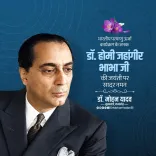
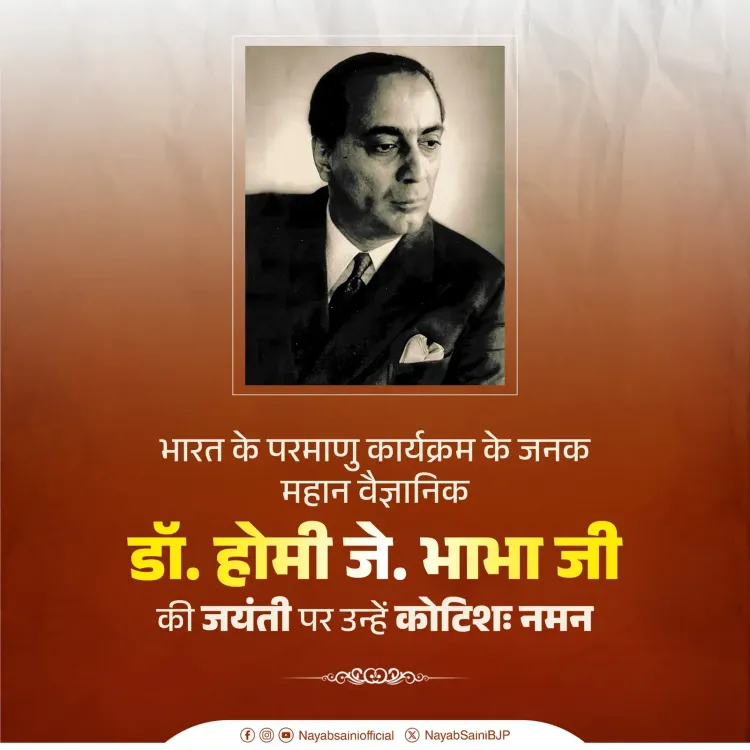
Haryana Chief Minister Nayab Singh Saini honoured Dr. Homi Jehangir Bhabha on his birth anniversary, calling the nuclear pioneer the father of India's atomic programme and a symbol of scientific self-reliance whose legacy continues to inspire the nation.
Key Takeaways
Haryana CM Nayab Singh Saini paid tribute to Dr.
Homi Jehangir Bhabha on his birth anniversary on 30 October 2026 .
Bhabha founded the Tata Institute of Fundamental Research in 1945 , India's first world-class science institution.
He served as the first chairman of the Atomic Energy Commission , established in 1948 .
CM Saini credited Bhabha with laying 'a strong foundation for a self-reliant and empowered India' through nuclear science.
The tribute connects Bhabha's legacy to the contemporary Aatmanirbhar Bharat narrative of technological self-reliance.
The man who gave India its nuclear identity is being remembered today. Haryana Chief Minister Nayab Singh Saini on Friday, 30 October 2026, paid homage to Dr. Homi Jehangir Bhabha on the legendary physicist's birth anniversary, saluting the architect of India's atomic age as a visionary whose legacy continues to shape the nation.
In his post, CM Saini described Bhabha as 'bharat ke parmaanu karyakram ke janak' — the father of India's nuclear programme — crediting him with giving India 'a new identity in the field of nuclear science' through 'farsighted thinking, unparalleled scientific talent, and tireless effort.' He added that Bhabha had laid 'a strong foundation for a self-reliant and empowered India,' and that his contribution to nation-building 'will always remain a source of inspiration.'
The Scientist Who Built India's Atomic Foundation
Dr. Homi Jehangir Bhabha founded the Tata Institute of Fundamental Research in 1945, creating India's first world-class centre for basic science at a moment when the country had not yet achieved independence. When India did gain freedom, Bhabha moved swiftly: he became the first chairman of the Atomic Energy Commission, established in 1948, and built the institutional scaffolding that would eventually make India a significant nuclear power. He did this not merely as an administrator but as a practising physicist of international standing. His death in a 1966 air crash cut short a career that had already transformed a newly independent nation's scientific ambitions.
Self-Reliance as a Through-Line, Then and Now
Indian political leaders across parties have long invoked Bhabha on his birth anniversary, and the framing is rarely accidental. The emphasis on 'self-reliant and empowered India' in CM Saini's tribute maps directly onto the current government's Aatmanirbhar Bharat narrative, connecting a 1940s scientific visionary to a 21st-century industrial and strategic ambition. The message is deliberate: India's drive for technological sovereignty has deep roots, and Bhabha planted several of them.
For a state chief minister, invoking Bhabha also signals alignment with a larger national story — one where science, strategic capability, and self-reliance are inseparable threads. It is a reminder that nation-building is not only built in parliament, but also in laboratories.
Point of View
Allowing leaders to trace present-day self-reliance ambitions back to a founding scientific hero. CM Saini's framing, invoking 'self-reliant and empowered India,' aligns this historical tribute with the ruling BJP's core economic and strategic messaging. It also reflects a broader pattern of reclaiming India's scientific founders as symbols of national capacity rather than leaving their legacy to academic circles alone. The ritual matters: it continuously embeds science and strategic capability into the mainstream political imagination.
NationPress
30 Oct 2026
Frequently Asked Questions
Who is Dr. Homi Jehangir Bhabha?
Dr. Homi Jehangir Bhabha was the founding father of India's nuclear programme. He established the Tata Institute of Fundamental Research in 1945 and served as the first chairman of the Atomic Energy Commission from 1948, building India's civilian nuclear infrastructure from the ground up.
When is Homi Bhabha's birth anniversary?
Dr. Homi Jehangir Bhabha's birth anniversary falls on 30 October. Indian political leaders and scientific institutions commemorate this day annually to honour his contributions to nuclear science.
What did Nayab Singh Saini say about Homi Bhabha?
Haryana CM Nayab Singh Saini called Bhabha the 'father of India's nuclear programme,' crediting his visionary thinking and tireless effort with giving India a new identity in nuclear science and laying the foundation for a self-reliant, empowered India.
What did Homi Bhabha contribute to India's nuclear programme?
Bhabha founded the Tata Institute of Fundamental Research in 1945 and chaired the Atomic Energy Commission established in 1948, creating the institutional and scientific foundation for India's entire civilian nuclear programme.
Why do Indian leaders pay tribute to Homi Bhabha?
Bhabha is regarded as the architect of India's nuclear and scientific self-reliance. Leaders across the political spectrum invoke his legacy to connect current national ambitions — particularly technological self-sufficiency — to a proven founding heritage.