Kishan Reddy Hails IMF Projecting India's GDP at 6.4% in 2026
Synopsis
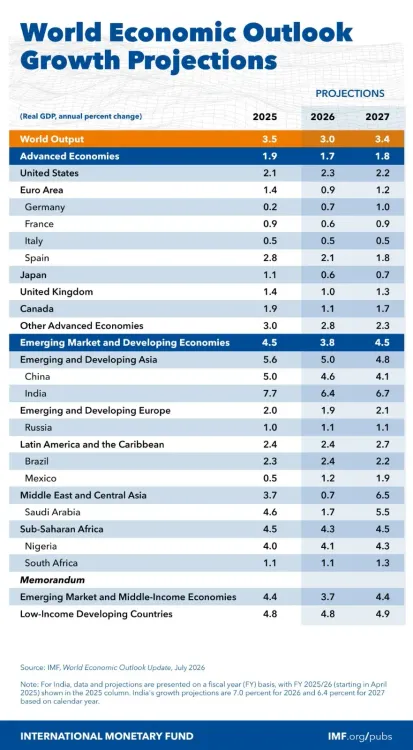
The IMF has projected India's GDP growth at 6.4 per cent in 2026 and upgraded the 2027 forecast to 6.7 per cent. Union Minister G. Kishan Reddy highlighted the figures as proof of India's resilience amid global uncertainty, crediting PM Modi's leadership and the Viksit Bharat mission for sustaining the country's status as a top-ranked growth engine.
Key Takeaways
The IMF has projected India's GDP growth at 6.4 per cent in 2026 and upgraded the 2027 forecast to 6.7 per cent .
Kishan Reddy shared the projections on 9 July 2026 , attributing the outlook to resilient domestic demand and a robust services sector.
India has consistently been ranked among the fastest-growing major economies in successive IMF World Economic Outlook reports since 2021 .
The government's Viksit Bharat mission targets developed-nation status for India by 2047 .
The next key checkpoints are the October 2026 IMF update and the Union Budget 2026–27 presentation.
Global investors and the Indian services sector are identified as primary stakeholders watching the growth trajectory.
Union Coal and Mines Minister G. Kishan Reddy on Thursday, 9 July 2026 cited the International Monetary Fund's latest growth projections to underscore India's standing as one of the world's fastest-growing major economies, noting that the IMF has forecast India's GDP growth at 6.4 per cent for 2026 and upgraded its 2027 outlook to 6.7 per cent.
Context
In his post on X, the Minister stated that the IMF has 'reaffirmed confidence in India's medium-term economic strength' even amid what he described as prevailing global uncertainties. He attributed the momentum to 'resilient domestic demand and a robust services sector,' and linked the trajectory to Prime Minister Narendra Modi's leadership and the government's Viksit Bharat vision — the national target of achieving developed-nation status by 2047.
Reddy, who also serves as BJP Telangana state president, regularly amplifies national economic indicators through his social media presence, placing them within the ruling party's broader reform narrative.
Policy Backdrop
The IMF publishes its World Economic Outlook twice a year, and successive editions since 2021 have repeatedly identified India as the fastest-growing major economy, driven primarily by domestic consumption and an expanding digital and services sector. This pattern has held even as global growth absorbed repeated shocks — from the pandemic, inflationary surges, and geopolitical tensions — after 2020.
The government's Atmanirbhar Bharat package, announced in 2020, was an early structural intervention aimed at strengthening domestic production and services resilience. Analysts have since pointed to policy continuity in prioritising internal consumption and services-led expansion as a key factor sustaining India's position above the 6 per cent growth threshold in IMF medium-term rankings.
India's consistent placement ahead of other large emerging markets in the IMF's 2025–2030 horizon assessments has reinforced the government's framing of the economy as a global growth anchor.
Stakeholders and Impact
Global investors and sovereign wealth funds tracking emerging-market allocations closely monitor IMF growth differentials; a sustained upgrade in India's forecast relative to peers can influence capital flows and foreign direct investment decisions. The Indian services sector — encompassing information technology, financial services, and business process management — stands as a primary beneficiary if the growth trajectory holds, given its outsized contribution to the projected expansion.
Domestically, the projections carry political weight as the ruling BJP prepares its economic messaging ahead of state elections and the next Union Budget cycle. Opposition parties have, in past cycles, challenged whether headline IMF figures translate into broad-based welfare gains and employment growth on the ground.
What's Next
The October 2026 IMF World Economic Outlook update will be the next major checkpoint, offering a revised read on whether India's growth momentum has held through the second half of the year. Simultaneously, the Union Budget 2026–27 presentation will signal whether fiscal policy continues to support the structural drivers — infrastructure spending, services competitiveness, and domestic demand — that underpin the current projections.
If both the IMF update and the Budget reinforce the current trajectory, India's positioning as the world's fastest-growing large economy is likely to remain a central plank of the government's economic communication strategy heading into the next electoral cycle.
Point of View
The political dividend will depend on whether the macro story translates into visible gains in employment and household incomes, a gap that opposition voices have persistently highlighted. The October IMF update and the next Union Budget will together determine whether this optimism hardens into durable policy momentum or remains a headline-level talking point.
NationPress
7 Oct 2026
Frequently Asked Questions
What is the IMF's GDP growth forecast for India in 2026?
The IMF has projected India's GDP growth at 6.4 per cent in 2026 , reaffirming the country's position among the world's fastest-growing major economies.
What is India's IMF growth forecast for 2027?
The IMF has upgraded India's 2027 GDP growth forecast to 6.7 per cent , reflecting continued confidence in India's medium-term economic strength.
What is Viksit Bharat and how does it relate to India's growth?
Viksit Bharat is the Indian government's mission to achieve developed-nation status by 2047 . The IMF's growth projections are cited by the government as evidence that the economy is on track to meet this long-term target.
Why did Kishan Reddy comment on the IMF projections?
As Union Minister of Coal and Mines and BJP Telangana state president , G. Kishan Reddy regularly highlights national economic indicators on social media to reinforce the ruling party's narrative of strong economic governance under PM Modi.
What factors are driving India's high growth according to the IMF assessment?
The IMF assessment points to resilient domestic demand and a robust services sector as the primary drivers sustaining India's growth above 6 per cent even amid global uncertainties.