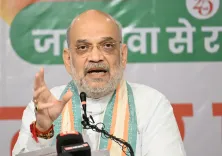
Kishan Reddy Hails India's Rise to Global Top 5 in Manufacturing
Synopsis
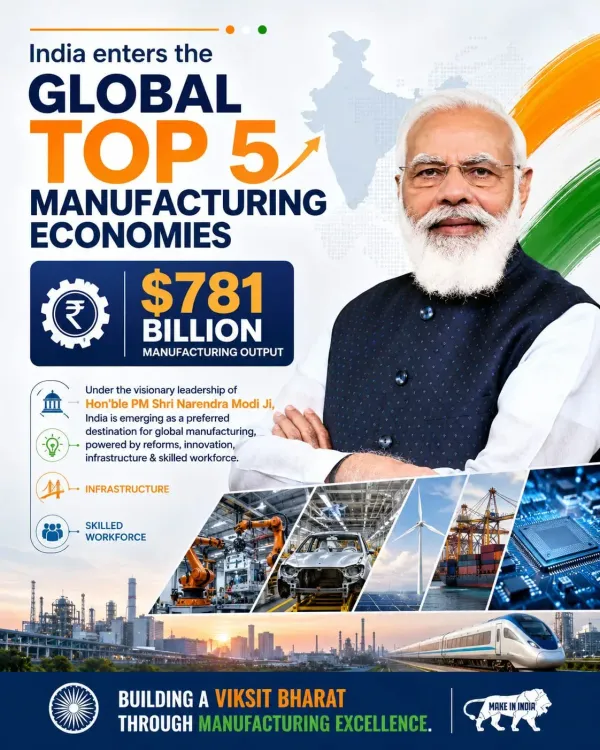
Union Minister G. Kishan Reddy has hailed India's entry into the Global Top 5 Manufacturing Economies with a $781 billion output, crediting PM Modi's Make in India initiative, PLI schemes, and infrastructure reforms as the drivers of this landmark achievement on the path to Viksit Bharat.
Key Takeaways
Union Coal and Mines Minister G.
Kishan Reddy declared India has entered the Global Top 5 Manufacturing Economies as of June 2026.
India's manufacturing output is cited at $781 billion , described as a historic milestone by the minister.
The achievement is attributed to Make in India , launched in September 2014 , and PLI schemes rolled out across 14 sectors from 2020.
The milestone is framed as a step toward Viksit Bharat , the government's vision for a developed India by 2047 .
Policy enablers cited include progressive reforms, FDI liberalisation , infrastructure corridors, and a skilled workforce.
Parliamentary scrutiny of PLI disbursements and new manufacturing-share-in-GDP targets is expected at the next Union Budget session.
Union Coal and Mines Minister G. Kishan Reddy on Monday, June 15, 2026, hailed India's emergence among the world's top five manufacturing economies, citing a manufacturing output of $781 billion as a landmark achievement under the leadership of Prime Minister Narendra Modi. The minister attributed the milestone to progressive reforms, infrastructure investment, and a skilled workforce, linking it directly to the success of the 'Make in India' initiative and the broader Viksit Bharat vision.
Context
In his post on X, Reddy described the development as 'a historic milestone for the nation,' stating that India has 'proudly emerged among the Global Top 5 Manufacturing Economies with a monumental $781 Billion manufacturing output.' He credited 'progressive reforms, robust infrastructure, and a highly skilled workforce' for the achievement, calling it a testament to the success of Make in India.
Reddy, who also serves as the BJP Telangana state president, framed the milestone as a significant step toward the government's long-term goal of building a Viksit Bharat — a developed India — by 2047. The post reflects a broader pattern of senior ministers amplifying economic data points as markers of policy success.
Policy Backdrop
Make in India was launched in September 2014 with the explicit goal of positioning India as a global manufacturing hub and raising manufacturing's share of GDP from around 15 percent toward 25 percent. The initiative opened up FDI across key sectors and was followed by the Atmanirbhar Bharat self-reliance package in May 2020, which placed manufacturing and supply-chain resilience at its core.
From 2020 onward, the government rolled out Production Linked Incentive (PLI) schemes across 14 sectors — including electronics, pharmaceuticals, and automobiles — to directly incentivise scaled domestic production and attract global manufacturers to set up operations in India. These schemes have been central to the government's strategy for climbing global manufacturing rankings.
Successive administrations have grappled with the challenge of raising manufacturing's contribution to GDP, with accelerated policy focus post-2014 through infrastructure corridor development and liberalised investment norms. Analysts have noted persistent headwinds including employment intensity and logistics costs alongside the incremental gains in output.
Stakeholders and Impact
The claimed rise in manufacturing output has direct implications for India's industrial sector, which spans heavy industries, electronics, textiles, and defence production. A higher global manufacturing rank strengthens India's negotiating position in trade agreements and its pitch to multinational companies seeking to diversify supply chains away from other major producers.
For the skilled workforce — a demographic Reddy specifically highlighted — a sustained manufacturing boom translates into job creation across both formal and informal segments of the economy. Industry bodies and state governments competing for manufacturing investment are likely to cite the ranking as a draw for foreign direct investment.
What's Next
Parliamentary scrutiny of PLI scheme disbursements and targets for manufacturing's share of GDP is expected during the next Union Budget session, where the government will be pressed to provide sector-wise breakdowns of output growth and employment generated. The $781 billion output figure, if officially tabled, will become a baseline against which future manufacturing targets under the Viksit Bharat roadmap will be measured.
As India consolidates its position among the world's top manufacturing economies, the policy focus is expected to shift toward deepening value addition in high-technology sectors, reducing import dependence in critical inputs, and expanding the logistics and energy infrastructure needed to sustain large-scale industrial growth through 2047.
Point of View
Tethering a current data point to a long-horizon national narrative that is central to the BJP's electoral and governance identity. However, the broader policy record shows that while output has grown, manufacturing's share of GDP has remained stubbornly below the 25 percent target, meaning the ranking claim will face scrutiny on the quality and composition of growth. The announcement is likely to sharpen the opposition's demand for granular employment and value-addition data in the next parliamentary session.
NationPress
14 Sept 2026
Frequently Asked Questions
Has India entered the Global Top 5 Manufacturing Economies?
Union Minister G. Kishan Reddy stated on June 15, 2026 that India has entered the Global Top 5 Manufacturing Economies with a manufacturing output of $781 billion, crediting PM Modi's policy reforms.
What is the Make in India initiative?
Make in India is a flagship government scheme launched in September 2014 to position India as a global manufacturing destination, attract foreign direct investment, and raise manufacturing's share of GDP toward 25 percent.
What are PLI schemes and how do they help manufacturing?
Production Linked Incentive schemes, introduced from 2020 across 14 sectors, provide financial incentives to companies that scale up domestic manufacturing output, helping India attract global producers and boost industrial output.
What is Viksit Bharat and how does manufacturing relate to it?
Viksit Bharat is the Indian government's vision for a fully developed India by 2047. A strong manufacturing base is considered central to achieving the income levels and industrial capacity that the vision targets.
What is India's manufacturing share of GDP?
India's manufacturing sector has historically contributed around 15 percent of GDP. Government policy since 2014 has aimed to raise this to 25 percent, though closing that gap remains a key challenge cited by economists.