Kishan Reddy Flags 12-Year Mining Surge, Pitches 2026 MMDR Bill
Synopsis
Union Coal and Mines Minister G. Kishan Reddy has highlighted India's mining sector transformation under PM Modi — citing 1 billion tonnes of mineral output for two consecutive years, a near-200-times expansion in exploration, states' revenue share rising to 88%, and the upcoming MMDR Amendment Bill, 2026 aimed at standardising mineral taxation.
Key Takeaways
India achieved 1 billion tonnes of mineral production for two consecutive years under the current policy regime.
Non-coal mineral production has nearly tripled and exploration has expanded by nearly 200 times over 12 years.
India now ranks 4th in iron ore, 2nd in limestone, 3rd in zinc, and 5th in bauxite globally.
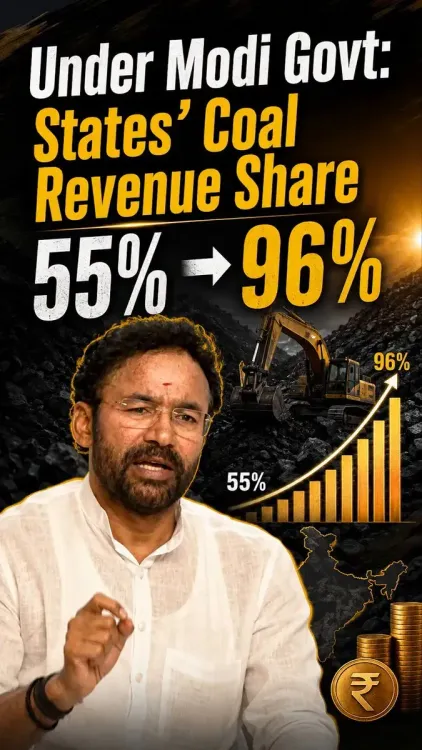
States' share of mineral revenue rose from 63% to 88% , with over ₹6 lakh crore accruing to states since 2015.
District Mineral Foundations are channelling royalty revenues into roads, schools, hospitals, and drinking water in mining districts.
The Mines and Minerals (Development and Regulation) Amendment Bill, 2026 seeks to bring uniformity and fiscal stability to mineral taxation to attract fresh investment.
A decade-plus of auction-based reform, 1 billion tonnes of mineral production for two consecutive years, and a new amendment bill on the floor — Union Coal and Mines Minister G. Kishan Reddy laid out the full arc of India's mining transformation on Thursday, 13 August 2026, framing it as the foundation for a Viksit Bharat @2047.
From auction chaos to a billion-tonne milestone
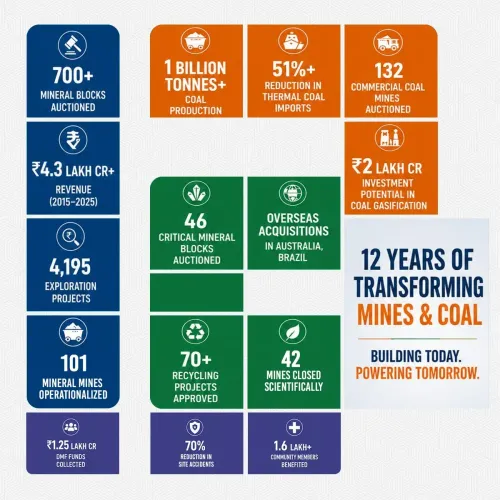
The pivot began in 2015, when the Mines and Minerals (Development and Regulation) Amendment Act scrapped discretionary licensing and replaced it with competitive auctions — ending what critics had long called an era of opacity and underperformance. The results, as Reddy framed them, are now measurable: India has hit 1 billion tonnes of mineral output for two straight years, nearly tripled non-coal mineral production, and expanded exploration coverage by nearly 200 times.
The global scoreboard tells its own story. India now ranks 4th in iron ore, 2nd in limestone, 3rd in zinc, and 5th in bauxite production worldwide — positions that matter directly for steel, cement, and the battery-supply chains that every major economy is racing to lock in.
States' share jumps from 63% to 88% — what that means on the ground
The revenue story is as striking as the output numbers. States' share of mineral revenue has climbed from 63% to 88%, with more than ₹6 lakh crore accruing to state governments since 2015. That is not an abstraction — it is the fiscal oxygen behind roads, schools, hospitals, and drinking-water projects in districts that sit atop the ore but have historically seen little of the upside.
The mechanism is the District Mineral Foundation (DMF), a statutory body created alongside the 2015 reforms to direct a share of royalties into local infrastructure and welfare. Mining districts from Jharkhand to Rajasthan to Odisha are the intended beneficiaries — communities that have long borne the environmental and social costs of extraction with limited economic return.
What the Mines and Minerals Amendment Bill, 2026 adds
Reddy's post was also a pitch for the next legislative step: the Mines and Minerals (Development and Regulation) Amendment Bill, 2026. The minister described it as bringing 'uniformity, predictability and fiscal stability' to the mineral tax structure — language aimed squarely at investors who have flagged inconsistent state-level levies as a deterrent.
By standardising the tax framework, the Centre is betting it can unlock a fresh wave of mining investment and auction activity across states. The bill's parliamentary passage and subsequent state-level adoption of the new regime are the immediate milestones to watch.
India's mineral belt is vast, its critical-mineral reserves increasingly strategic in a world rewiring supply chains away from single-country dependence. If the 2026 bill clears Parliament and states align, the next chapter of this transformation will be written not in royalty percentages but in battery factories, steel plants, and semiconductor inputs — the hard infrastructure of a developed economy.
Point of View
2026. The revenue-sharing numbers — states' share rising from 63% to 88% — are politically significant, signalling to mineral-rich states that Centre-state resource tensions are being actively addressed. The framing around District Mineral Foundations and local welfare spending is a deliberate counter to long-standing criticism that mining communities bear costs without seeing proportionate benefits. The 2026 bill's emphasis on tax uniformity suggests the Centre is responding to investor feedback that state-level fiscal unpredictability has suppressed private capital in the sector.
NationPress
28 Sept 2026
Frequently Asked Questions
What is the MMDR Amendment Bill 2026?
The Mines and Minerals (Development and Regulation) Amendment Bill, 2026 is proposed legislation that aims to bring uniformity, predictability and fiscal stability to India's mineral tax structure, reducing inconsistencies across states to encourage fresh mining investment.
How much mineral revenue have Indian states received since 2015?
According to Union Minister G. Kishan Reddy, states have received over ₹6 lakh crore in mineral revenue since 2015, with their share of total mineral revenue rising from 63% to 88%.
What is a District Mineral Foundation?
A District Mineral Foundation (DMF) is a statutory body established in mining districts under the 2015 MMDR Amendment. It receives a portion of royalty revenues and directs them toward local infrastructure and welfare projects such as roads, schools, hospitals, and drinking water.
What is India's global ranking in mineral production?
India ranks 4th in iron ore, 2nd in limestone, 3rd in zinc, and 5th in bauxite production globally, according to figures cited by Union Coal and Mines Minister G. Kishan Reddy.
What was the key change in India's mining policy in 2015?
The Mines and Minerals (Development and Regulation) Amendment Act of 2015 replaced discretionary licensing with competitive auction-based allocation of mineral blocks, aiming to bring transparency and reduce scope for arbitrary decisions in the sector.