Kishan Reddy Backs MMDR Amendment Act 2026 for Stronger Mining Sector

Synopsis
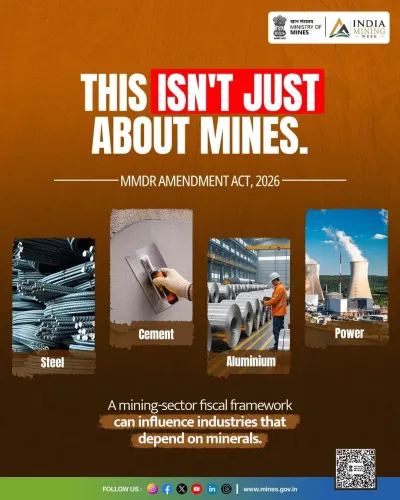
Union Coal and Mines Minister G. Kishan Reddy has endorsed the MMDR Amendment Act 2026, framing it as a legislative overhaul to strengthen regulation, expand exploration, and boost domestic mineral production — building on a decade of competitive-auction reforms under the 1957 Mines and Minerals Act.
Key Takeaways
Kishan Reddy , Union Coal and Mines Minister, publicly backed the MMDR Amendment Act 2026 on August 19, 2026 .
The Act aims to improve regulation, exploration, and domestic mineral production across India.
The MMDR Act, 1957 is India's foundational mining law; the 2015 amendment introduced competitive auctions for major minerals, replacing the first-come-first-served system.
Successive reforms have focused on reducing India's import dependence on critical minerals and increasing state-level participation in licensing.
Mineral-rich states — including Jharkhand, Odisha, Chhattisgarh, and Rajasthan — are central to whether the new rules translate into real production gains.
Key indicators to watch: number of auctioned blocks , pace of exploration licences , and the Act's parliamentary and state-level scrutiny.
India's mining law is getting its most significant overhaul in years. Union Coal and Mines Minister G. Kishan Reddy on Wednesday, August 19, 2026, threw his weight behind the MMDR Amendment Act 2026, calling it the legislative backbone that will make India's mineral sector stronger, more transparent, and future-ready.
Posting on X, the Minister declared — 'MMDR Amendment Act 2026 भारत के खनिज क्षेत्र को बनाएगा और मजबूत, पारदर्शी और भविष्य के लिए तैयार' ('The MMDR Amendment Act 2026 will make India's mineral sector stronger, more transparent, and ready for the future'). The amendment, he said, will drive better regulation, expanded exploration, and a decisive push for domestic mineral production. His three-word summation: 'Strong states, strong minerals, strong India.'
What the MMDR Framework Has Meant for India
The Mines and Minerals (Development and Regulation) Act, 1957 is the foundational law governing every stage of India's non-coal mineral economy — from exploration licences to production and sale. It has been amended repeatedly as governments grappled with the twin pressures of rising domestic demand and import dependence on critical minerals.
The landmark MMDR Amendment Act 2015 was a turning point: it scrapped the opaque first-come-first-served system for major minerals and replaced it with competitive auctions, injecting transparency and significantly boosting state revenues. Each successive reform has built on that foundation — deepening auction frameworks, expanding exploration incentives, and pulling state governments closer into the licensing process.
Why 2026 Feels Different
India's appetite for minerals — lithium, cobalt, graphite, rare earths — has never been greater, driven by the electric-vehicle push, defence manufacturing, and the broader clean-energy transition. Domestic production has consistently lagged, leaving India exposed to supply-chain shocks from overseas. The 2026 amendment is being positioned as the legislative answer to that structural gap.
Kishan Reddy's post specifically flags three pillars: better regulation, expanded exploration, and higher domestic mineral production. Together, they sketch an agenda aimed squarely at reducing import dependence and giving states a more muscular role in unlocking their own mineral wealth.
State Governments: Partners, Not Bystanders
The Minister's framing — 'strong states, strong mineral sector, strong India' — is not incidental. Mineral-rich states like Jharkhand, Odisha, Chhattisgarh, and Rajasthan hold the bulk of India's reserves, and any reform lives or dies by how quickly those states adopt new rules, auction fresh blocks, and clear ground for exploration. The political signal here is clear: the Centre wants states invested in the outcome, not just compliant with the mandate.
The real test will come in the months ahead — in the number of blocks auctioned, the pace of exploration licences granted, and whether parliamentary and state-level scrutiny sharpens or softens the Act's ambitions. India's mineral future is being legislated now; the question is how fast the ground catches up with the law.
Point of View
Strong minerals, strong India' is a deliberate political signal — Centre-state alignment is the reform's biggest execution risk, and the Minister is pre-empting friction by casting states as co-owners of the outcome. With India's critical-mineral import bill climbing alongside EV and defence ambitions, the 2026 amendment carries real strategic weight beyond routine legislative housekeeping. Whether the law delivers will depend less on its text and more on how quickly states auction blocks and grant exploration licences.
NationPress
3 Oct 2026
Frequently Asked Questions
What is the MMDR Amendment Act 2026?
The MMDR Amendment Act 2026 is a proposed update to India's foundational Mines and Minerals (Development and Regulation) Act, 1957. It aims to strengthen regulation, expand mineral exploration, and boost domestic mineral production to reduce India's reliance on imported critical minerals.
What did G. Kishan Reddy say about the MMDR Amendment Act 2026?
Union Coal and Mines Minister G. Kishan Reddy said the MMDR Amendment Act 2026 will make India's mineral sector stronger, more transparent, and future-ready, with a focus on better regulation, exploration, and domestic production.
How is the MMDR Amendment Act 2026 different from earlier amendments?
Earlier amendments, particularly the 2015 reform, replaced first-come-first-served allocation with competitive auctions for major minerals. The 2026 amendment is expected to build further on that foundation by deepening exploration incentives and increasing state-level participation, though its exact provisions are still subject to parliamentary scrutiny.
Which states are most affected by MMDR reforms in India?
Mineral-rich states like Jharkhand, Odisha, Chhattisgarh, and Rajasthan hold the bulk of India's mineral reserves and are most directly affected by MMDR reforms, as state governments are responsible for adopting new rules and auctioning mining blocks.
Why does India need to reform its mining laws?
India faces growing demand for critical minerals — including lithium, cobalt, and rare earths — driven by its electric-vehicle push, defence manufacturing, and clean-energy transition. Domestic production has lagged, creating import dependence. MMDR reforms aim to unlock domestic reserves and reduce that vulnerability.