Kishan Reddy pitches MMDR 2026 as mining investment reset
Synopsis
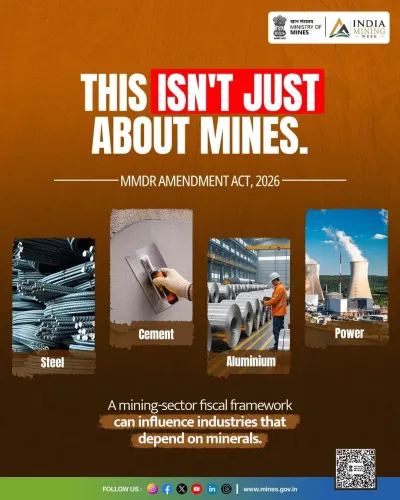
Union Coal and Mines Minister G. Kishan Reddy has described the Mines and Minerals (Amendment) Act, 2026 as a stable, predictable mineral taxation framework designed to bring clarity and uniformity, attract investment, and raise production across India's mining sector.
Key Takeaways
Kishan Reddy publicly explained the Mines and Minerals (Amendment) Act, 2026 on 19 August 2026 .
The amendment targets mineral taxation, aiming to deliver clarity, uniformity, and certainty for investors and state governments.
The MMDR Act dates to 1957 and has been amended significantly in 2015 and around 2021 to modernise mineral governance.
The 2015 amendment introduced auction-based concessions and District Mineral Foundations ; the 2021 round removed end-use restrictions.
State-level adoption of the new taxation rules and trends in exploration licences will be the key indicators of real-world impact.
A stable tax framework that removes uncertainty for investors and unlocks higher mineral production — that is how Union Coal and Mines Minister G. Kishan Reddy framed the Mines and Minerals (Amendment) Act, 2026 in a post on Wednesday, 19 August 2026.
Reddy described the legislation as delivering 'a stable and predictable framework for mineral taxation that ensures clarity, uniformity and certainty, while paving the way for greater investment and higher production across the mining sector.' The message was direct: clear policy, stronger foundation.
Decades of amendments, one persistent problem
The Mines and Minerals (Development and Regulation) Act, first enacted in 1957, has been the backbone of India's mineral governance for nearly seven decades. But its long history is also a record of accumulated complexity. A landmark 2015 amendment shifted mineral concessions entirely to an auction model and established District Mineral Foundations — a structural overhaul meant to bring transparency and community benefit. A further round of amendments around 2021 removed end-use restrictions on auctioned mines and introduced new exploration incentives, each change chipping away at the policy uncertainty that had long kept large capital on the sidelines. The 2026 amendment, as Reddy has framed it, targets the taxation layer specifically — the royalty and levy structures that vary in application and have historically made long-term project planning difficult for mining companies and state governments alike.Why uniform mineral taxation matters to investors
India's mining sector sits at a strategic crossroads. Demand for critical minerals — lithium, cobalt, rare earths — is surging globally as the energy transition accelerates, and India is positioning itself as both a producer and a processor. But investment in exploration and extraction has lagged, partly because the fiscal terms governing mines have not always been predictable across states or over project lifetimes. A uniform national framework for mineral taxation, if implemented effectively, would give mining companies the cost visibility they need to commit capital over the 10-to-20-year horizons that large mines require. State governments, which receive royalties as a primary revenue stream from mineral extraction, stand to benefit from higher production volumes even if per-unit rates are standardised. The real test will come at the state level — how quickly and consistently state governments adopt the new rules, and whether exploration licence applications and production figures begin to reflect the promised certainty.Point of View
And shifts accountability for outcomes to state-level implementation. For Reddy, who oversees both coal and non-coal minerals, a credible investment story in mining also reinforces the BJP's broader economic-governance narrative ahead of state election cycles. The amendment's true test is not the legislation itself but the speed and fidelity with which royalty and levy structures are harmonised on the ground.
NationPress
3 Oct 2026
Frequently Asked Questions
What is the Mines and Minerals Amendment Act 2026?
The Mines and Minerals (Amendment) Act, 2026 is a central legislation that revises India's mineral governance framework, specifically targeting taxation to create a stable, uniform, and predictable structure aimed at attracting investment and boosting production.
What is the MMDR Act and why does it matter?
The Mines and Minerals (Development and Regulation) Act, originally enacted in 1957, is the primary law governing mineral development, concessions, and regulation across India. It has been amended several times — notably in 2015 and 2021 — to modernise the sector.
What did the 2015 MMDR amendment do?
The 2015 amendment was a landmark overhaul that replaced discretionary allocation of mineral concessions with a transparent auction system and established District Mineral Foundations to channel royalty revenue into local community development.
How does uniform mineral taxation help investors?
Uniform taxation gives mining companies predictable long-term cost structures, which is essential for projects that require capital commitments over 10 to 20 years. Reduced policy uncertainty makes it easier to plan, finance, and execute large-scale mining operations.
What should we watch after the MMDR 2026 amendment?
The key indicators will be how quickly state governments adopt the new royalty and taxation rules, and whether exploration licence applications and actual mineral production figures rise in the months and years that follow.