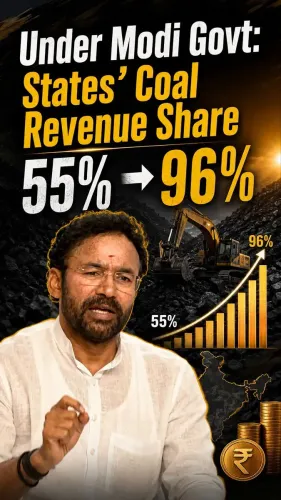
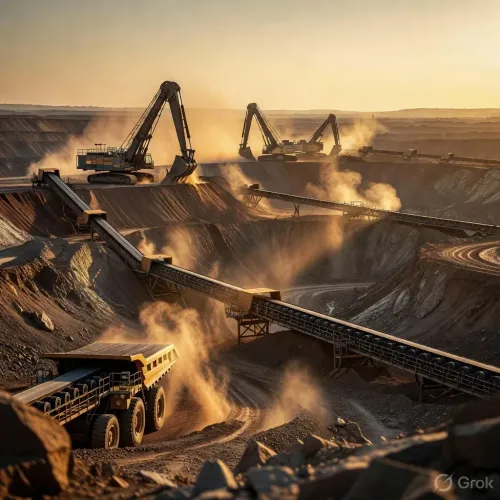
Kishan Reddy tables MMDR Amendment Bill 2026 in Lok Sabha
Synopsis
Union Coal and Mines Minister G. Kishan Reddy introduced the Mines and Minerals (Development and Regulation) Amendment Bill, 2026 in the Lok Sabha on 10 August, aiming to boost mineral exploration, secure critical minerals, and advance PM Modi's Viksit Bharat vision.
Key Takeaways
Kishan Reddy introduced the MMDR Amendment Bill, 2026 in the Lok Sabha on 10 August 2026 .
The Bill targets three areas: mineral exploration, critical mineral security, and sustainable resource development.
It is positioned as part of PM Narendra Modi 's Viksit Bharat 2047 development roadmap.
The MMDR Act, 1957 has been amended multiple times — in 2015 , 2021 , and 2023 — progressively opening the sector to private participation.
Critical minerals such as lithium, cobalt, and rare earths are central to India's EV, solar, and electronics manufacturing ambitions.
State governments, mining lease holders, and critical-mineral industries are key stakeholders in the Bill's passage.
A sweeping push to rewire India's mining law landed in Parliament on Monday, 10 August 2026, when Union Coal and Mines Minister G. Kishan Reddy introduced the Mines and Minerals (Development and Regulation) Amendment Bill, 2026 in the Lok Sabha — a move the government frames as central to securing the raw materials that will power India's clean-energy and technology future.
What the Bill targets: exploration, critical minerals, and resource security
The amendment seeks to strengthen three pillars: mineral exploration, critical mineral security, and sustainable resource development. Reddy, tabling the Bill, linked it directly to Prime Minister Narendra Modi's Viksit Bharat vision — the government's flagship roadmap to make India a developed nation by 2047. The stakes are not abstract. India's electric vehicle supply chains, solar panel manufacturing, and electronics industries all depend on minerals — lithium, cobalt, graphite, rare earths — that the country currently imports in large volumes. Reducing that dependence has become a strategic priority as global competition for these resources intensifies.A law that has been rewritten before — and why it keeps changing
The Mines and Minerals (Development and Regulation) Act, 1957 is the foundational statute governing mineral concessions across India. It has been amended repeatedly as priorities have shifted. The 2015 amendment was a landmark: it scrapped the old first-come-first-served system for mining leases and replaced it with competitive auctions, injecting transparency into an opaque sector. Subsequent rule changes in 2021 and 2023 further opened the door to private exploration and carved out a distinct framework for critical minerals. The 2026 Bill continues that arc — pushing further toward private participation in exploration and tightening the country's grip on minerals it cannot afford to leave underdeveloped.Who holds a stake in Parliament's decision
The Bill's passage will be watched closely by state governments, which share jurisdiction over mineral resources under the Constitution and receive royalties from mining leases. Mining lease holders and industries that consume critical minerals — from battery makers to defence contractors — also have direct skin in the game. Parliamentary debate will test whether the opposition raises concerns about state autonomy, environmental safeguards, or the pace of private-sector entry into a sector long dominated by public enterprises. India's mineral security is no longer a bureaucratic footnote — it is a front-line economic and strategic question. How Parliament shapes this Bill will determine whether the country can mine its own path to the clean-energy transition, or remain dependent on supply chains it does not control.Point of View
2026 is the latest step in a decade-long legislative effort to shift India's mining sector from a state-controlled, allocation-based model toward a competitive, exploration-driven one. The explicit focus on critical minerals signals that New Delhi is treating resource security as a strategic — not merely economic — imperative, aligning mining law with the geopolitical reality of global supply-chain competition. For the BJP, tabling this Bill also reinforces the Viksit Bharat narrative ahead of electoral cycles, tying industrial self-reliance to the Modi government's identity. The real test will be whether Parliament can resolve the perennial tension between central ambition and state governments' jealously guarded rights over mineral revenues.
NationPress
24 Sept 2026
Frequently Asked Questions
What is the MMDR Amendment Bill 2026?
The Mines and Minerals (Development and Regulation) Amendment Bill, 2026 is a proposed law introduced in the Lok Sabha by Union Minister G. Kishan Reddy on 10 August 2026. It aims to strengthen mineral exploration, secure critical minerals, and promote sustainable resource development in India.
What are critical minerals and why does India need them?
Critical minerals — including lithium, cobalt, graphite, and rare earth elements — are essential for electric vehicles, solar panels, electronics, and defence equipment. India currently imports large quantities of these minerals, making domestic policy to secure and develop them a strategic priority.
How has the MMDR Act been changed before?
The MMDR Act, 1957 was significantly amended in 2015 to replace first-come-first-served lease allocation with competitive auctions. Further amendments and rules in 2021 and 2023 liberalised exploration norms and introduced specific provisions for critical minerals.
What is the Viksit Bharat vision mentioned in the Bill's introduction?
Viksit Bharat — meaning 'Developed India' — is PM Narendra Modi's stated goal of transforming India into a fully developed nation by 2047, the centenary of independence. The government has linked multiple legislative and economic reforms, including this mining Bill, to that overarching framework.
Who will be most affected by the MMDR Amendment Bill 2026?
State governments, which share constitutional jurisdiction over minerals and earn royalties from mining leases, are key stakeholders. Mining companies, critical-mineral industries such as battery and EV manufacturers, and public-sector mining enterprises will also be directly affected by the Bill's provisions.