Kishan Reddy Marks 12 Years of Coal and Mining Reform Under Modi
Synopsis
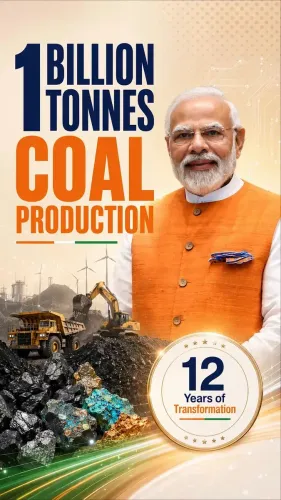
Union Coal and Mines Minister G. Kishan Reddy has credited PM Modi's twelve years in office with a sweeping transformation of India's coal and mining sectors, citing record production, reduced imports, and community empowerment as hallmarks of the reform era under the Viksit Bharat 2047 vision.
Key Takeaways
Kishan Reddy , Union Minister of Coal and Mines, posted on June 17, 2026 marking 12 years of coal and mining sector reform under PM Modi .
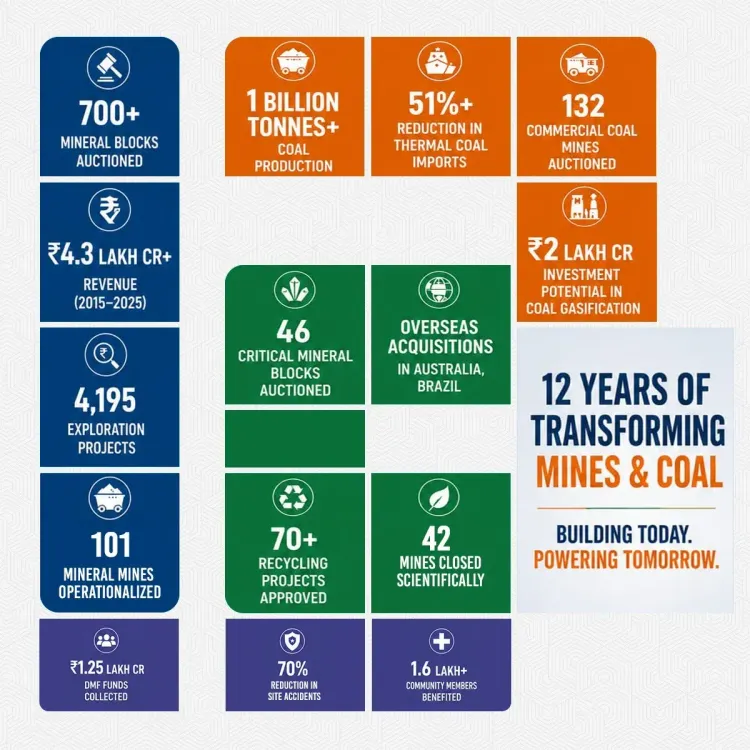
The minister cited 'record-breaking production,' slashed imports, and community empowerment as the three headline outcomes of the period.
The Coal Mines (Special Provisions) Act, 2015 introduced e-auctions after the Supreme Court's 2014 cancellation of coal block allocations.
Commercial coal mining was opened to private players for the first time since nationalisation in 2020 , ending the monopoly of Coal India Ltd .
The MMDR Amendment Act, 2021 introduced composite licences and eased exploration norms to accelerate mineral production.
The next round of commercial coal and critical mineral block auctions will be a key test of the reform framework's continued momentum.
Union Coal and Mines Minister G. Kishan Reddy on Wednesday, June 17, 2026 credited Prime Minister Narendra Modi's twelve years in office with a 'monumental transformation' of India's coal and mining sectors, citing record production, reduced imports, and community empowerment as the defining outcomes of the period.
Context
Posting on X, the minister wrote that PM Modi's 'unwavering dedication to transparency, growth, self-reliance, and sustainability has driven record-breaking production, slashed imports, and empowered local communities.' He framed the progress as part of the government's larger mission to build a 'prosperous tomorrow for a Viksit Bharat 2047.' The post tagged both the Ministry of Coal and the Ministry of Mines, signalling an official communication rather than a personal reflection.
The twelve-year milestone coincides with Modi's assumption of office in May 2014, making 2026 the point at which the government marks a full dozen years of continuous rule — and a natural occasion for sector-level stock-taking.
Policy Backdrop
The transformation the minister references has a traceable legislative spine. After the Supreme Court cancelled coal block allocations in 2014, Parliament enacted the Coal Mines (Special Provisions) Act, 2015, introducing e-auctions to restore transparency to block allocation. That was followed in 2020 by the landmark opening of commercial coal mining to private players — the first such liberalisation since nationalisation — ending the de facto monopoly of Coal India Ltd.
On the minerals side, the Mines and Minerals (Development and Regulation) Amendment Act, 2021 eased exploration norms and introduced a composite licence regime designed to shorten the path from discovery to production. Together, these reforms constitute the structural backbone of what Kishan Reddy describes as a sector-wide overhaul.
The push for self-reliance — echoed in the minister's language of 'slashed imports' — aligns with the Atmanirbhar Bharat framework that has guided energy and mineral policy since 2020, seeking to reduce dependence on imported coking coal and critical minerals alike.
Stakeholders and Impact
The constituencies most directly affected by this policy arc include coal mining communities in states such as Jharkhand, Chhattisgarh, and Odisha, where employment and local development funds are tied to production volumes and block auction revenues. Power utilities — which depend on domestic coal for baseload generation — stand to benefit from higher output and more stable supply chains.
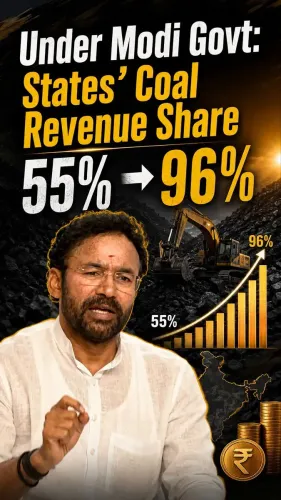
Mineral-rich states have seen royalty and district mineral foundation inflows grow as auction activity has increased, though the distribution of those benefits remains a subject of ongoing negotiation between the Centre and state governments. The minister's reference to 'empowered local communities' points to these district-level fiscal transfers as a key social dividend of the reform cycle.
India's energy transition also frames this moment: even as renewable capacity expands rapidly, coal remains the backbone of baseload power, and the government's position — reflected in Kishan Reddy's post — is that domestic production growth and sustainability can coexist within the Viksit Bharat 2047 vision.
What's Next
The immediate policy calendar includes the next round of commercial coal and critical mineral block auctions, which will test whether the liberalised framework continues to attract competitive bids. Any revision of production targets ahead of the 2026-27 Union Budget will serve as a further indicator of the government's ambitions for the sector in the years remaining before the 2047 horizon.
With Kishan Reddy also serving as BJP Telangana state president, the political dimension of the communication — reinforcing the party's governance record ahead of any state or national electoral cycle — is an additional layer that observers of both energy policy and electoral strategy will track closely.
Point of View
Arriving at the symbolic twelve-year mark of Modi's tenure and anchoring the BJP's governance narrative to measurable sector outcomes. By invoking both transparency — a direct counter to the pre-2014 coal block scandal — and self-reliance, the minister connects two distinct voter concerns: clean governance and economic nationalism. The dual tagging of the Coal and Mines ministries signals that this is coordinated messaging, not a personal tribute. Placed within the Viksit Bharat 2047 frame, the post also performs forward-looking work, positioning current achievements as a foundation rather than a terminus — a rhetorical move that will recur as the government approaches the next electoral cycle.
NationPress
21 Sept 2026
Frequently Asked Questions
What reforms did the Modi government introduce in India's coal sector?
The Modi government introduced e-auctions for coal block allocation through the Coal Mines (Special Provisions) Act, 2015, and in 2020 opened commercial coal mining to private companies for the first time since nationalisation, ending Coal India Ltd's monopoly.
What is Viksit Bharat 2047?
Viksit Bharat 2047 is the Indian government's long-term national vision to make India a fully developed nation by the centenary of its independence in 2047, with energy and mineral security identified as foundational pillars.
Who is G. Kishan Reddy?
G. Kishan Reddy is the Union Minister of Coal and Mines in the Modi government and also serves as the BJP's Telangana state president.
Why did India reform its coal block allocation system?
The Supreme Court cancelled existing coal block allocations in 2014 citing opacity and irregularities, prompting Parliament to enact the Coal Mines (Special Provisions) Act, 2015, which introduced competitive e-auctions to bring transparency to the process.
How does India's mining reform affect local communities?
Auction revenues generate District Mineral Foundation funds that are directed toward development projects in mining-affected communities, which the government cites as a social dividend of the liberalised allocation regime.