Kishan Reddy: 42 Coal Mines Closed, 147 More Targeted for Reclamation

Synopsis
Union Coal and Mines Minister G. Kishan Reddy says the Modi government has scientifically closed 42 coal mines over 12 years, with 147 more targeted. Mission Green Coal and the RECLAIM framework are driving afforestation and land reclamation to align India's coal sector with its climate and Viksit Bharat goals.
Key Takeaways
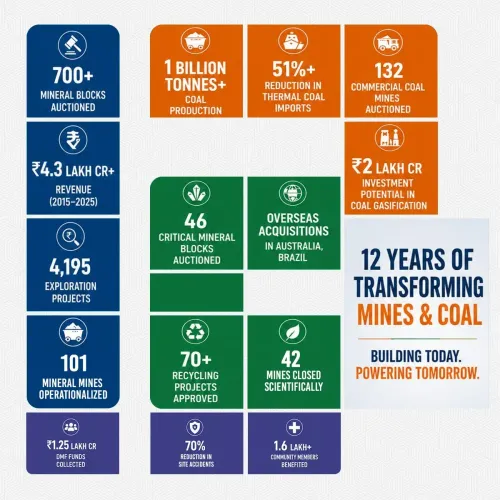
42 coal mines have been scientifically closed under the Modi government over the last 12 years , according to Minister G.
147 additional coal mines are targeted for scientific closure as part of ongoing reclamation efforts.
Mission Green Coal and the RECLAIM framework are the two named programmes driving afforestation, land reclamation and ecological restoration.
The initiative is framed within the national goals of Atmanirbhar Bharat and Viksit Bharat 2047 .
Mine reclamation directly supports India's commitments under the National Action Plan on Climate Change , including forest and tree cover targets.
Coal-belt states such as Jharkhand , Chhattisgarh , Odisha and Madhya Pradesh stand to benefit most from ecological restoration of abandoned mine land.
Union Coal and Mines Minister G. Kishan Reddy on Monday, June 8, 2026, highlighted the Modi government's decade-long push to convert abandoned coal mines into green and productive landscapes, citing scientific closures and active reclamation programmes as central pillars of India's energy-environment balance.
Context
In a post on X, Kishan Reddy stated that over the last 12 years, the Narendra Modi government has transformed abandoned mines under a framework linking ecological restoration to the twin national goals of Atmanirbhar Bharat (self-reliant India) and Viksit Bharat (developed India by 2047). He noted that 42 coal mines have been 'scientifically closed' so far, with 147 more targeted for closure. The minister tagged both the Ministry of Coal and the Ministry of Mines in the post, signalling a coordinated inter-ministerial framing.
The post references two specific initiatives — Mission Green Coal and the RECLAIM framework — as the operational vehicles driving afforestation, land reclamation and ecological restoration across the country. These programmes represent the government's effort to address the environmental liability left behind by exhausted or abandoned mine sites.
Policy Backdrop
India's approach to mine closure has evolved significantly since the Mines and Minerals (Development and Regulation) Amendment Act, 2015, which introduced competitive auctions for coal blocks and placed greater emphasis on scientific mine closure obligations. The Ministry of Coal subsequently updated mine closure guidelines to require operators to set aside funds for post-closure land rehabilitation.
The opening of commercial coal mining to private players in 2020 under the Atmanirbhar Bharat package brought renewed attention to environmental safeguards across the mine life cycle. India has historically operated under a nationalised coal regime dating to the 1970s; the shift toward regulated private participation has been accompanied by mounting pressure to demonstrate environmental accountability at legacy sites managed by Coal India subsidiaries.
Afforestation and land reclamation at mine sites also feed into India's commitments under the National Action Plan on Climate Change, which sets targets for increasing forest and tree cover as a carbon sink — a goal that repurposed mine land can directly support.
Stakeholders and Impact
The primary beneficiaries of mine reclamation are communities in coal-belt states — including Jharkhand, Chhattisgarh, Odisha, and Madhya Pradesh — where decades of extraction have left degraded land, subsidence risks and depleted water tables. Successful ecological restoration can restore agricultural potential and improve air and water quality for residents living near former pit heads.
Coal India Limited and its subsidiaries bear the primary operational and financial responsibility for mine closures under existing guidelines, coordinating with state pollution control boards on compliance. Environmental groups and civil society organisations have long pressed for faster closure timelines and transparent reporting on reclamation outcomes at legacy sites.
What's Next
Progress on the targeted 147 mine closures and the outcomes of Mission Green Coal and the RECLAIM framework are expected to be periodically reported to Parliament through annual mine closure updates. The government's ability to meet its afforestation and land reclamation benchmarks will be closely watched as India approaches its 2030 climate targets and the longer horizon of Viksit Bharat 2047. Independent audits of reclaimed land quality and community livelihood outcomes will be critical to assessing whether the programme delivers durable ecological and social gains.
Point of View
The messaging positions environmental reclamation as a BJP policy achievement rather than a regulatory obligation. The specific figures — 42 closed, 147 targeted — lend the claim a data-driven credibility, though independent verification of outcomes remains outstanding. The dual-ministry tagging signals an attempt to project whole-of-government coordination on a topic that straddles energy security and environmental accountability.
NationPress
24 Oct 2026
Frequently Asked Questions
What is Mission Green Coal India?
Mission Green Coal is a Government of India initiative under the Ministry of Coal aimed at promoting afforestation, land reclamation and ecological restoration at coal mine sites, particularly those that have been exhausted or abandoned.
What is the RECLAIM framework for mines in India?
The RECLAIM framework is a policy mechanism referenced by the Ministry of Coal to drive scientific closure and ecological rehabilitation of coal mines, focusing on restoring degraded land to productive or green use after mining operations cease.
How many coal mines have been closed in India under Modi government?
According to Union Coal and Mines Minister G. Kishan Reddy, 42 coal mines have been scientifically closed under the Modi government over the last 12 years, with 147 more targeted for closure.
What is scientific mine closure in India?
Scientific mine closure refers to a structured process mandated by the Ministry of Coal whereby mining operators must rehabilitate land, manage environmental hazards such as subsidence and water contamination, and restore vegetation cover before a mine is formally decommissioned.
How does coal mine reclamation help India's climate goals?
Reclaimed mine land can be afforested, directly contributing to India's targets for increasing forest and tree cover under the National Action Plan on Climate Change, and supporting the country's broader carbon sink commitments under its climate pledges.