Kishan Reddy Marks 12 Years of Modi Govt's Economic Reforms
Synopsis
Union Coal and Mines Minister G. Kishan Reddy marked twelve years of the Modi government with a post citing sweeping economic reforms — from GST and the Insolvency Code to labour law consolidation — as foundational steps toward the Viksit Bharat 2047 vision of a developed India.
Key Takeaways
Union Coal and Mines Minister G.
Kishan Reddy posted on 9 June 2026 under #12YearsOfSeva to mark the BJP-led government's twelfth anniversary.
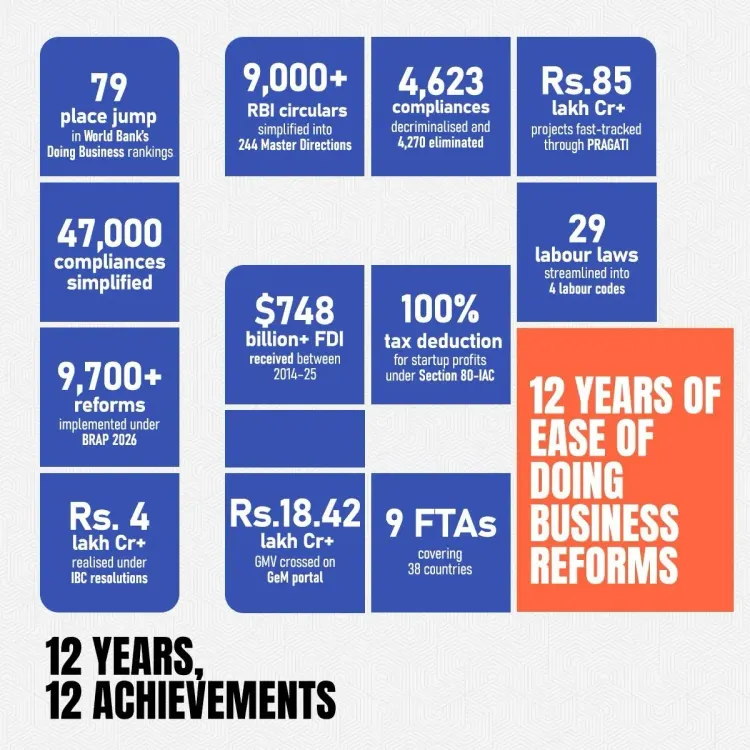
The post highlights reforms including regulatory simplification, labour law consolidation, and measures to attract foreign direct investment .
Key legislative milestones cited span Make in India (2014) , the Insolvency and Bankruptcy Code (2016) , GST (2017) , and four consolidated labour codes (2019-2020) .
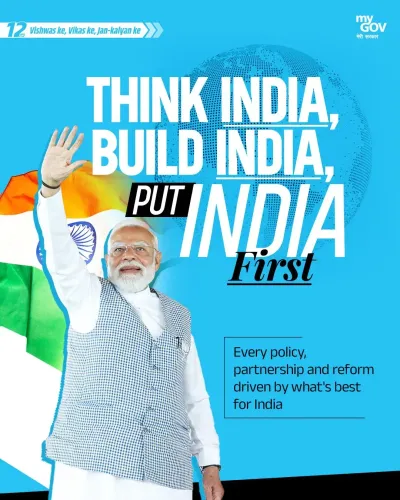
The minister linked the reform record to the government's Viksit Bharat 2047 vision of transforming India into a developed economy by independence's centenary.
Primary beneficiaries highlighted include entrepreneurs, MSMEs , and foreign investors operating in a simplified regulatory environment.
The next Union Budget and Economic Survey are expected to outline the forthcoming phase of the structural reform agenda.
Union Coal and Mines Minister G. Kishan Reddy on Tuesday, 9 June 2026 invoked the hashtag #12YearsOfSeva to mark a dozen years of economic reforms under Prime Minister Narendra Modi, highlighting strides in regulatory simplification, foreign direct investment, and the broader push toward a competitive business environment.
Context
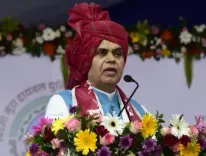
Reddy's post, shared on the twelfth anniversary of the BJP-led National Democratic Alliance government taking office in May 2014, frames the period as one of sustained structural transformation. 'From simplifying thousands of compliances and labour laws to boosting FDI inflows and strengthening ease of doing business,' he wrote, 'these initiatives have laid the foundation for a more competitive, transparent, and future-ready economy.'
The minister, who also serves as BJP's Telangana state president, positioned the anniversary within the ruling party's broader political messaging around governance delivery and economic nationalism.
Policy Backdrop
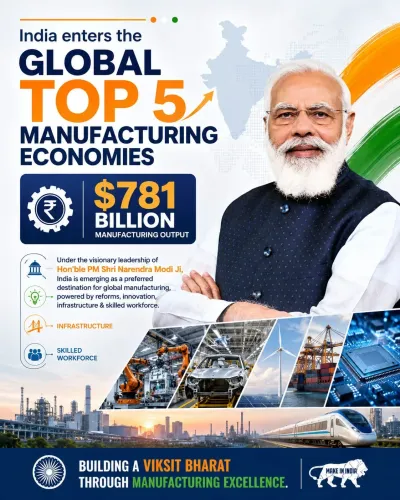
The twelve-year arc of reform referenced by Reddy spans several landmark legislative and administrative overhauls. The Make in India initiative, launched in 2014, sought to reposition the country as a global manufacturing hub. The Insolvency and Bankruptcy Code, enacted in 2016, created a time-bound mechanism for resolving stressed assets, while the Goods and Services Tax, rolled out in 2017, unified India's fragmented indirect tax regime into a single national market.
On the labour front, four labour codes were consolidated between 2019 and 2020, collapsing dozens of legacy statutes into a simplified compliance framework aimed at easing the burden on employers, particularly small businesses. Together, these measures form the policy lineage Reddy's post celebrates.
Stakeholders and Impact
Entrepreneurs, micro, small and medium enterprises (MSMEs), and foreign investors are among the primary constituencies that government spokespersons cite when touting the reform record. Regulatory simplification and digital public infrastructure have been positioned as enabling conditions for both domestic capital formation and global supply-chain integration.
The post also references the Viksit Bharat 2047 vision — the government's official roadmap to transform India into a developed economy by the centenary of independence. Reddy described the journey as one of 'reform, innovation, and inclusive growth,' linking the twelve-year record to this longer-horizon national goal.
What's Next
The government's reform agenda is expected to be further articulated in the forthcoming Union Budget and the accompanying Economic Survey, which typically outline the next phase of structural priorities. Parliamentary progress on the implementing rules under the consolidated labour codes also remains a key policy milestone to watch.
As the NDA government enters its thirteenth year, the political and economic test will be translating the legislative architecture of the past decade into measurable gains in employment, manufacturing's share of GDP, and India's standing in global investment rankings — the metrics against which the Viksit Bharat promise will ultimately be judged.
Point of View
Deploying the BJP's established 'delivery vs. dynasty' political grammar to frame twelve years in office as a record of tangible economic transformation rather than mere incumbency. By anchoring the tribute in specific reform pillars — GST, the IBC, labour codes, Make in India — rather than generic praise, the party signals confidence in its legislative record as an electoral asset. The invocation of Viksit Bharat 2047 is equally deliberate: it projects the reform arc beyond any single term, casting the BJP as the indispensable custodian of a long-horizon national project. For analysts, the interesting question is whether the government's communication strategy will shift from cataloguing past reforms to demonstrating their on-the-ground economic outcomes as the 2047 deadline becomes a more concrete benchmark.
NationPress
20 Sept 2026
Frequently Asked Questions
What is the #12YearsOfSeva hashtag about?
#12YearsOfSeva marks twelve years since the BJP-led NDA government under Prime Minister Narendra Modi came to power in May 2014, with party leaders using the occasion to highlight economic reforms and governance milestones.
What economic reforms did the Modi government introduce in 12 years?
Key reforms include the Make in India initiative (2014), the Insolvency and Bankruptcy Code (2016), the Goods and Services Tax (2017), and the consolidation of dozens of labour statutes into four labour codes between 2019 and 2020.
What is Viksit Bharat 2047?
Viksit Bharat 2047 is the Indian government's official vision to transform India into a fully developed economy by 2047, the centenary of independence, through sustained structural reforms, inclusive growth, and higher manufacturing output.
Who is G. Kishan Reddy?
G. Kishan Reddy is India's Union Minister of Coal and Mines and serves as the BJP's Telangana state president. He is a senior party leader and a member of Parliament.
How have India's ease of doing business reforms affected MSMEs and investors?
Regulatory simplification, digital public infrastructure, and the consolidation of labour laws have been aimed at reducing compliance costs for MSMEs and making India more attractive to domestic and foreign investors, though the precise scale of outcomes continues to be assessed.