Rijiju Hails India's 7.7% GDP Growth, Cites Modi's Reform Push
Synopsis
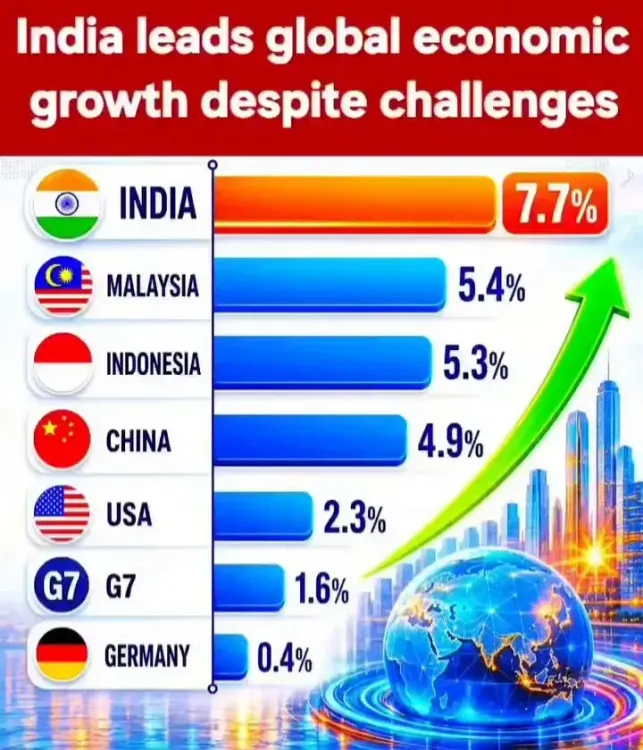
Union Parliamentary Affairs Minister Kiren Rijiju on June 6, 2026 cited India's 7.7% Real GDP and 7.9% GVA growth for FY 2025-26, crediting PM Modi's reform agenda and the 'Reform Express' drive toward Viksit Bharat. The figures, pending official MoSPI confirmation, would place India among the world's fastest-growing major economies.
Key Takeaways
Union Parliamentary Affairs Minister Kiren Rijiju posted on June 6, 2026 highlighting India's economic performance for FY 2025-26 .
India recorded a reported 7.7% Real GDP growth and 7.9% GVA growth for the fiscal year, according to Rijiju's post.
The minister attributed the performance to PM Narendra Modi 's reform agenda, invoking the 'Reform Express' metaphor.
The growth figures are framed as progress toward Viksit Bharat , the government's goal of a developed India by 2047 .
Official confirmation of the figures is awaited from MoSPI ; the Union Budget 2026-27 is the next major policy milestone to watch.
Union Parliamentary Affairs Minister Kiren Rijiju on Saturday, June 6, 2026, cited India's strong economic performance for FY 2025-26, declaring the country a global growth leader and attributing the momentum to Prime Minister Narendra Modi's reform agenda.
Context
Rijiju posted that India recorded a 7.7% Real GDP growth and 7.9% Gross Value Added (GVA) growth in FY 2025-26, describing the figures as evidence that the economy is advancing despite global headwinds. He framed the performance under the metaphor of a 'Reform Express' moving toward the government's long-term development goal of Viksit Bharat — a developed India by 2047. The post, accompanied by a video, was addressed to the minister's social media following and signals the ruling party's intent to foreground economic data in its public communication.
Policy Backdrop
India's growth story has been built on successive reform waves: the landmark 1991 liberalisation, the Make in India initiative launched in 2014, and the Atmanirbhar Bharat package of 2020 that combined fiscal stimulus with structural changes. Since 2014, the government has consistently prioritised infrastructure spending, digital public infrastructure, and production-linked incentive schemes to sustain high-single-digit growth. These measures have positioned India — the world's fifth-largest economy — as one of the fastest-growing major economies through multiple global disruptions, including post-2022 inflation spikes and supply-chain stress.
The Viksit Bharat vision, the central organising theme of the current government's long-term policy, targets transforming India into a fully developed nation by the centenary of independence in 2047. High and sustained GDP growth is treated as a necessary condition for that ambition, making quarterly and annual growth prints politically significant beyond their economic meaning.
Stakeholders and Impact
Strong GDP and GVA numbers carry direct implications for Indian businesses and global investors assessing emerging-market allocations. A 7.7% real GDP print, if confirmed by official estimates, would place India comfortably above the growth rates of most peer economies and reinforce its narrative as an engine of global demand at a time when several large economies face slowdowns. For domestic consumers and workers, sustained GVA growth — which strips out net taxes and is often seen as a closer proxy for productive activity — signals broad-based expansion across agriculture, industry, and services.
The government's communication strategy, with senior ministers like Rijiju amplifying the data, suggests a concerted effort to consolidate investor and voter confidence ahead of the Union Budget 2026-27 cycle and ongoing state-level electoral activity.
What's Next
The official release of FY 2025-26 GDP estimates by the Ministry of Statistics and Programme Implementation (MoSPI) will be the definitive benchmark against which Rijiju's cited figures are assessed. The Union Budget 2026-27 is expected to carry forward the reform agenda, with analysts watching for announcements on capital expenditure targets, fiscal consolidation, and new production-linked incentives. If the growth figures hold in official data, India's positioning as the world's fastest-growing large economy is likely to feature prominently in both domestic policy debates and international economic forums.
Point of View
Designed to anchor the party's governance narrative around hard growth numbers ahead of the budget season. Invoking the 'Reform Express' and Viksit Bharat in the same breath ties short-term data to a decade-long ideological project, reinforcing continuity as a political asset. The choice of GVA alongside GDP is notable — GVA is a more granular indicator of productive output, and citing both suggests an intent to pre-empt criticism that headline GDP flatters actual economic activity. With official MoSPI estimates still pending, the communication also serves as a framing exercise: by the time the data is formally published, the government's interpretive lens is already in place.
NationPress
22 Sept 2026
Frequently Asked Questions
What is India's GDP growth rate for FY 2025-26?
Union Parliamentary Affairs Minister Kiren Rijiju stated that India recorded 7.7% Real GDP growth for FY 2025-26. Official confirmation from MoSPI is awaited.
What is Viksit Bharat?
Viksit Bharat is the Indian government's national goal to transform India into a fully developed nation by 2047, the centenary of independence. It serves as the overarching framework for current economic and social policy.
What is GVA and how does it differ from GDP?
Gross Value Added (GVA) measures the value of goods and services produced in the economy, excluding net taxes. GDP equals GVA plus net taxes on products. GVA is often seen as a closer indicator of actual productive activity across sectors.
Why is Kiren Rijiju talking about GDP growth?
As a senior BJP minister and member of the Union Cabinet, Rijiju regularly communicates government achievements on social media. Highlighting strong GDP data is part of the ruling party's effort to underscore economic progress under PM Modi's leadership.
When will India's official FY 2025-26 GDP data be released?
The official GDP estimates for FY 2025-26 will be published by the Ministry of Statistics and Programme Implementation (MoSPI). No specific date has been announced in the available information.