Rijiju marks 11 years of Digital India, eyes AI and semiconductor push

Synopsis
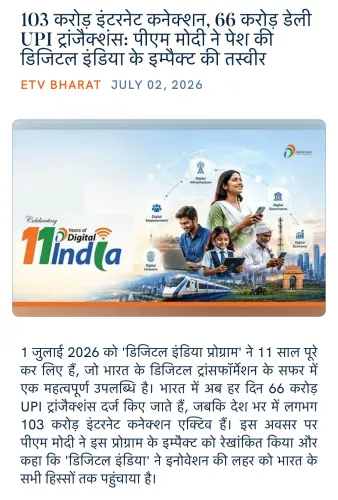
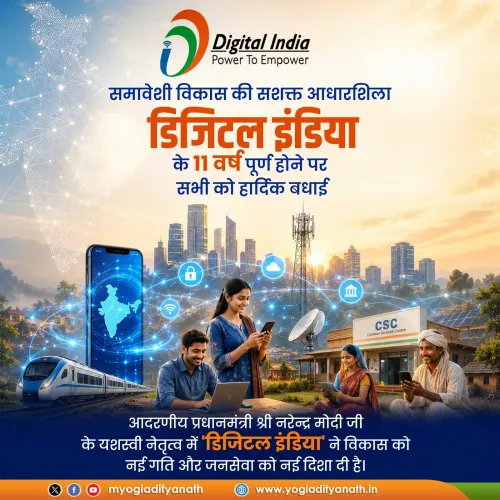
Union Minister Kiren Rijiju on 1 July 2026 marked 11 years of the Digital India programme, crediting PM Modi's leadership for advances in UPI, internet access, AI and semiconductors, and declaring India is on course to become a digital superpower.
Key Takeaways
Union Parliamentary Affairs Minister Kiren Rijiju posted on X on 1 July 2026 to mark the 11th anniversary of Digital India .
The Digital India programme was launched on 1 July 2015 by Prime Minister Narendra Modi to build a digitally empowered society and knowledge economy.
Rijiju highlighted UPI and internet access as flagship achievements of the past decade of digital policy.
The minister pointed to AI, semiconductors , and other emerging technologies as the next frontier for citizen empowerment under the Atmanirbhar Bharat vision.
India's digital policy arc now targets Viksit Bharat — developed-economy status — by 2047 , with semiconductor and AI governance expected in upcoming parliamentary sessions.
Union Parliamentary Affairs Minister Kiren Rijiju on Wednesday, 1 July 2026 marked the 11th anniversary of the Digital India programme, crediting Prime Minister Narendra Modi's leadership for what he described as a digital revolution transforming the country's economy and citizen services.
Context
Rijiju posted in Hindi on X, writing: 'Atmanirbhar Bharat, ban raha hai Digital Bharat' ('Self-reliant India is becoming Digital India'). He said the Digital India initiative, launched 11 years ago under Modi's leadership, has today brought about a digital revolution in India. The minister specifically highlighted internet access and UPI (Unified Payments Interface) as emblematic achievements of this decade-long push.
Rijiju further noted that the country is now empowering citizens through AI, semiconductors, and other emerging technologies, and declared that 'India is moving towards becoming a digital superpower.' The post carried hashtags #DigitalIndia, #11YearsOfDigitalIndia, #ViksitBharat, and #NewIndia.
Policy Backdrop
The Digital India programme was formally launched on 1 July 2015 by Prime Minister Narendra Modi with the stated goal of creating a digitally empowered society and a knowledge economy. In the years since, the government rolled out a suite of digital public goods — most notably Aadhaar-linked services and the Unified Payments Interface (UPI), introduced in 2016 by the National Payments Corporation of India — that have reshaped financial inclusion and administrative delivery at scale.
The broader Atmanirbhar Bharat vision, announced in 2020, extended this digital ambition into manufacturing self-reliance, encompassing technology hardware, semiconductors, and data infrastructure. Policy emphasis has since shifted progressively from basic connectivity toward high-end domains including artificial intelligence and chip fabrication, aligning with the government's stated goal of achieving developed-economy status by 2047 under the Viksit Bharat framework.
Stakeholders and Impact
The primary beneficiaries of the Digital India decade have been Indian citizens — particularly those in rural and semi-urban areas — who gained access to government services, digital payments, and internet connectivity that were previously out of reach. The technology industry has simultaneously grown into a key economic pillar, with India now among the world's largest markets for mobile internet and real-time digital payments.
The pivot toward semiconductors and AI signals the next phase of this arc: moving India from a consumer and services hub to a producer of frontier technology. Domestic chip fabrication policy and an emerging AI regulatory framework are expected to feature in upcoming parliamentary sessions as the government seeks to institutionalise these ambitions.
What's Next
The monsoon session of Parliament is expected to see debates on semiconductor policy implementation and the contours of any new AI governance framework. Rijiju's post, timed precisely to the programme's anniversary, signals that the ruling dispensation intends to keep the Digital India narrative central to its political and policy communication ahead of those legislative discussions. The trajectory — from rural internet access to AI and chip sovereignty — will be closely watched by the technology industry and opposition alike.
Point of View
Timed to the exact date of the Digital India launch to reinforce the BJP government's decade-long technology narrative ahead of the monsoon session. By yoking UPI's mass-market success to the more aspirational domains of AI and semiconductors, the minister is attempting to bridge a proven track record with a forward-looking growth story. The framing under 'Atmanirbhar Bharat' and 'Viksit Bharat' positions digital policy not merely as administrative reform but as an instrument of national sovereignty and economic ambition. Whether Parliament translates that ambition into concrete semiconductor and AI legislation will be the real test of the narrative's substance.
NationPress
30 Sept 2026
Frequently Asked Questions
When was Digital India launched and by whom?
The Digital India programme was formally launched on 1 July 2015 by Prime Minister Narendra Modi to create a digitally empowered society and knowledge economy.
What is UPI and when did it start?
UPI (Unified Payments Interface) is a real-time digital payment system introduced in 2016 by the National Payments Corporation of India ; it has since become one of the world's largest instant-payment platforms.
What did Kiren Rijiju say about Digital India?
On 1 July 2026 , Rijiju posted on X saying the Digital India initiative has brought a digital revolution to India and that the country is now moving towards becoming a digital superpower through AI, semiconductors and other emerging technologies.
What is Atmanirbhar Bharat?
Atmanirbhar Bharat ('Self-reliant India') is an economic vision announced in 2020 that encompasses technology, manufacturing and digital sectors, aiming to reduce import dependence and build domestic capability.
What is India's next step in digital policy after Digital India?
India's policy focus is shifting toward AI governance, semiconductor fabrication , and advanced data infrastructure under the Viksit Bharat framework, targeting developed-economy status by 2047 . Parliamentary debates on semiconductor policy and AI regulation are expected in the monsoon session.