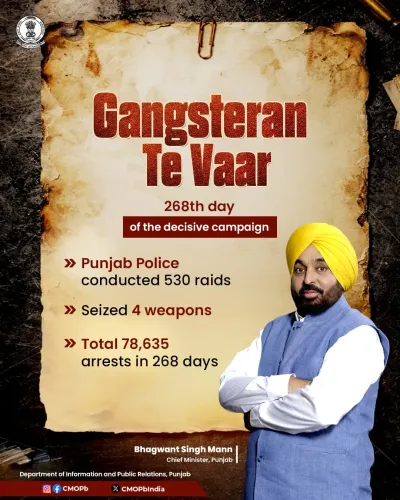
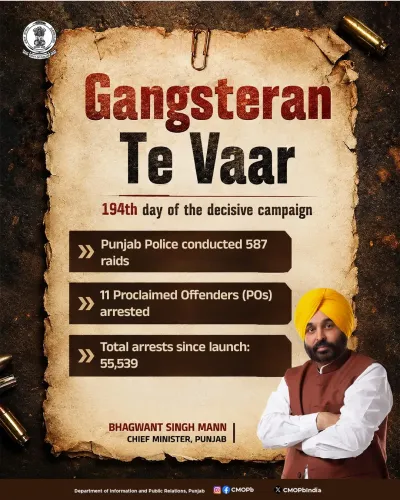
Punjab Police hit Day 297 of 'Gangsteran Te Vaar' with 525 raids

Synopsis
On Day 297 of the 'Gangsteran Te Vaar' campaign, Punjab Police executed 525 raids at gangster-linked locations, arrested individuals, recovered six weapons, and pushed the drive's cumulative arrest total to 84,072.
Key Takeaways
525 raids were conducted on Day 297 of the 'Gangsteran Te Vaar' anti-gangster campaign across Punjab.
Police teams arrested individuals and recovered six weapons during Saturday's operations.
Cumulative arrests since the campaign's launch have reached 84,072 .
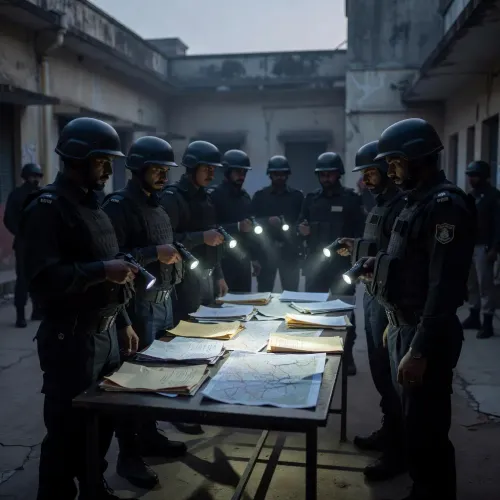
Raids target pre-identified and mapped locations linked to associates of wanted gangsters — an intelligence-led approach.
The campaign has run continuously for nearly ten months , reflecting the state government's framing of gangsterism as a governance emergency.
Daily data releases by the Chief Minister's Office of Punjab embed public accountability into the operation's design.
Nearly ten months in and still swinging hard — Punjab Police marked Day 297 of the state's sustained anti-gangster offensive with 525 raids at locations linked to associates of wanted gangsters across the state, the Chief Minister's Office of Punjab announced on Saturday, 14 November 2026. The day's operations added fresh arrests and yielded six recovered weapons, pushing the campaign's cumulative arrest tally to a striking 84,072 since the drive began.
297 days, 84,000-plus arrests — the scale of 'Gangsteran Te Vaar'
The campaign, titled 'Gangsteran Te Vaar' — Punjabi for 'Strike Against Gangsters' — has become one of the most prolonged and numerically intensive anti-organised-crime offensives in the state's recent policing history. Running every day without pause, it has amassed more than 84,000 arrests and conducted raids measured in the hundreds on a single day alone. Saturday's 525 raids were executed at pre-identified and mapped locations, underscoring that this is an intelligence-led operation rather than a reactive sweep.
The recovery of six weapons on Day 297 continues a pattern of steady arms seizures that authorities say disrupts the supply chains gangster networks depend on. Punjab's gangs have historically operated at the intersection of drug trafficking and organised violence, making weapons recoveries a core metric of success.
Why Punjab made gangsterism a governance emergency
Punjab has grappled with organised crime that runs disturbingly parallel to its drug-trafficking crisis — two problems that frequently share the same networks, the same corridors, and the same backers. Extortion calls to businesspeople, targeted killings, and cross-border criminal links have repeatedly made headlines, forcing successive state governments to treat gangsterism not as a law-and-order footnote but as a governance emergency demanding sustained, structured police action.
The mapped-raid model — identifying associate locations, logging them, and then hitting them in coordinated waves — reflects a shift from reactive policing toward network disruption. Arresting a gangster's associate, seizing a stashed weapon, or raiding a safe house does not make front-page news on its own. Do it 84,000 times over 297 days, however, and the cumulative pressure on a criminal ecosystem becomes structural, not incidental.
What daily updates signal about Punjab's policing strategy
The CMO's decision to publish daily operational data — raid counts, arrests, recoveries — is itself a governance signal. Transparency on numbers builds public accountability into the campaign's architecture: if the raids stop or the numbers plateau, the data makes it visible. It also frames the anti-gangster drive as a living, breathing priority of the state government rather than a one-off crackdown that fades from view.
With cumulative arrests crossing 84,000 and daily raids still numbering in the hundreds, the question now is whether the intensity translates into a measurable, durable drop in gang-linked violence and extortion across Punjab's districts — the number that ultimately matters most to the people living inside this campaign's reach.
Point of View
Data-driven network attrition. Publishing daily operational metrics is both a governance tool and a political statement, tying the ruling dispensation's credibility directly to the trajectory of the numbers. With cumulative arrests crossing 84,000, the campaign's real test is whether courtroom outcomes and ground-level crime indices validate the arrest volume, or whether critics begin questioning the depth of enforcement behind the headline figures. Either way, the model is being watched as a template for how Indian state governments can sustain political will on organised crime over the long arc of a full term.
NationPress
14 Nov 2026
Frequently Asked Questions
What is the 'Gangsteran Te Vaar' campaign in Punjab?
'Gangsteran Te Vaar' — Punjabi for 'Strike Against Gangsters' — is a sustained Punjab Police anti-organised-crime offensive targeting gangsters and their associate networks across the state through daily intelligence-led raids, arrests, and weapons seizures.
How many arrests have been made under Gangsteran Te Vaar?
As of Day 297, the total arrests under the campaign have reached 84,072 since the drive was launched.
How many raids did Punjab Police conduct on Day 297?
Punjab Police conducted 525 raids at identified and mapped locations linked to associates of gangsters across the state on Day 297 of the campaign.
Why is Punjab particularly affected by organised gangsterism?
Punjab's gangster problem is closely intertwined with drug trafficking networks and cross-border criminal links. Extortion, targeted violence, and organised crime have made gangsterism a persistent public-order challenge that successive state governments have treated as a governance priority.
What weapons were recovered during Day 297 of Gangsteran Te Vaar?
Punjab Police recovered six weapons during the Day 297 operations, continuing a pattern of arms seizures aimed at disrupting the supply chains that gangster networks rely on.