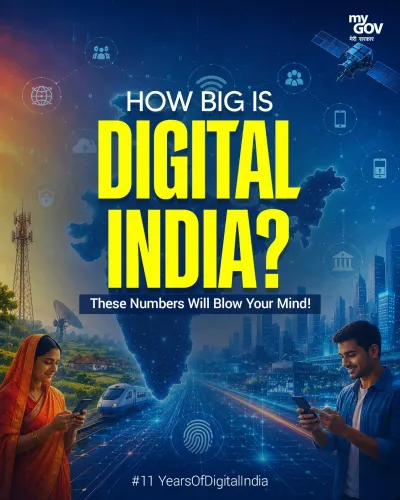
Rajnath Singh marks 11 years of Digital India, hails Modi's vision
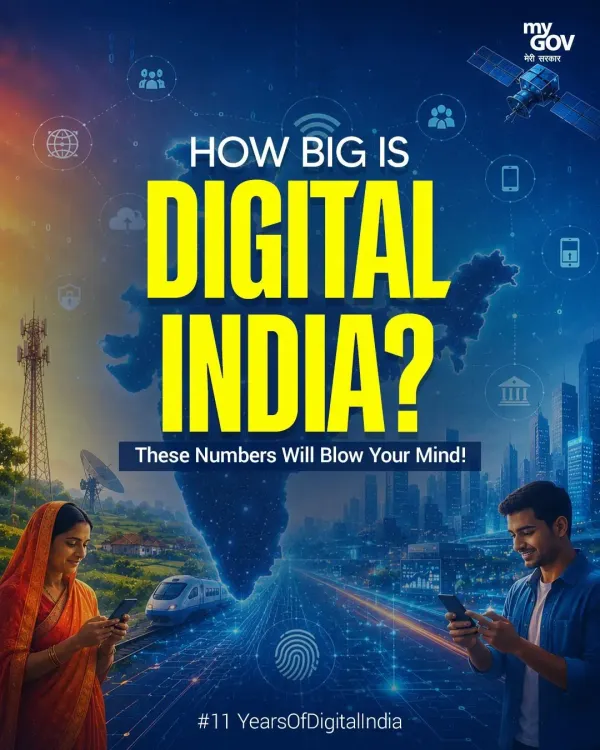
Synopsis
Union Defence Minister Rajnath Singh marked the eleventh anniversary of Digital India on 1 July 2026, crediting PM Modi's flagship programme with transforming governance, expanding financial inclusion, and positioning India as a global technology leader pursuing AI, semiconductors, and quantum computing.
Key Takeaways
Digital India completes 11 years on 1 July 2026 , having been launched by PM Narendra Modi on 1 July 2015.
Union Defence Minister Rajnath Singh hailed the programme as a 'transformative force' driving inclusive growth through technology.
India has built one of the world's largest Digital Public Infrastructure ecosystems, anchored by Aadhaar , UPI , and Jan Dhan accounts.
Singh highlighted advances in Artificial Intelligence , semiconductors , and quantum computing as markers of India's global technology leadership.
The programme is framed as a cornerstone of the Viksit Bharat vision — India's goal of becoming a developed nation by 2047 .
Upcoming milestones include rollouts under the IndiaAI Mission and India Semiconductor Mission , and new data protection legislation.
Union Defence Minister Rajnath Singh on Wednesday, 1 July 2026 marked the eleventh anniversary of the Digital India programme, calling it a transformative initiative that has reshaped the nation's digital landscape and ushered in citizen-centric governance. Singh credited the programme's launch to Prime Minister Narendra Modi, describing it as a cornerstone of India's march towards a developed nation.
Context
The Digital India programme was formally launched on 1 July 2015 by Prime Minister Narendra Modi as a flagship initiative to integrate technology into governance and service delivery. Built around nine pillars — including broadband highways, e-governance, and electronic manufacturing — it was designed to deliver public services electronically and create a digitally empowered society. The programme completes eleven years on this date, prompting senior government leaders across the Union Cabinet to mark the occasion.
Singh, in his post on X, stated that Digital India has 'emerged as a transformative force, driving inclusive growth through technology and innovation.' He noted that India has built 'one of the world's largest Digital Public Infrastructure ecosystems,' revolutionising public service delivery, expanding financial inclusion, and making governance 'more transparent, efficient, and accessible.'
Policy Backdrop
The programme's foundation rests on a triad of large-scale digital public infrastructure: Aadhaar (the biometric identity system), the Unified Payments Interface (UPI), and Jan Dhan bank accounts. Together, these systems enabled direct benefit transfers, reduced leakage in welfare delivery, and brought millions of unbanked citizens into the formal financial system. These platforms have since been presented internationally as replicable models for other developing economies.
Singh's post also highlighted India's advances in frontier technologies — specifically Artificial Intelligence, semiconductors, and quantum computing — as evidence of the country's growing stature as a global technology leader. These areas are currently being pursued under dedicated national missions, including the IndiaAI Mission and the India Semiconductor Mission, which aim to build domestic computing capacity and chip fabrication infrastructure.
Stakeholders and Impact
The beneficiaries of Digital India span Indian citizens, digital service providers, and government departments at the central and state levels. The programme's push for financial inclusion has been particularly significant in rural and semi-urban areas, where digital payments and e-governance portals have reduced dependence on physical infrastructure. For technology companies and startups, the Digital Public Infrastructure stack has provided a foundation on which new services — from fintech to agritech — have been built.
Singh linked the programme explicitly to the government's overarching Viksit Bharat vision — a national goal of achieving developed-country status by 2047. He described Digital India as 'a cornerstone of national progress, empowering every citizen with greater opportunity, connectivity, and the transformative benefits of technology.' The framing positions digital infrastructure not merely as a service-delivery tool but as a driver of economic competitiveness and social equity.
What's Next
Attention in the coming months will be on rollout milestones under the IndiaAI Mission and the India Semiconductor Mission, including the commissioning of new fabrication units and the expansion of AI computing capacity. Parliamentary proceedings on proposed data protection and digital personal data rules will also shape the regulatory environment within which the next phase of Digital India unfolds. As the programme enters its twelfth year, the government's ability to translate frontier-technology ambitions into verifiable industrial and social outcomes will be the key test of Digital India's next chapter.
Point of View
Signalling a deliberate, party-wide messaging exercise rather than a departmental statement. The explicit linkage to frontier technologies such as AI and semiconductors is designed to shift the programme's identity from a service-delivery initiative to a national competitiveness story. This framing will face scrutiny as India's semiconductor fabrication and AI infrastructure ambitions move from policy announcements to measurable industrial output.
NationPress
30 Sept 2026
Frequently Asked Questions
When was Digital India launched and by whom?
Digital India was launched on 1 July 2015 by Prime Minister Narendra Modi as a flagship programme to integrate technology into governance and deliver public services electronically.
What did Rajnath Singh say about Digital India on its 11th anniversary?
Union Defence Minister Rajnath Singh said Digital India has emerged as a 'transformative force' driving inclusive growth, built one of the world's largest Digital Public Infrastructure ecosystems, and positioned India as a global leader in AI, semiconductors, and quantum computing.
What is the Viksit Bharat vision and how does Digital India relate to it?
Viksit Bharat is the government's vision to make India a developed nation by 2047 . Digital India is described as a cornerstone of this vision, providing the connectivity and technology infrastructure needed to achieve inclusive economic growth.
What is India's Digital Public Infrastructure?
India's Digital Public Infrastructure refers to the ecosystem built around Aadhaar (biometric identity), UPI (Unified Payments Interface), and Jan Dhan bank accounts, which together enable direct benefit transfers, digital payments, and e-governance at scale.
What are the next big milestones for India's digital programme?
Key upcoming milestones include rollout targets under the IndiaAI Mission and the India Semiconductor Mission — covering AI computing capacity and chip fabrication — as well as the passage of new digital personal data protection rules in Parliament.