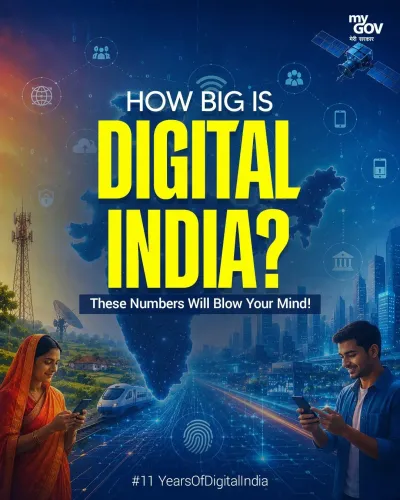
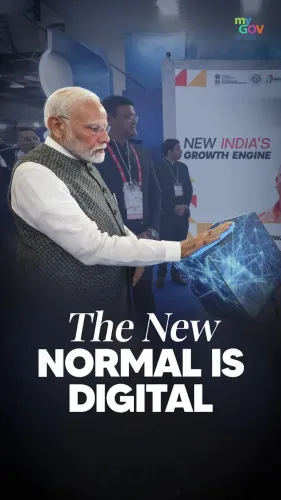
CM Rekha Gupta Marks 11 Years of Digital India
Synopsis
Delhi Chief Minister Rekha Gupta marked the 11th anniversary of the Digital India programme on 1 July 2026, praising PM Modi's leadership for overhauling governance through Direct Benefit Transfer, UPI, and digital literacy, and framing the milestone as a step toward the Viksit Bharat vision.
Key Takeaways
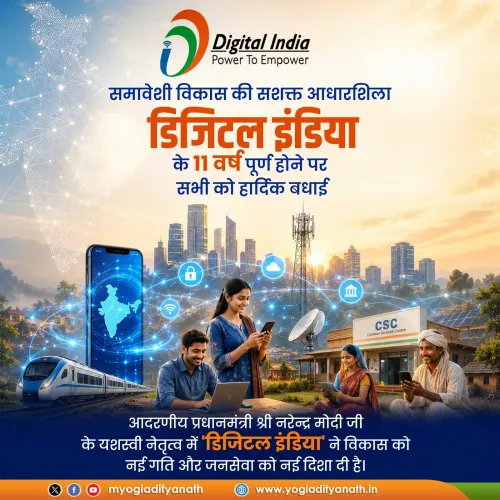
Delhi CM Rekha Gupta posted on 1 July 2026 to mark 11 years of the Digital India programme , launched on 1 July 2015 .
She credited PM Narendra Modi's leadership for eliminating middlemen through the Direct Benefit Transfer (DBT) mechanism, which routes welfare payments directly to beneficiaries' bank accounts.
UPI (Unified Payments Interface) was highlighted as a global benchmark, with CM Gupta stating India's digital payments system is 'setting standards for the world.' The programme's stated goals of transparency and ease of living have been advanced through expanded digital literacy and wider technology access.
CM Gupta linked the milestone to the Viksit Bharat vision, framing digital empowerment as central to India's developed-nation ambitions.
The post is part of a wider #11YearsOfDigitalIndia commemorative push across the ruling party's network.
Delhi Chief Minister Rekha Gupta on Wednesday, 1 July 2026, marked the 11th anniversary of the Digital India programme, crediting Prime Minister Narendra Modi's leadership for transforming governance and citizen services over the past decade through digital infrastructure, direct benefit transfers, and expanded digital literacy.
Context
In her post, CM Gupta wrote: 'डिजिटल इंडिया अभियान आज अपनी सफलता के 11 गौरवशाली वर्ष पूर्ण कर रहा है' — ('The Digital India campaign today completes 11 glorious years of success'). She highlighted how the initiative has reshaped governance by eliminating middlemen and ensuring direct transfer of benefits to citizens.
The Digital India programme was formally launched on 1 July 2015 by the central government with the stated aim of advancing e-governance, building digital infrastructure, and promoting digital literacy across the country. The anniversary falls on the exact date of the programme's inception, making the milestone a significant marker for the ruling party.
Policy Backdrop
A central pillar of the programme has been the Direct Benefit Transfer (DBT) mechanism, which routes government subsidies and welfare payments directly into beneficiaries' bank accounts, bypassing intermediary layers. The DBT framework began rolling out from 2013 onward, initially covering LPG subsidies before expanding to a wide range of welfare schemes.
Alongside DBT, India's Unified Payments Interface (UPI) — developed by the National Payments Corporation of India — has emerged as a flagship product of the digital public infrastructure stack. CM Gupta specifically noted that India's digital payments system and e-governance architecture are now 'setting standards for the world,' positioning UPI as a global benchmark for real-time, bank-to-bank transfers.
The broader digital infrastructure built over this period combines Aadhaar-based identity, nationwide broadband networks, and payments rails to streamline service delivery — a stack that has been presented as a model for financial inclusion and administrative efficiency that other nations could replicate.
Stakeholders and Impact
CM Gupta emphasised that the programme has worked to connect the person 'standing on the last rung of society' ('समाज के अंतिम पायदान पर खड़े व्यक्ति') to the mainstream of development. The primary beneficiaries span hundreds of millions of Indian citizens who access welfare payments, banking services, and government programmes through digital channels.
Digital literacy expansion has been cited as a key enabler, allowing citizens in rural and semi-urban areas to participate in the digital economy. The twin goals of transparency and ease of living ('सुगमता एवं पारदर्शिता') have been central to the programme's stated public rationale since its launch.
What's Next
CM Gupta framed the 11-year milestone as part of the larger Viksit Bharat ('Developed India') vision, saying the journey of digital empowerment is 'providing new energy to the resolve of a developed India.' The post carries the hashtag #11YearsOfDigitalIndia, indicating a coordinated commemorative push across the ruling party's political network on this date.
Going forward, continued integration of UPI with additional government services and potential new phases of digital literacy or broadband programmes — likely to be signalled in upcoming Union Budget announcements — will determine the next chapter of India's digital public infrastructure story.
Point of View
Using a programme anniversary to reinforce the BJP's core governance narrative around technology-led welfare delivery and anti-corruption. The emphasis on DBT and UPI as middleman-eliminating tools is a recurring motif in the ruling party's communication strategy, designed to draw a sharp contrast with the pre-2014 era of subsidy leakages. By invoking Viksit Bharat, Gupta ties a decade-old scheme to a forward-looking electoral promise, signalling that digital infrastructure will remain central to the BJP's development pitch. The coordinated hashtag suggests this is less a spontaneous tribute and more a disciplined party-wide communication exercise around a milestone the BJP regards as electorally resonant.
NationPress
30 Sept 2026
Frequently Asked Questions
When was Digital India launched and how many years has it completed?
The Digital India programme was formally launched on 1 July 2015 and completed 11 years on 1 July 2026.
What did Delhi CM Rekha Gupta say about Digital India?
CM Rekha Gupta said Digital India has reshaped governance and citizen services over 11 years, eliminated middlemen through Direct Benefit Transfer, expanded digital literacy, and positioned India's UPI as a global standard for digital payments.
What is Direct Benefit Transfer (DBT) in India?
Direct Benefit Transfer (DBT) is a government mechanism that transfers subsidies and welfare payments directly into beneficiaries' bank accounts, bypassing intermediaries to reduce leakages. It began rolling out from 2013, initially for LPG subsidies.
Why is UPI considered a global benchmark?
UPI (Unified Payments Interface), developed by the National Payments Corporation of India, enables instant real-time bank-to-bank transfers and has been adopted or studied by several countries as a model for national digital payments infrastructure.
What is Viksit Bharat and how does it relate to Digital India?
Viksit Bharat ('Developed India') is the central government's long-term vision for India to become a fully developed nation. CM Gupta linked Digital India's 11-year journey to this goal, framing digital empowerment as a foundational pillar of the vision.