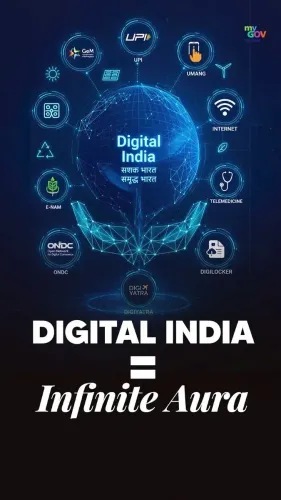
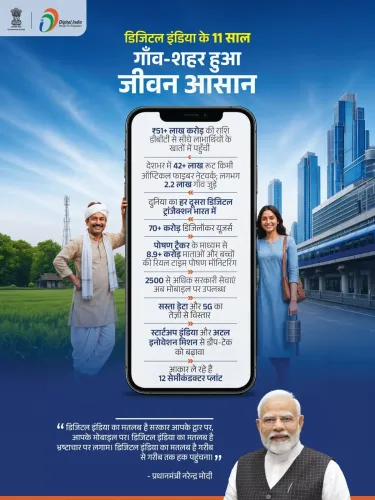
PM Modi marks 11 years of Digital India, hails digital empowerment
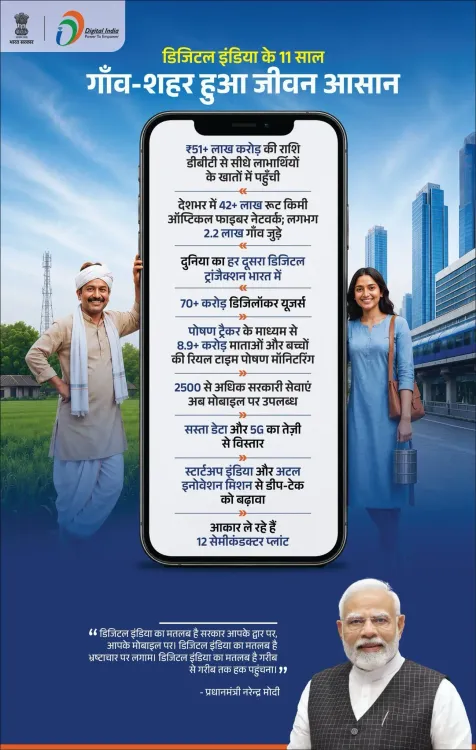
Synopsis
Prime Minister Narendra Modi on 1 July 2026 marked 11 years of the Digital India programme, calling it the foundation of a self-reliant and developed India and highlighting optical fibre expansion and the rise of digital transactions as defining achievements of the initiative.
Key Takeaways
Digital India completed 11 years on 1 July 2026 , having been launched by PM Modi on 1 July 2015.
PM Modi described the programme as the 'strong foundation of a developed and self-reliant India,' linking it to the Viksit Bharat and Atmanirbhar Bharat frameworks.
BharatNet has been the primary vehicle for extending optical fibre connectivity to gram panchayats in rural India.
UPI , introduced in 2016 , has enabled real-time digital transactions and is credited with expanding financial inclusion among marginalised households and small merchants.
The government frames digital public infrastructure as foundational to reducing welfare leakages through Aadhaar-linked direct benefit transfers.
Updated BharatNet Phase-III progress reports and Digital India impact assessments are anticipated ahead of the next Union Budget .
Prime Minister Narendra Modi on Wednesday, 1 July 2026, marked the 11th anniversary of the Digital India programme, calling it the 'strong foundation of a developed and self-reliant India' and crediting it with empowering the poor and marginalised while easing the daily lives of citizens across the country.
In a post on X, Prime Minister Modi wrote in Hindi: 'Digital India vikasit aur atmanirbhar Bharat ki sashakt neenv hai' ('Digital India is the strong foundation of a developed and self-reliant India'). He highlighted that over the past 11 years, the initiative has played a 'crucial role in empowering the poor and the deprived' and has made life easier for the people of the country, citing the expansion of the optical fibre network and the rise of digital transactions as landmark achievements.
Context
The Digital India programme was formally launched by Prime Minister Modi on 1 July 2015, with the stated aim of transforming India into a digitally empowered society and knowledge economy. Its three core pillars were digital infrastructure as a utility for every citizen, governance and services on demand, and digital empowerment of citizens. The anniversary falls as the government continues to position digital public infrastructure as central to its broader development agenda.
The programme's decade-plus run has seen a significant expansion of broadband connectivity under BharatNet, the government project to connect gram panchayats with high-speed optical fibre, and the rapid mainstreaming of the Unified Payments Interface (UPI), introduced in 2016 by the National Payments Corporation of India (NPCI), which enabled real-time digital transactions across banks and payment applications.
Policy Backdrop
BharatNet, whose Phase-I was approved as far back as 2011 and substantially scaled up under Digital India, has sought to bridge the rural-urban digital divide by laying optical fibre to villages. The programme has been a key vehicle for delivering Aadhaar-linked direct benefit transfers, reducing leakages in welfare schemes and extending financial services to previously unbanked households.
The Digital India initiative sits within the larger Atmanirbhar Bharat (self-reliant India) and Viksit Bharat (developed India) policy frameworks that successive Union Budgets have reinforced. The government has consistently linked broadband expansion, digital payments and e-governance to financial inclusion and economic self-reliance, treating digital public infrastructure as foundational rather than supplementary to service delivery.
Stakeholders and Impact
The primary beneficiaries identified by the government are rural citizens, marginalised households, and small merchants, for whom digital connectivity and cashless payment rails have reduced dependence on physical banking infrastructure. UPI in particular has enabled micro-transactions at the village level, while BharatNet has brought broadband access to gram panchayats that previously had little or no connectivity.
India's state-led digitalisation model has drawn international attention as an example of a large emerging economy using digital public infrastructure to leapfrog traditional infrastructure gaps, with comparable drives seen in several other developing nations seeking similar outcomes in financial inclusion and e-governance.
What's Next
Observers will watch for updated BharatNet Phase-III progress reports and fresh Digital India impact assessments, which are expected ahead of the next Union Budget. The anniversary messaging from the Prime Minister signals that digital infrastructure will remain a centrepiece of the government's communication and policy priorities in the months ahead, with the Viksit Bharat goal providing the overarching narrative frame.
Point of View
Tying a decade-old programme to the forward-looking Viksit Bharat and Atmanirbhar Bharat narratives that define the BJP government's second-decade identity. By foregrounding the empowerment of the poor and marginalised, the messaging attempts to convert a technology policy milestone into a social-equity story, broadening its electoral resonance beyond urban, digitally literate audiences. The timing — on the exact launch anniversary — reflects a disciplined communications strategy that uses programme milestones to reinforce governance credibility. With BharatNet Phase-III and the next Union Budget on the horizon, this post also serves as a soft signal that digital infrastructure investment will remain a headline priority.
NationPress
30 Sept 2026
Frequently Asked Questions
When was Digital India launched and by whom?
The Digital India programme was launched on 1 July 2015 by Prime Minister Narendra Modi with the goal of transforming India into a digitally empowered society and knowledge economy.
What is BharatNet and what does it do?
BharatNet is a government project to connect all gram panchayats across India with high-speed optical fibre broadband, aimed at bridging the rural-urban digital divide. Its Phase-I was approved in 2011 and it was significantly expanded under the Digital India programme.
What is UPI and how does it relate to Digital India?
UPI (Unified Payments Interface) is a real-time digital payments system introduced in 2016 by the National Payments Corporation of India (NPCI) . It is a core achievement of the Digital India era, enabling cashless transactions for citizens, small merchants and rural households.
What did PM Modi say about Digital India on its 11th anniversary?
PM Modi said Digital India is the 'strong foundation of a developed and self-reliant India,' crediting it with empowering the poor and the deprived over the past 11 years and highlighting optical fibre expansion and digital transactions as key successes.
How does Digital India connect to Atmanirbhar Bharat and Viksit Bharat?
The government positions Digital India as foundational infrastructure for both the Atmanirbhar Bharat (self-reliant India) and Viksit Bharat (developed India) frameworks, arguing that broadband access, digital payments and e-governance reduce welfare leakages and drive economic self-reliance.