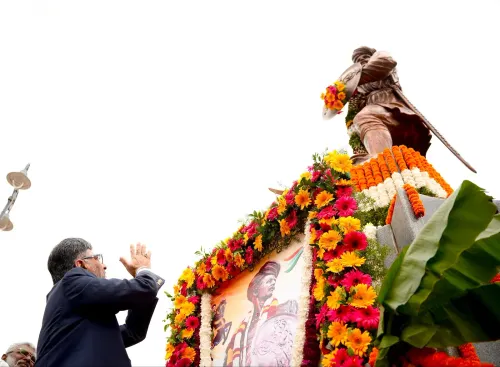
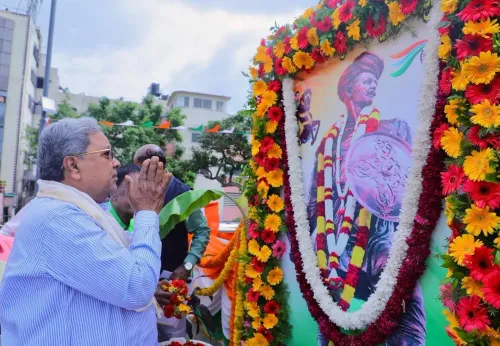
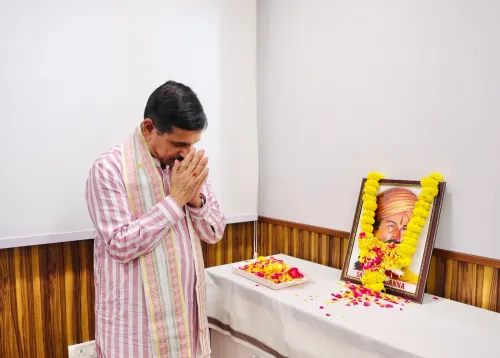
CM Siddaramaiah Pays Tribute to Sangolli Rayanna on Birth Anniversary
Synopsis
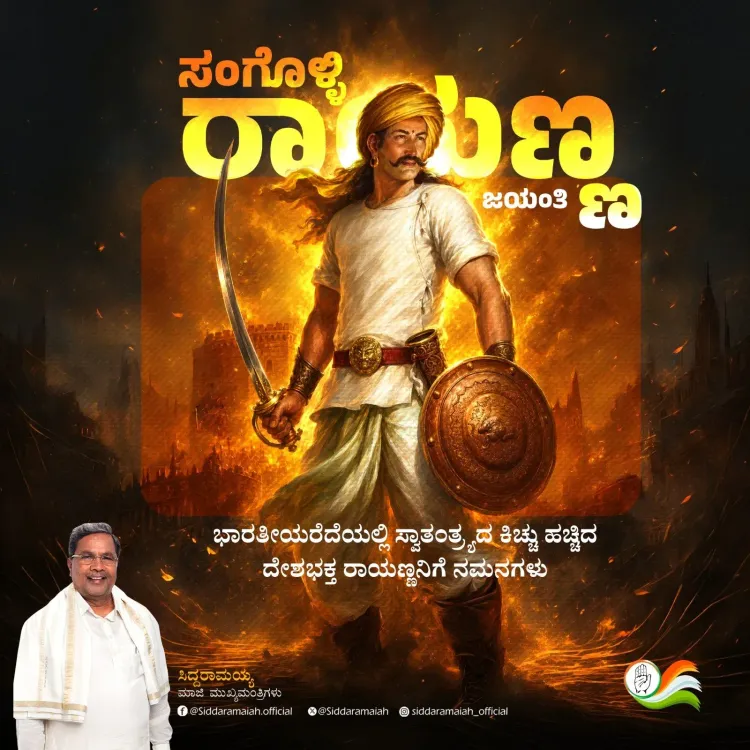
Karnataka Chief Minister Siddaramaiah marked Independence Day by honouring Sangolli Rayanna, the 19th-century Kittur commander hanged by the British, calling him a timeless symbol of sacrifice and patriotism whose selfless spirit will inspire generations.
Key Takeaways
Karnataka CM Siddaramaiah paid tribute to Sangolli Rayanna on 15 August 2026 , India's Independence Day.
Rayanna was a 19th-century commander who led armed resistance against the British East India Company in the 1820s–1830s and was executed by hanging.
Siddaramaiah described Rayanna as 'the symbol of sacrifice and martyrdom' who led Indians 'towards the light called freedom.' The tribute was posted in Kannada, connecting Karnataka's regional history to the national Independence Day narrative.
Rayanna's resistance predates the 1857 uprising, making him one of India's earliest documented armed freedom fighters.
On India's Independence Day, 15 August, Karnataka Chief Minister Siddaramaiah paused to honour a warrior who never lived to see freedom — Sangolli Rayanna, the 19th-century rebel who chose the gallows over surrender, and whose defiance against the British Empire remains one of Karnataka's most enduring stories of sacrifice.
Writing in Kannada, the Chief Minister described Rayanna as a symbol of selfless devotion and martyrdom — 'tyaga mattu balidanada sanketa' (the symbol of sacrifice and martyrdom) — who 'led Indians languishing in the darkness of slavery towards the light called freedom.' He added that Rayanna's patriotism and spirit of dedication 'will inspire us for many more centuries to come.'
Who Was Sangolli Rayanna — and Why Karnataka Remembers
Sangolli Rayanna was a commander in the service of the Kittur kingdom in present-day northern Karnataka. After the British East India Company annexed Kittur following the death of its ruler, Rayanna mounted a sustained armed resistance through the 1820s and 1830s — organising guerrilla raids and refusing to accept colonial authority. The British captured him and executed him by hanging, a death he reportedly met without flinching.
That image — a man who 'proudly offered his neck to the noose of the British autocratic empire,' as Siddaramaiah put it — has made Rayanna an icon of pre-1857 resistance, long before the better-known uprisings entered national memory. In Karnataka, his birthday is observed as an occasion to reaffirm the state's distinct contribution to India's freedom struggle.
A Tribute Timed to the Nation's Biggest Day
The timing is deliberate. Issuing the tribute on Independence Day rather than on a quieter calendar date amplifies its resonance, weaving a regional martyr's story into the national moment of reflection. Indian chief ministers regularly mark such anniversaries — particularly those of fighters who predate the Gandhian era — as a way of grounding the abstract idea of national freedom in local, tangible sacrifice.
For Karnataka, Rayanna occupies the same cultural space that figures like Bhagat Singh or Tipu Sultan do in other states: a fighter whose end was violent, whose cause was just, and whose memory the state claims as its own.
Nearly two centuries after Sangolli Rayanna walked to the gallows, a Chief Minister invokes his name on the day the nation celebrates what he never lived to see — a reminder that independence was paid for in instalments, long before 1947.
Point of View
Invoking figures like Rayanna serves a dual purpose: reinforcing the party's self-image as the custodian of India's pluralist freedom struggle while also deepening its roots in Kannada pride. The choice of Rayanna — a subaltern warrior, not an elite nationalist — also carries a quiet ideological signal about whose sacrifices the state chooses to remember. As identity politics intensifies across Indian states, such tributes are increasingly a form of soft governance.
NationPress
30 Sept 2026
Frequently Asked Questions
Who was Sangolli Rayanna?
Sangolli Rayanna was a 19th-century Karnataka freedom fighter and commander of the Kittur kingdom who led armed guerrilla resistance against the British East India Company in the 1820s–1830s. He was captured and executed by hanging by the British.
Why is Sangolli Rayanna famous in Karnataka?
Rayanna is celebrated in Karnataka as one of India's earliest armed resistors to British colonial rule, predating the 1857 uprising. His defiance and martyrdom have made him a symbol of Kannada pride and regional identity.
What did CM Siddaramaiah say about Sangolli Rayanna?
Siddaramaiah called Rayanna 'the symbol of sacrifice and martyrdom' who 'proudly offered his neck to the noose of the British autocratic empire' and said his patriotism would inspire people for many more centuries.
When is Sangolli Rayanna's birth anniversary?
Sangolli Rayanna's birth anniversary falls on 15 August, which coincides with India's Independence Day, giving the occasion added national significance.
What was the Kittur kingdom?
Kittur was a princely kingdom in present-day northern Karnataka. After the British East India Company annexed it, Sangolli Rayanna led resistance on behalf of the kingdom, becoming one of the earliest fighters against British rule in the region.