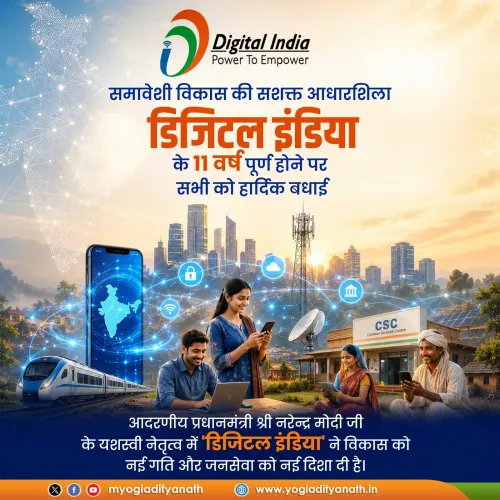
Gadkari hails 11 years of Digital India under PM Modi

Synopsis
Union Minister Nitin Gadkari marked 11 years of Digital India on 1 July 2026, crediting PM Modi's leadership for advancing e-governance, digital payments, and internet connectivity. He linked the programme's next phase to the Viksit Bharat 2047 vision of a fully developed India.
Key Takeaways
Union Minister Nitin Gadkari posted a tribute on 1 July 2026 to mark 11 years of the Digital India programme .
The Digital India initiative was launched by Prime Minister Narendra Modi on 1 July 2015 .
Gadkari highlighted internet connectivity, digital payments, transparent service delivery, and innovation as the programme's core achievements.
The programme is positioned as a cornerstone of the Viksit Bharat 2047 vision — India's goal to become a developed nation by the centenary of independence.
Digital India operates as an umbrella initiative coordinating Aadhaar , UPI , broadband expansion, and e-governance across ministries.
Key stakeholders include Indian citizens — especially rural populations — and the country's growing technology startup ecosystem .
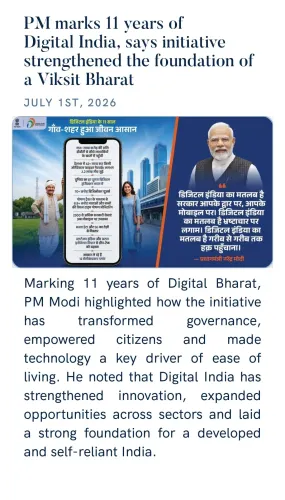
Union Road Transport and Highways Minister Nitin Gadkari on Wednesday, 1 July 2026 marked the 11th anniversary of the Digital India programme, crediting Prime Minister Narendra Modi's leadership for transforming governance and everyday life through technology over the past decade.
Context
The Digital India programme was formally launched by Prime Minister Narendra Modi on 1 July 2015, with the stated goal of creating a digitally empowered society and a knowledge-based economy. The initiative brought under one umbrella a range of efforts — from expanding broadband connectivity in rural areas to enabling digital payments and online delivery of government services.
Gadkari, in his post on X, described the programme as having 'transformed governance, empowered citizens, and revolutionised everyday life through technology,' pointing to internet connectivity, digital payments, transparent service delivery, and innovation as its key pillars.
Policy Backdrop
Since 2014, the central government has built a layered digital public infrastructure that includes Aadhaar, the Unified Payments Interface (UPI), and large-scale broadband expansion. Digital India functions as the overarching umbrella coordinating e-governance, digital payments, and online service delivery across ministries and departments.
The programme's consistent expansion reflects a long-term policy approach that links technology adoption with economic and administrative reform — a thread visible across successive Union Budgets and policy announcements by the Ministry of Electronics and Information Technology (MeitY).
Stakeholders and Impact
The initiative's direct beneficiaries span Indian citizens at large — particularly those in rural and semi-urban areas who gained access to banking, welfare transfers, and government services through digital channels. Technology startups and the broader innovation ecosystem have also benefited from the digital infrastructure and policy environment the programme created.
Gadkari's statement connects these gains to the government's longer-term ambition: 'As India advances towards Viksit Bharat 2047, Digital India continues to drive inclusion, innovation, and sustainable growth, creating new opportunities for every citizen.' Viksit Bharat 2047 is the government's vision for India to emerge as a fully developed nation by the centenary of its independence.
What's Next
With the programme entering its second decade, attention will turn to the next phase of Digital India guidelines and any fresh budgetary allocations announced in forthcoming Union Budgets or MeitY policy updates. The government's ability to deepen last-mile digital inclusion — bridging gaps in connectivity, digital literacy, and device access — will be a key measure of the initiative's continued momentum.
As the Viksit Bharat 2047 roadmap takes shape, Digital India is expected to remain a central pillar, with technology increasingly embedded in infrastructure planning, public service delivery, and economic growth strategies across ministries — including Road Transport and Highways.
Point of View
While ceremonial in tone, signals the ruling BJP's intent to keep Digital India at the centre of its governance narrative as it approaches the 2047 centenary deadline. The post is notable for a road minister — rather than a technology portfolio holder — amplifying the digital agenda, reflecting a whole-of-government communication strategy around flagship schemes. Framing the programme's next phase through the 'Viksit Bharat 2047' lens allows the party to stitch together disparate policy achievements under a single aspirational arc. It also reinforces that digital infrastructure is no longer siloed within MeitY but is seen as cross-cutting across all ministries.
NationPress
29 Sept 2026
Frequently Asked Questions
When was Digital India launched?
The Digital India programme was formally launched by Prime Minister Narendra Modi on 1 July 2015 , making 2026 its 11th anniversary.
What is Viksit Bharat 2047?
Viksit Bharat 2047 is the Indian government's vision for the country to become a fully developed nation by 2047 , the centenary of India's independence.
What has Digital India achieved?
Digital India has expanded internet connectivity, enabled large-scale digital payments through platforms like UPI , linked citizens to government services via Aadhaar , and promoted e-governance and transparent service delivery across India.
Why did Nitin Gadkari comment on Digital India?
As a senior cabinet minister and BJP leader, Gadkari posted on X to mark the programme's 11th anniversary on 1 July 2026 , reflecting the government's whole-of-cabinet communication around flagship schemes.
What comes next for Digital India?
The next phase is expected to focus on deeper last-mile digital inclusion, fresh budgetary allocations, and new guidelines from MeitY , with the programme remaining central to the Viksit Bharat 2047 roadmap.