Nadda cites IMF data: India fastest-growing major economy at 7%
Synopsis
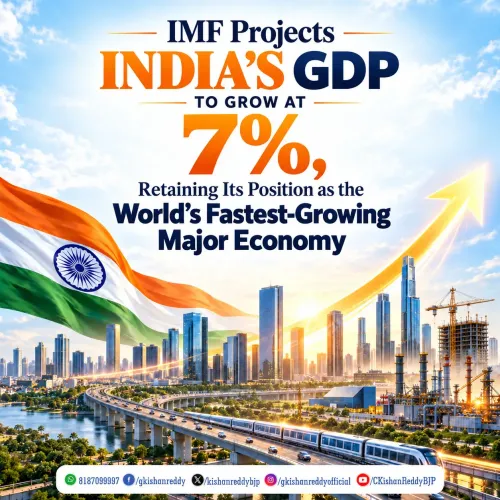
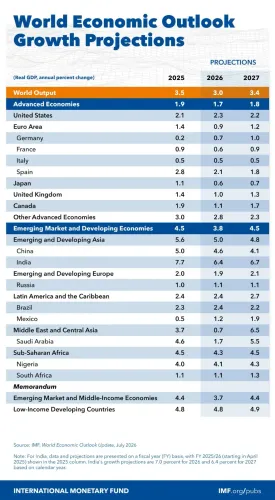
The IMF's World Economic Outlook projects India's GDP growth at 7.0% for both 2026 and 2027, sustaining its status as the fastest-growing major economy. Union Minister J. P. Nadda highlighted the figures on October 13, linking the momentum to PM Modi's leadership and the Viksit Bharat 2047 vision.
Key Takeaways
The IMF's World Economic Outlook projects India's GDP growth at 7.0% in both 2026 and 2027 .
India retains its position as the fastest-growing major economy globally, according to the IMF estimates cited.
Nadda shared the data on October 13, 2026 , framing it as evidence of the government's economic reform impact.
The growth narrative is anchored to the Viksit Bharat 2047 goal — India's ambition to achieve developed-economy status by its independence centenary.
Structural drivers cited in policy lineage include the 1991 liberalisation , the 2017 GST rollout , and post- 2020 PLI schemes .
While much of the world grapples with economic headwinds, India is holding a rare distinction — the International Monetary Fund's World Economic Outlook projects the country's GDP growth at 7.0% for both 2026 and 2027, sustaining its run as the fastest-growing major economy on the planet. Union Health Minister J. P. Nadda, who also serves as BJP national president, amplified the data point on Tuesday, October 13, 2026, framing it as proof of an economy in accelerating transformation.
What the IMF numbers say — and why they matter now
A 7.0% GDP growth projection in back-to-back years is not routine. At a moment when advanced economies in Europe and North America are fighting sluggish demand and elevated interest rates, India sustaining that pace puts it in a category largely by itself among major economies. The IMF's World Economic Outlook, released periodically by the Bretton Woods institution, is among the most closely watched barometers of global economic health — and India's consistent placement near the top of its growth table has become a recurring headline since the mid-2010s.
Nadda's post frames the numbers not as a statistical accident but as the result of deliberate policy direction under Prime Minister Narendra Modi, who has led the country since 2014. 'India's economic transformation continues to gain unprecedented momentum,' the minister wrote, anchoring the narrative to the national goal of Viksit Bharat 2047 — the government's stated ambition to become a fully developed economy by the centenary of independence.
The reform arc behind the headline figure
India's growth story has roots that predate any single administration. The 1991 economic liberalisation cracked open the economy to foreign investment and set the foundation for sustained expansion. More recently, the Goods and Services Tax, rolled out in 2017, unified the country's fragmented indirect-tax structure — a structural shift that economists credit with improving ease of doing business over time.
Post-2020 recovery packages and Production-Linked Incentive (PLI) schemes targeting sectors from semiconductors to pharmaceuticals added another layer — pushing a 'Make in India' manufacturing push that seeks to capture supply chains diversifying away from other Asian hubs. Digital public infrastructure, from payments to identity, has further lowered friction for commerce at scale.
Viksit Bharat 2047 — the horizon behind the data
The Viksit Bharat 2047 vision is the organising framework the current government uses to give the growth numbers a destination. The idea: compound the current momentum long enough that by India's 100th year of independence, the economy has fully crossed the threshold into developed-nation status. At 7% annual growth, the arithmetic is plausible — but economists note execution on infrastructure, employment quality, and climate resilience will be as decisive as the headline rate.
For global investors, the IMF endorsement arrives at a useful moment — a data-backed reassurance that the world's most populous nation remains a growth anchor even as geopolitical turbulence rattles other markets.
In a world searching for bright spots, India's IMF-backed 7% growth number is the kind of signal that moves boardroom conversations — and the government intends to keep it that way.
Point of View
The BJP is stitching a short-term data win into a multi-decade political promise. The framing of global turmoil as a foil — 'a world in turmoil, a Bharat on the rise' — is a tested rhetorical move that positions India's stability as a government achievement rather than a structural inevitability. Analysts will watch whether the 7% projection holds through the next IMF update and whether job-quality and consumption metrics keep pace with the headline rate.
NationPress
13 Oct 2026
Frequently Asked Questions
What is India's GDP growth forecast for 2026 according to the IMF?
According to the IMF's World Economic Outlook cited by Union Minister J. P. Nadda, India's GDP growth is projected at 7.0% for both 2026 and 2027 .
Is India the fastest-growing major economy in the world in 2026?
Yes, the IMF's World Economic Outlook projects India as the fastest-growing major economy globally, with a projected GDP growth rate of 7.0% for 2026.
What is Viksit Bharat 2047?
Viksit Bharat 2047 is India's stated national goal to become a fully developed economy by 2047 , the centenary of the country's independence, as articulated by the Modi government.
Why did J. P. Nadda post about the IMF World Economic Outlook?
J. P. Nadda , Union Minister and BJP national president, shared the IMF projections on October 13, 2026, to highlight India's economic momentum under PM Modi's leadership and connect it to the Viksit Bharat 2047 vision.
What reforms are behind India's high GDP growth rate?
Key structural drivers include the 1991 economic liberalisation , the 2017 Goods and Services Tax reform, and post- 2020 Production-Linked Incentive (PLI) schemes aimed at boosting manufacturing and self-reliance.