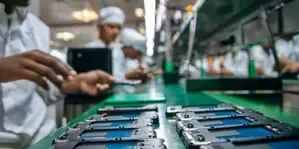
India smartphone exports hit $9.84 billion record in Q1 FY27, Apple leads surge

Synopsis
India's smartphone exports crossed $9.84 billion in a single quarter for the first time ever — and Apple is the reason why. With iPhones contributing over 75% of FY26's total smartphone export value and Foxconn posting 48% growth, India's shift from consumption market to global manufacturing base is no longer a projection. It is a quarterly data point.
Key Takeaways
India's smartphone exports hit a record $9.84 billion in Q1 FY27 (April–June 2025) , up 23.4% year-on-year.
Smartphones accounted for 64.8% of India's total electronics exports of $15.2 billion in the quarter.
The United States was the largest destination market for India-made smartphones.
Foxconn Hon Hai posted 48% export growth in 2025; Samsung grew 4% .
Apple became India's single largest branded exporter in FY26 , with iPhone exports crossing ₹2 lakh crore .
Government PLI , SEZ reforms, and FDI relaxations have been key policy drivers of the surge.
India's smartphone exports surged to a record $9.84 billion in Q1 FY27 (April–June 2025), a 23.4% year-on-year jump from $7.97 billion in the same quarter of the previous fiscal, according to the latest trade data. Apple iPhone shipments were the primary engine of this growth, cementing India's standing as a major global smartphone manufacturing hub.
Scale of the Milestone
The $9.84 billion figure is the highest ever recorded for a single quarter of Indian smartphone exports. Notably, smartphones now account for 64.8% of India's total electronics exports, which stood at $15.2 billion during the April–June period. The United States remained by far the largest destination market for India-manufactured devices during the quarter.
Apple and Its Manufacturing Partners Drive Growth
Apple's contract manufacturers have been the dominant force behind the export surge. Foxconn Hon Hai recorded a 48% year-on-year rise in exports in 2025, powered by strong iPhone shipments. Samsung also expanded its export contribution, registering 4% growth over the same period.
Earlier in FY26, India's iPhone exports crossed a record ₹2 lakh crore, making Apple the country's single largest branded exporter across all product categories. Overall smartphone exports from India reached approximately ₹2.6 trillion ($29.4 billion) during that fiscal year, with iPhones contributing more than 75% — roughly $22 billion — of the total.
Broader Sector Momentum
The Q1 FY27 data builds on strong multi-year momentum. According to available industry data, shipments of 'Made in India' smartphones grew 8% in 2025, driven by a 28% jump in exports, with exports accounting for nearly one-third of all smartphones manufactured domestically. This trajectory reflects a structural shift: India is no longer just a consumption market but an increasingly significant production base for global smartphone supply chains.
Policy Enablers Behind the Push
The rapid export expansion has been underpinned by several government initiatives. The Production-Linked Incentive (PLI) scheme for electronics has provided direct financial incentives tied to incremental production. Complementary reforms in Special Economic Zones (SEZs), higher budgetary allocations for electronics manufacturing, and relaxed Foreign Direct Investment (FDI) norms have collectively strengthened India's appeal as a global manufacturing destination.
What to Watch
With the US remaining the dominant export market, any shifts in American trade policy or tariff structures could affect near-term volumes. However, the diversification of Apple's supply chain away from China — and India's expanding manufacturing capacity — suggests the structural tailwind is likely to persist. The next quarterly data will indicate whether the record pace can be sustained or whether Q1 FY27 represents a tariff-driven front-loading effect.
Point of View
But the concentration risk is equally notable: iPhones alone contributed over 75% of FY26's total smartphone export value, meaning India's electronics export story is, at present, largely an Apple story. That is a structural vulnerability dressed up as a diversification win. The PLI scheme deserves credit for attracting investment, but the real test is whether India can replicate this with domestic brands or second-tier global manufacturers — not just Foxconn assembling iPhones for the US market. With American trade policy in flux, the heavy dependence on a single brand, a single product category, and a single destination market warrants scrutiny that the headline number alone does not invite.
NationPress
29 Jul 2026
Frequently Asked Questions
What is India's smartphone export record in Q1 FY27?
India's smartphone exports reached $9.84 billion in Q1 FY27 (April–June 2025), the highest ever for a single quarter, representing a 23.4% increase from $7.97 billion in the same period of the previous fiscal year. Apple iPhone shipments were the primary driver of this growth.
Which company drove India's smartphone export growth?
Apple's manufacturing partners, particularly Foxconn Hon Hai, were the biggest contributors. Foxconn recorded a 48% year-on-year rise in exports in 2025, while Samsung posted 4% growth. Apple became India's single largest branded exporter in FY26, with iPhone exports crossing ₹2 lakh crore.
What share of electronics exports do smartphones represent?
Smartphones accounted for 64.8% of India's total electronics exports of $15.2 billion during April–June 2025, making them by far the dominant category in the country's electronics trade.
Which country is the largest market for India's smartphone exports?
The United States remained the largest single destination market for India-manufactured smartphones during Q1 FY27, according to the latest trade data.
What government policies have supported India's smartphone export growth?
The Production-Linked Incentive (PLI) scheme for electronics, reforms in Special Economic Zones (SEZs), higher budgetary support for electronics manufacturing, and relaxed Foreign Direct Investment (FDI) norms have collectively driven India's emergence as a global smartphone manufacturing hub.