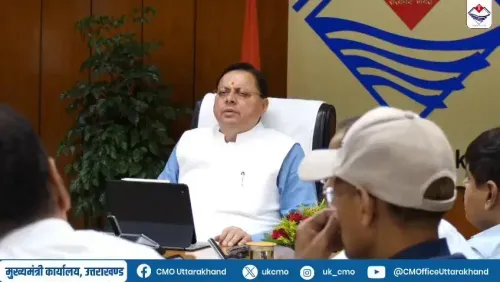
CM Dhami Pushes Innovation in Uttarakhand Farm, Horticulture Sector

Synopsis
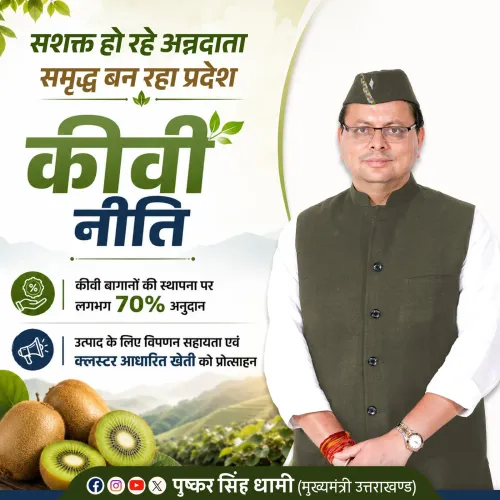
The Chief Minister's Office of Uttarakhand says innovative experiments in agriculture and horticulture are underway under CM Pushkar Singh Dhami, with Pithoragarh highlighted as a key district in the Himalayan state's farm-sector push.
Key Takeaways
The Chief Minister's Office of Uttarakhand announced on 29 July 2026 that innovative experiments are being conducted in agriculture and horticulture under CM Pushkar Singh Dhami .
Pithoragarh , a high-altitude Himalayan district bordering Nepal and Tibet, is specifically named in the government's messaging.
Uttarakhand has been part of India's National Horticulture Mission since the mid-2000s, expanding area under fruits, vegetables, and floriculture.
The initiative fits a broader Himalayan-state pattern of location-specific agricultural innovation to counter terrain challenges and rural outmigration.
Specific technologies, timelines, and institutional partnerships involved in the experiments have not yet been publicly detailed.
In the high-altitude districts of Uttarakhand — where thin soils, steep slopes, and outmigration have long squeezed farming communities — the state government is signalling a new chapter. The Chief Minister's Office of Uttarakhand announced on Wednesday, 29 July 2026 that innovative experiments are underway in agriculture and horticulture under the leadership of Chief Minister Pushkar Singh Dhami, with Pithoragarh specifically named as a focus district.
The official post, shared in Hindi, stated: 'मुख्यमंत्री श्री पुष्कर सिंह धामी के नेतृत्व में उत्तराखण्ड में कृषि और उद्यानिकी क्षेत्र में नवाचार प्रयोग हो रहे हैं' — ('Under the leadership of Chief Minister Shri Pushkar Singh Dhami, innovative experiments are being conducted in the agriculture and horticulture sector in Uttarakhand.')
Pithoragarh at the Centre of Himalayan Farming Ambition
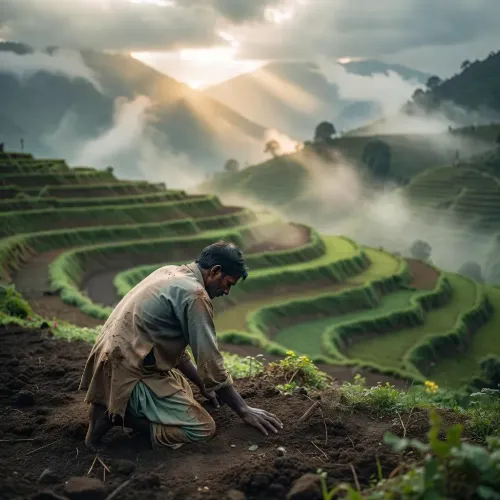
Pithoragarh, a northern Himalayan district bordering Nepal and Tibet, has long been associated with fruit cultivation, floriculture, and vegetable farming suited to its altitude and climate. The district's geography makes it both a natural candidate for high-value horticulture and a difficult terrain to modernise at scale. Naming it explicitly in the government's messaging signals that state-level attention is being directed toward precisely the kind of remote, hill-economy district that often gets left behind in agricultural policy rollouts. Uttarakhand has been part of India's National Horticulture Mission since the mid-2000s, a programme designed to expand the area under fruits, vegetables, and floriculture while boosting farmer incomes. The current push under CM Dhami builds on that foundation — but the government's framing around 'innovation experiments' (navachar prayog) suggests an intent to go beyond standard scheme implementation.Why Hill States Are Betting on Agricultural Innovation
Uttarakhand is not alone. Across the Himalayas — from Himachal Pradesh to Sikkim — state governments have pursued location-specific agricultural strategies to counter the twin pressures of difficult terrain and accelerating rural outmigration. The logic is straightforward: if farming in hill districts cannot deliver competitive incomes, villages empty. Innovation — whether in protected cultivation, new crop varieties, or market linkages — is the lever governments are reaching for. India's broader national agenda on agricultural technology adoption, including precision farming tools and digital market access, gives state-level experiments like Uttarakhand's a larger scaffolding to plug into. The question hill farmers and horticulture growers will be watching is whether these experiments translate into concrete support — cold-chain infrastructure, processing units, direct buyer linkages — or remain at the level of demonstration plots. The specifics of which technologies are being trialled, which research institutions are involved, and what timelines are envisaged have not yet been detailed by the government. Those announcements will determine whether this initiative marks a genuine inflection point for Uttarakhand's farming communities — or another well-intentioned signal awaiting execution.Point of View
The vagueness around specifics is a recurring feature of such announcements; the real test will come when infrastructure investments and market linkages are either delivered or deferred. For Dhami, whose political identity is tied to Uttarakhand's development narrative, converting this messaging into visible ground-level outcomes before the next electoral cycle is the underlying pressure.
NationPress
28 Oct 2026
Frequently Asked Questions
What innovation experiments is Uttarakhand doing in agriculture and horticulture?
The Chief Minister's Office of Uttarakhand has announced that innovative experiments are underway in agriculture and horticulture under CM Pushkar Singh Dhami, with Pithoragarh named as a focus district. The specific technologies or programmes involved have not yet been publicly detailed.
What is Pithoragarh known for in terms of farming?
Pithoragarh is a high-altitude district in northern Uttarakhand known for fruit cultivation, floriculture, and vegetables suited to its Himalayan climate. Its location bordering Nepal and Tibet makes it both a natural horticulture zone and a challenging area for agricultural modernisation.
What is the National Horticulture Mission and does Uttarakhand participate?
The National Horticulture Mission is a central government programme launched in the mid-2000s to expand area under fruits, vegetables, and floriculture and improve farmer incomes. Uttarakhand has been a participating state since the mission's early years.
Who is Pushkar Singh Dhami?
Pushkar Singh Dhami is the Chief Minister of Uttarakhand, in office since 2021. He has positioned state-level development — including in rural and hill-economy sectors — as a central theme of his administration.
Why are Himalayan states focusing on horticulture innovation?
Himalayan states like Uttarakhand face twin pressures of difficult terrain and rural outmigration that make conventional farming unviable at scale. High-value horticulture, supported by innovation in cultivation and market linkages, is seen as a way to raise farm incomes and slow village depopulation.