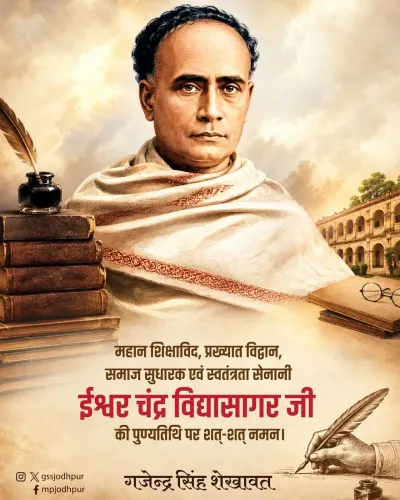
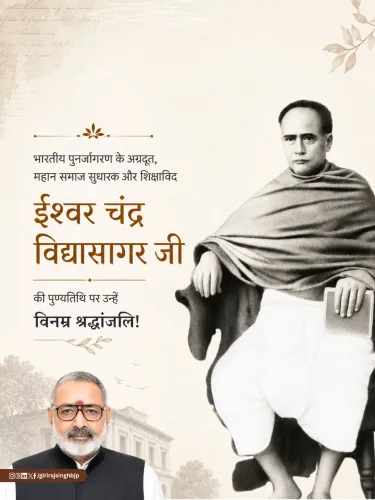
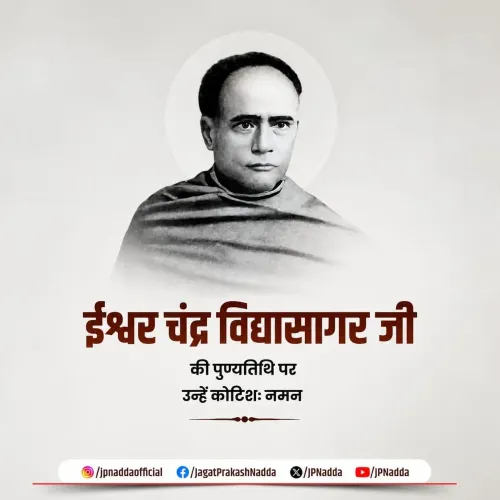
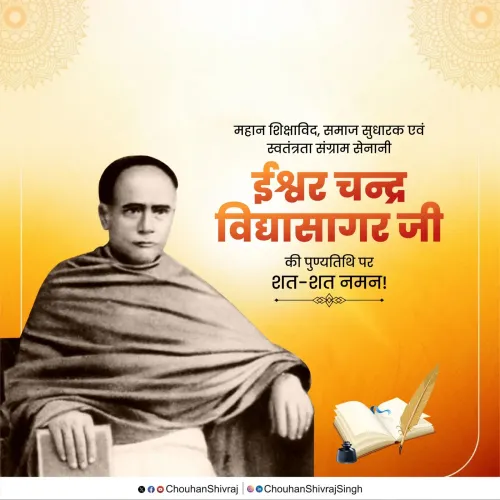
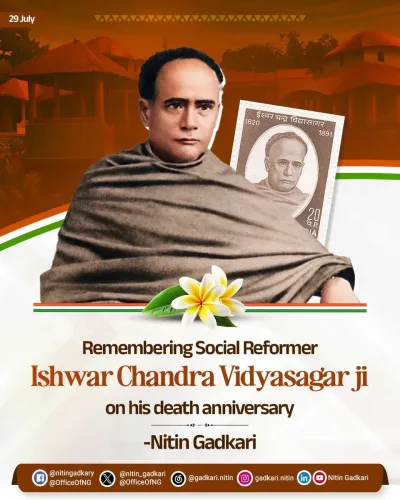
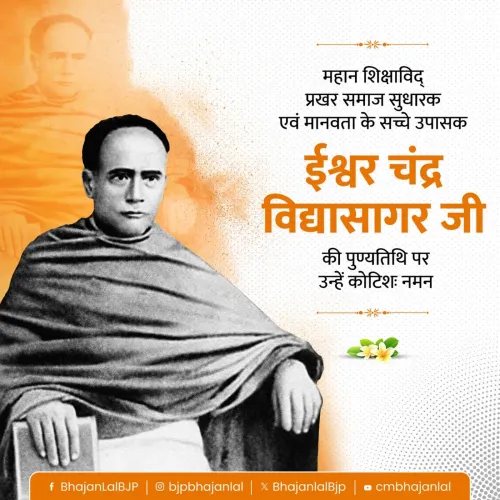
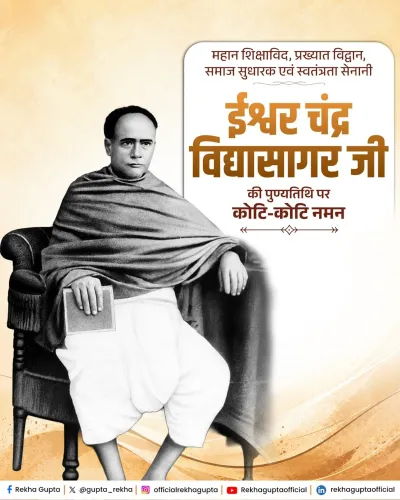
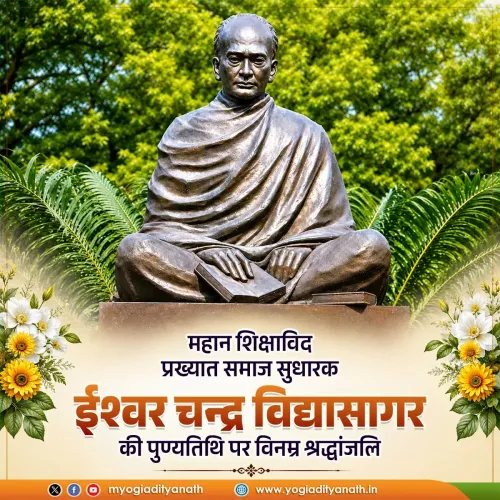
Rajnath Singh pays tribute to Ishwar Chandra Vidyasagar on death anniversary

Synopsis
Union Defence Minister Rajnath Singh paid homage to 19th-century Bengali social reformer Ishwar Chandra Vidyasagar on his death anniversary, citing his lifelong campaigns for women's education and widow remarriage as milestones inscribed in Indian history.
Key Takeaways
Union Defence Minister Rajnath Singh paid tribute to Ishwar Chandra Vidyasagar on his death anniversary on 29 July 2026 .
Vidyasagar was a 19th-century Bengali social reformer and educator who championed women's education and widow remarriage.
His advocacy contributed directly to the passage of the Hindu Widows' Remarriage Act of 1856 .
Singh credited Vidyasagar's 'lifelong struggle' against social evils as being 'inscribed in golden letters' in Indian history.
Indian political leaders across parties regularly mark Vidyasagar's death and birth anniversaries with public tributes.
A reformer who fought to educate women and free widows from social chains — Union Defence Minister Rajnath Singh remembered Ishwar Chandra Vidyasagar on his death anniversary on Wednesday, 29 July, paying homage to the 19th-century Bengali scholar whose battles against entrenched social customs reshaped Indian society.
Posting in Hindi, Singh wrote: 'महान समाज सुधारक और शिक्षाविद् ईश्वरचंद्र विद्यासागर जी की पुण्यतिथि पर उन्हें कोटि-कोटि नमन।' ('Heartfelt salutations to the great social reformer and educationist Ishwar Chandra Vidyasagar on his death anniversary.') He credited Vidyasagar's 'lifelong struggle for the spread of women's education, support for widow remarriage, and the eradication of social evils' as being 'inscribed in golden letters in the history of Indian society.'
The reformer who rewrote the rules for Indian women
Vidyasagar was no armchair intellectual. Born in Bengal in the early 19th century, he used his position as a scholar and educator to wage two of the most consequential social campaigns of colonial India. His relentless advocacy directly contributed to the passage of the Hindu Widows' Remarriage Act of 1856 — a legislative milestone that gave legal sanction to widow remarriage for the first time, overturning centuries of orthodox Hindu custom. Simultaneously, he pushed hard to establish schools for girls at a time when female education was considered socially transgressive. His methods were practical and persistent: petitions, public arguments, institutional action. He founded and supported dozens of schools, translated and wrote texts in accessible Bengali, and used his own resources to fund causes he believed in. The breadth of that commitment is precisely what Singh's tribute underscores.A routine commemoration with a consistent message
India's political class — across party lines — marks the anniversaries of 19th-century reformers with regularity, and Vidyasagar draws particular attention given the contemporary resonance of his causes: women's education and gender equity remain live policy priorities. Singh's tribute follows this established pattern, invoking Vidyasagar's 'ideals, thoughts, and spirit of social service' as an enduring inspiration for future generations. Vidyasagar's birth anniversary falls on 26 September, and similar tributes are expected to follow from political leaders at that time. A man who took on orthodoxy with a scholar's pen and a reformer's nerve — Vidyasagar's legacy is one India's leaders continue to invoke precisely because the work he began is still unfinished.Point of View
Honouring Vidyasagar — whose legacy is particularly strong in West Bengal — also carries a subtle political geography. The post's emphasis on women's education and widow remarriage maps neatly onto contemporary government messaging around gender empowerment schemes. These commemorations function as low-cost, high-visibility signals of cultural continuity, connecting a ruling party's present agenda to a broadly respected reform tradition.
NationPress
29 Jul 2026
Frequently Asked Questions
Who was Ishwar Chandra Vidyasagar?
Ishwar Chandra Vidyasagar was a 19th-century Bengali social reformer, educator, and scholar who campaigned for widow remarriage and the expansion of girls' education in India, and whose advocacy helped pass the Hindu Widows' Remarriage Act of 1856.
When is Ishwar Chandra Vidyasagar's death anniversary?
Ishwar Chandra Vidyasagar's death anniversary falls on 29 July , and his birth anniversary is on 26 September .
What did Rajnath Singh say about Vidyasagar?
Rajnath Singh said Vidyasagar's lifelong struggle for women's education, support for widow remarriage, and eradication of social evils is 'inscribed in golden letters in the history of Indian society,' and that his ideals will continue to inspire future generations.
What was the Hindu Widows' Remarriage Act of 1856?
The Hindu Widows' Remarriage Act of 1856 was a landmark colonial-era law that gave legal sanction to widow remarriage in India for the first time, overturning centuries of orthodox custom — a reform Vidyasagar campaigned vigorously to achieve.
Why do Indian politicians pay tribute to Vidyasagar?
Indian political leaders across parties regularly mark Vidyasagar's anniversaries because his campaigns for women's education and social reform remain culturally significant and align with contemporary government priorities around gender empowerment.