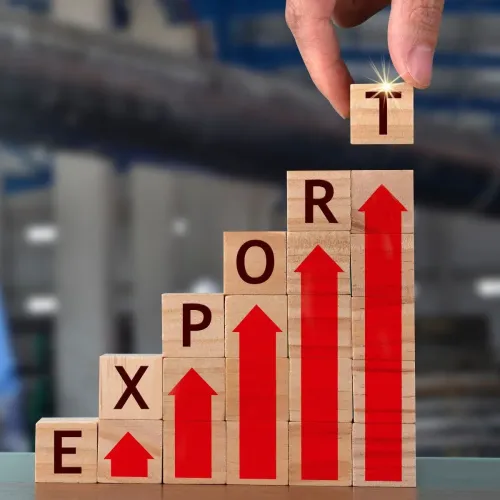
India's services exports hit $421.3 billion in FY26, driven by IT and business services
Synopsis
India's services exports crossed $421 billion in FY26 — a 65% jump in five years — with IT and telecom alone contributing over $206 billion. The real story is structural: FTAs are now embedding time-bound regulatory guarantees and professional mobility routes, quietly reshaping how Indian talent and services reach global markets.
Key Takeaways
India's services exports reached $421.3 billion in FY2025-26 , up from $387.5 billion in FY25.
Telecommunications, computer and information services contributed $206.6 billion ; business services added $124.2 billion .
Services exports have grown from $254.5 billion in FY22 — a cumulative rise of approximately 65% in five years.
FTAs now include domestic regulation disciplines, ensuring time-bound and transparent authorisation for Indian service suppliers in partner markets.
Dedicated provisions for traditional medicine were secured in agreements with Oman and the European Union .
Mutual Recognition Agreements (MRAs) are being pursued to allow Indian professionals to practice abroad without duplicative re-certification.
India's services exports reached $421.3 billion in fiscal year 2025-26, marking a sustained multi-year expansion fuelled by telecommunications, computer and information services, and business services, the government informed Parliament on Friday, 25 July 2025. The figures were shared by Minister of State for Commerce and Industry Jitin Prasada in the Rajya Sabha, who credited free trade agreements (FTAs) and targeted trade promotion events as key enablers of the growth.
Sector-wise breakdown
Telecommunications, computer and information services emerged as the dominant contributor, accounting for $206.6 billion of total services exports in FY26. Business services followed with $124.2 billion. Together, these two categories represent the backbone of India's services export engine, reflecting the country's established strength in IT outsourcing, software development, and professional services.
A five-year growth trajectory
The $421.3 billion figure for FY26 represents a remarkable climb from $254.5 billion in 2021-22. The intervening years tell a consistent upward story: $325.3 billion in 2022-23, $341.1 billion in 2023-24, and $387.5 billion in 2024-25. This translates to cumulative growth of approximately 65% over five years, outpacing many comparable economies in services trade expansion.
Role of FTAs and market access
According to Minister Prasada, the government's strategy rests on a multi-pronged approach: focused market and sector strategies, addressing domestic constraints through stakeholder consultation, and expanding market access via FTAs. India's recent trade agreements have secured comprehensive market access and national treatment for Indian service providers across modes including cross-border digital delivery, commercial presence in partner countries, and temporary movement of professionals.
Notably, India's FTAs now incorporate disciplines on domestic regulation, requiring that authorisation processes for key services be time-bound, predictable, objective, impartial, and transparent. This is designed to shield Indian service suppliers from opaque or burdensome regulatory barriers in partner markets.
Professional mobility and mutual recognition
A significant structural gain embedded in recent FTAs is the creation of structured, expedited mobility routes for skilled Indian professionals to deliver services in foreign markets. The government has also worked to secure Mutual Recognition Agreements (MRAs) between professional bodies, enabling partner nations to accept each other's certifications without requiring duplicative local testing, additional training, or lengthy re-certification processes.
In a sector-specific development, dedicated provisions covering traditional medicine were secured in agreements with Oman and the European Union — a reflection of India's push to export its comparative advantage in Ayurveda and allied health disciplines.
What comes next
With services exports now exceeding $400 billion for the first time, the policy focus is expected to shift toward deepening existing FTA commitments and operationalising MRAs across more professional categories. Industry observers note that sustained growth will depend on maintaining India's talent pipeline in high-value IT and business services, while expanding the services export basket beyond its current concentration in a handful of sectors.
Point of View
But the composition remains heavily concentrated — IT and telecom alone account for nearly half the total. The real policy bet being placed through FTAs is on professional mobility and mutual recognition, which, if operationalised effectively, could broaden the base beyond software. However, MRAs have historically moved slowly, and the gap between securing provisions in trade texts and professionals actually benefiting on the ground is wide. The traditional medicine annexes with Oman and the EU are an interesting outlier — a signal that India is beginning to export its non-IT comparative advantages, but one data point does not a strategy make.
NationPress
22 Oct 2026
Frequently Asked Questions
How much did India's services exports grow in FY26?
India's services exports rose to $421.3 billion in FY2025-26, up from $387.5 billion in FY25. This continues a five-year growth run that began at $254.5 billion in FY22.
Which sectors drove India's services exports in FY26?
Telecommunications, computer and information services were the largest contributor at $206.6 billion, followed by business services at $124.2 billion. Together, these two categories account for the majority of India's total services export value.
What role did FTAs play in boosting India's services exports?
India's free trade agreements have secured comprehensive market access and national treatment for Indian service providers, covering cross-border digital delivery, commercial presence abroad, and temporary movement of professionals. FTAs also embed domestic regulation disciplines to prevent opaque or burdensome authorisation barriers in partner countries.
What are Mutual Recognition Agreements and why do they matter for services exports?
Mutual Recognition Agreements (MRAs) are pacts between professional bodies in two countries that allow each to accept the other's qualifications and certifications. For Indian professionals, they eliminate the need for duplicative local testing or re-certification before practising in a partner country, making it easier to deliver services abroad.
What special provisions were secured for traditional medicine in India's FTAs?
India secured dedicated provisions or annexes covering traditional medicine in its trade agreements with Oman and the European Union. These provisions are aimed at facilitating the export of Indian expertise in Ayurveda and allied health disciplines to partner markets.