India-UK FTA set to boost Indian businesses, MSMEs across key sectors
Synopsis
The India-UK FTA isn't just a headline trade deal — industry says it could be a structural shift for Indian exports. From MSMEs to IT majors, the agreement promises preferential access to one of the world's largest high-income markets, with textiles, gems, and tech services first in line to benefit.
Key Takeaways
The India-UK Free Trade Agreement (FTA) has been described as a 'historic step' by Indian Merchants' Chamber (IMC) President Prof.
Mahendra Kumar Chouhan .
Benefits are expected to extend beyond large corporations to MSMEs , helping them expand their global footprint.
Key sectors set to gain include textiles and apparel , gems and jewellery , leather goods , IT , and professional services .
India's expertise in diamond cutting and polishing and its skilled IT and fintech workforce are cited as competitive strengths under the deal.
Aerospace startup Skyroot Aerospace was highlighted as an example of India's growing indigenous innovation capacity.
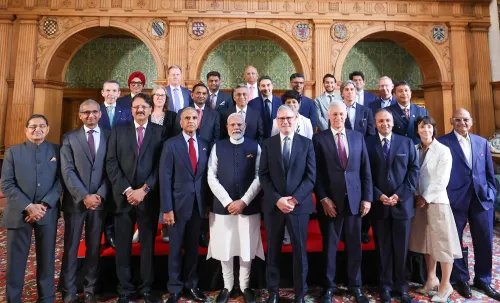
The recently concluded India-United Kingdom Free Trade Agreement (FTA) is poised to deliver significant gains for Indian businesses across sectors, with benefits expected to reach not just large corporations but also micro, small and medium enterprises (MSMEs), according to an industry body. The assessment was shared in Mumbai on 20 July.
A Historic Step for Indian Exports
Indian Merchants' Chamber (IMC) President Prof. Mahendra Kumar Chouhan described the agreement as a 'historic step' that would strengthen India's export ecosystem. He said the FTA is expected to democratise exports by enabling businesses of different sizes and industries to tap the UK market, making export growth more inclusive than previous trade arrangements.
According to Chouhan, the benefits will not be confined to large companies. Medium-sized firms and MSMEs stand to gain meaningfully, with improved access to the UK helping them expand their global footprint in a structured, sustainable manner.
Sectors Positioned to Gain the Most
Chouhan highlighted several industries likely to benefit significantly under the agreement. These include textiles and apparel, gems and jewellery, leather and leather goods, information technology, professional services, and other labour-intensive sectors.
He noted that India's globally recognised expertise in diamond cutting and polishing gives the country a strong competitive edge in gems and jewellery. Similarly, India's skilled workforce in information technology, fintech, financial services, and software engineering is well-positioned to deepen its presence in international markets through improved UK access.
This comes amid a broader push by Indian industry to move up the value chain — from low-cost manufacturing to higher-margin services and technology exports. The FTA, if implemented effectively, could accelerate that shift by providing preferential access to one of Europe's largest high-income consumer markets.
Cost Efficiency Meets High-Income Market Access
Chouhan argued that India's cost-efficient production, when combined with access to the United Kingdom's high-income consumer base, would enable domestic companies to achieve better value realisation for their products and services. This combination, he said, could enhance their overall global competitiveness — particularly for sectors where Indian labour costs remain a structural advantage.
Notably, the India-UK FTA has been years in the making, with negotiations spanning multiple rounds since 2022. Its conclusion is seen by industry observers as a significant diplomatic and commercial milestone for both nations.
India's Indigenous Innovation in Focus
Chouhan also used the occasion to spotlight India's growing technological self-reliance, citing aerospace startup Skyroot Aerospace as an example of indigenous innovation. He said the company's success in developing advanced rocket technology reflects India's increasing emphasis on research, domestic technology development, and homegrown engineering talent.
He added that the achievement of a young team of engineers and entrepreneurs demonstrates the depth of India's talent pool, and should encourage more industries to invest in locally developed components and technologies — a theme increasingly central to India's industrial policy.
What Comes Next
Industry bodies are now expected to work with the government on sector-specific implementation guidelines under the FTA. For MSMEs in particular, the focus will be on awareness, export readiness, and logistics support to ensure they can effectively leverage the new trade lanes. The agreement's full impact will depend on how swiftly the operational framework is put in place on both sides.
Point of View
But the FTA's real test lies in implementation, not announcement. India has signed trade agreements before that delivered less than projected because MSMEs lacked the export infrastructure to capitalise on them. The sectors named — textiles, gems, IT — are already competitive; the question is whether the agreement removes enough non-tariff barriers to move the needle on market share. Skyroot Aerospace is an inspiring data point, but a single startup does not a trade policy make. The government and industry bodies now need to focus on last-mile readiness: logistics, compliance simplification, and export financing for smaller firms, or the FTA's gains will accrue disproportionately to those already equipped to export.
NationPress
19 Oct 2026
Frequently Asked Questions
What is the India-UK Free Trade Agreement (FTA)?
The India-UK FTA is a bilateral trade agreement between India and the United Kingdom aimed at reducing tariffs and improving market access for goods and services. It is expected to boost Indian exports across sectors including textiles, IT, gems and jewellery, and professional services.
Which Indian sectors will benefit most from the India-UK FTA?
According to the Indian Merchants' Chamber, the sectors likely to gain the most include textiles and apparel, gems and jewellery, leather goods, information technology, fintech, financial services, and professional services. Labour-intensive industries are also expected to benefit.
Will MSMEs benefit from the India-UK trade deal?
Yes, industry representatives have said the FTA is designed to democratise exports, enabling MSMEs — not just large corporations — to access the UK market. However, realising those benefits will depend on adequate export readiness support for smaller firms.
Why is the India-UK FTA considered a landmark agreement?
The deal is considered landmark because it gives Indian businesses preferential access to one of Europe's largest high-income consumer markets. Negotiations had been ongoing since 2022, and its conclusion is seen as a significant diplomatic and commercial milestone.
What role does indigenous innovation play in India's trade outlook?
IMC President Prof. Mahendra Kumar Chouhan cited Skyroot Aerospace as an example of India's growing indigenous technological capabilities, arguing that domestic innovation in areas like aerospace should encourage broader industry investment in homegrown technologies and components.