India Introduces Groundbreaking Casebook on AI and Gender Empowerment

Synopsis
On February 27, the Indian government unveiled a transformative Casebook on AI and Gender Empowerment at the India AI Impact Summit 2026, showcasing 23 AI solutions that significantly advance gender equality and women's empowerment.
Key Takeaways
Launch of the Casebook on AI and Gender Empowerment by the Indian government.
Showcases 23 AI solutions with real-world impacts on gender equality.
Collaborative effort with UN Women and other international organizations.
Focus on critical sectors like healthcare , economic empowerment , and education .
Serves as a resource for policymakers and technology developers .
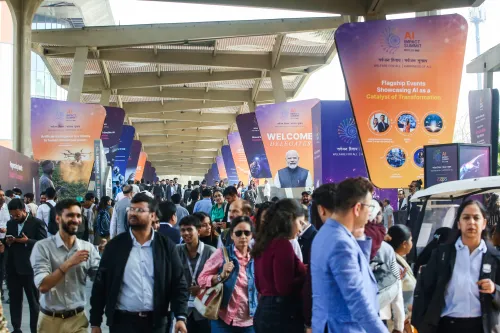
New Delhi, Feb 27 (NationPress) Marking a pivotal moment in India's dedication to the ethical and inclusive evolution of artificial intelligence (AI), the government has unveiled a Casebook on AI and Gender Empowerment, as announced by the IT Ministry on Friday.
Officially introduced at the India AI Impact Summit 2026, this casebook has been crafted by the government through the IndiaAI Mission under the Ministry of Electronics and Information Technology (MeitY), in collaboration with UN Women and with support from the Ministry of Women and Child Development (MoWCD).
The casebook compiles 23 practical AI solutions from the Global South, showcasing tangible impacts on gender equality and women's empowerment.
As stated by the ministry, the casebook highlights 23 AI innovations selected from a pool of 233 submissions from over 50 countries, following a stringent multi-stage evaluation process.
“An independent evaluation committee, which included senior officials from MeitY, MoWCD, and UN Women, assessed the submissions based on their real-world implementation, measurable gender impact, and evidence-based outcomes,” the statement revealed.
The showcased solutions cover vital areas such as healthcare (including menstrual health), economic empowerment, financial inclusion, digital safety and the prevention of technology-facilitated gender-based violence, climate resilience, sustainable agriculture, access to justice and legal services, education and skills development, and resources for policymakers and practitioners.
The casebook gained international acclaim when United Nations Secretary-General Antonio Guterres visited the UN Women stall at the JanAI Expo.
During his visit, the Secretary-General interacted with young women from rural areas pursuing careers in STEM through the WeSTEM project, a collaboration between UN Women and the governments of Madhya Pradesh, Gujarat, and Maharashtra, as well as the European Union, Micron, Nokia, and the Head Held High Foundation.
The young women expressed how they are leveraging AI to develop new skills, broaden access to education, and explore emerging job opportunities, illustrating tangible paths to becoming future leaders in technology.
Furthermore, the casebook acts as a valuable knowledge resource for policymakers, technology developers, researchers, and practitioners, emphasizing practical strategies to ensure that AI systems are ethical, inclusive, and attentive to the varied realities of women and girls in India and the Global South.
Point of View
It is vital to highlight the significance of the Indian government's new Casebook on AI and Gender Empowerment. This initiative not only showcases innovative solutions but also reinforces India's commitment to fostering gender equality through technology. The collaboration with international organizations further emphasizes the global importance of inclusive AI practices.
NationPress
17 Sept 2026
Frequently Asked Questions
What is the Casebook on AI and Gender Empowerment?
The Casebook is a compilation of 23 AI solutions that aim to promote gender equality and women's empowerment, launched by the Indian government in partnership with UN Women.
When was the Casebook launched?
The Casebook was officially launched on February 27, 2026, during the India AI Impact Summit.
How were the solutions in the Casebook selected?
The solutions were selected from 233 submissions worldwide through a rigorous multi-stage evaluation process by an independent committee.
What sectors do the featured solutions address?
The solutions cover sectors such as healthcare, economic empowerment, digital safety, climate resilience, education, and access to justice.
Who collaborated on the Casebook project?
The project was developed by the IndiaAI Mission under MeitY, in partnership with UN Women and supported by the Ministry of Women and Child Development.