Do Ready-Made Garment Export Figures Reflect the Resilience of India's Apparel Sector?
Synopsis
Discover how the latest ready-made garment export figures reveal the robust resilience of India's apparel sector amidst global challenges. With strategic opportunities on the horizon, the industry's growth trajectory is set to expand.
Key Takeaways
RMG exports reached $13,129.1 million from April to January 2025-26.
Exports grew by 1.6 percent compared to the previous year.
Challenges include high US tariff pressures and global market volatility.
India has signed FTAs with 37 countries .
MSMEs need targeted policy support for growth.
New Delhi, Feb 17 (NationPress) The Apparel Export Promotion Council (AEPC) announced on Tuesday that the most recent statistics for ready-made garment (RMG) exports demonstrate the remarkable resilience of Indian apparel exporters, who are effectively navigating through tough international conditions.
During the period from April to January 2025-26, RMG exports totaled $13,129.1 million, marking a growth of 1.6 percent compared to the same timeframe in April–January 2024-25, and a notable increase of 13.3 percent in comparison to April–January 2023-24.
An encouraging growth of 7.2 percent was also observed in RMG exports when compared to January 2024, reflecting an underlying strength and recovery in the industry despite ongoing global challenges, stated Dr. A Sakthivel, Chairman of AEPC.
The decline in January's exports can primarily be attributed to high tariff pressures from the US and persistent global instability, which have impacted order flow and created uncertainty across major markets.
“In an effort to retain customers, numerous RMG exporters have been absorbing some cost pressures by offering discounts of up to 20 percent. However, as tariff levels approach nearly 50 percent, the price disadvantage has become substantial, leading to a loss of orders to other sourcing destinations,” explained Sakthivel.
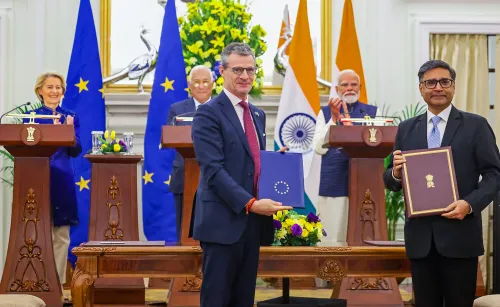
India has successfully entered into free trade agreements (FTAs) with 37 countries, thereby enhancing market access for the textile and apparel sector.
The upcoming decade offers a strategic opportunity for India to capitalize on its inherent strengths, which include a robust manufacturing base, a skilled workforce, and an integrated value chain, to boost export growth and expand its global market presence, emphasized Sakthivel.
Additionally, he highlighted that MSMEs are the backbone of the apparel sector and require focused policy support to improve competitiveness and ensure sustained growth.
On Monday, AEPC Chairman met with Reserve Bank of India (RBI) Governor Sanjay Malhotra, advocating for a dedicated export policy specifically designed for the MSME sector.
He proposed the introduction of a Special Interest Package Scheme aimed at enhancing access to affordable financing and bolstering the growth trajectory of smaller exporters.
To tackle export finance challenges, Dr. Sakthivel requested an increase in the Interest Equalisation Scheme from the present 2.75 percent to 5 percent for manufacturing exporters.
He also urged the RBI to consider eliminating the current cap of Rs 50 lakh and to raise eligibility limits under the scheme through a graded structure linked to turnover and export performance.
Point of View
The resilience of the apparel sector is commendable given the challenging global landscape. It's crucial to support MSMEs through tailored policies to ensure sustained growth and enhance India's competitive edge in the global market.
NationPress
23 Sept 2026
Frequently Asked Questions
What recent figures indicate about India’s RMG exports?
The recent figures indicate that RMG exports reached $13,129.1 million from April to January 2025-26, showing a growth of 1.6% compared to the previous year.
What challenges are Indian apparel exporters facing?
Indian apparel exporters are facing challenges such as high US tariff pressures and ongoing global volatility that disrupt order flows and create uncertainty.
How is the government supporting the apparel sector?
The government is supporting the apparel sector by signing free trade agreements with 37 countries and advocating for dedicated export policies for MSMEs.