Is India Really Aiming for $500 Billion in Electronics Manufacturing by 2030?
Synopsis
India's quest for a $500 billion electronics manufacturing industry by 2030 is more than just a goal; it's a transformative journey. With record exports and strategic partnerships, the nation is positioning itself as a global electronics hub. Discover the key initiatives and the promising future that lies ahead for India's electronics sector.
Key Takeaways
India aims for $500 billion in electronics manufacturing by 2030.
41.9% surge in electronics exports in 2025.
Smartphone exports increased by 58% .
India ranks as the third-largest smartphone exporter .
Government initiatives are streamlining trade processes.
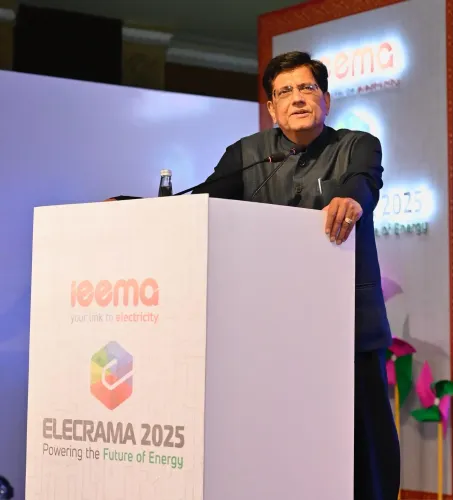
New Delhi, Oct 29 (NationPress) Commerce Minister Piyush Goyal emphasized the necessity of bolstering domestic capabilities throughout the electronics value chain. He highlighted that enhancing self-reliance in both finished products and components will be crucial for maintaining India’s export momentum and decreasing import reliance.
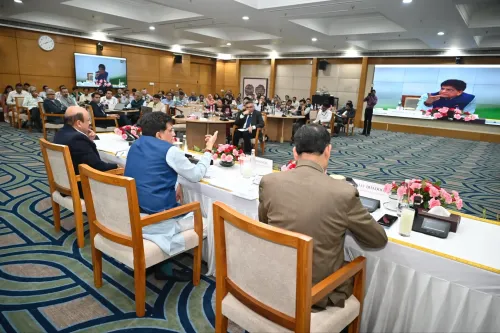
Speaking at the 4th Annual General Meeting (AGM) of the Mobile and Electronic Devices Export Promotion Council (MEDEPC), he noted that India’s electronics manufacturing sector is currently undergoing a significant transformation, driven by visionary policy initiatives, record investments, and growing global partnerships.
In line with the Prime Minister’s ambition of achieving $500 billion in electronics manufacturing by 2030, India is swiftly establishing itself as a dependable global hub for electronics design, production, and exports.
The country’s export performance tells an impressive growth narrative, with overall electronics exports soaring by 41.9 percent, reaching $22.2 billion during April–September 2025, up from $15.6 billion in the same timeframe last year.
Smartphone exports saw a remarkable increase of 58 percent, climbing to $13.38 billion, compared to $8.47 billion in the corresponding period of 2024.
In FY 2024–25, India achieved $38.6 billion in electronics exports, marking a 32.6 percent year-on-year growth, solidifying its expanding role within global value chains.
India now holds the position of the third-largest smartphone exporter worldwide, marking a significant achievement in its journey towards manufacturing supremacy.
The country’s growing involvement in global value chains (GVCs) highlights its evolution into a resilient and trustworthy manufacturing hub, providing stability and scalability during global supply chain adjustments.
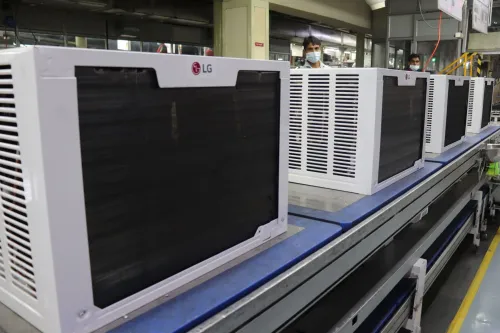
Increased domestic sourcing of key components—such as batteries, chargers, camera, and display modules—has further improved local value addition and self-sufficiency.
Guided by the Ministry of Commerce and Industry and DGFT, the government has implemented various measures to simplify trade operations and boost export competitiveness.
Initiatives like customs automation, single-window clearances, and export facilitation cells at major ports and industrial clusters have enhanced logistics and minimized compliance challenges for exporters.
Current Free Trade Agreement (FTA) negotiations with the EU, UK, and EFTA aim to unveil new market access possibilities for Indian electronics manufacturers.
Point of View
It's clear that India's ambitious electronics manufacturing goal is not only a strategic move but a necessary evolution in response to global market dynamics. The government's commitment to fostering self-reliance in electronics is commendable, and the ongoing efforts to simplify trade operations will undoubtedly enhance India's competitiveness on the world stage.
NationPress
30 Sept 2026
Frequently Asked Questions
What is India's target for electronics manufacturing by 2030?
India aims for a target of $500 billion in electronics manufacturing by the year 2030.
How much did India's electronics exports grow in 2025?
India's electronics exports surged by 41.9 percent, reaching $22.2 billion during April–September 2025.
What initiatives are being taken to boost electronics exports?
The government is implementing customs automation, single-window clearances, and export facilitation cells to enhance export competitiveness.
What is the significance of the Free Trade Agreement negotiations for India?
FTA negotiations with the EU, UK, and EFTA are expected to unlock new market access opportunities for Indian electronics manufacturers.
How has the smartphone export market performed?
Smartphone exports grew by 58 percent, reaching $13.38 billion, solidifying India's position as the third-largest smartphone exporter globally.