India's Economy Projected for Significant Growth with Revised GDP Forecast
Synopsis
India's economic landscape is set for a promising future, with an estimated GDP growth of 7.6% for FY 2025-26. This strategic move to update the GDP base year to 2022-23 aligns India with global standards, enhancing data accuracy and fostering sustainable development.
Key Takeaways
India's GDP is expected to grow by 7.6% in FY 2025-26.
The GDP base year has been revised to 2022-23 .
New methodologies enhance the accuracy of economic data.
India adheres to international statistical standards through the IMF’s SDDS .
Modernization efforts include updates to CPI and IIP.
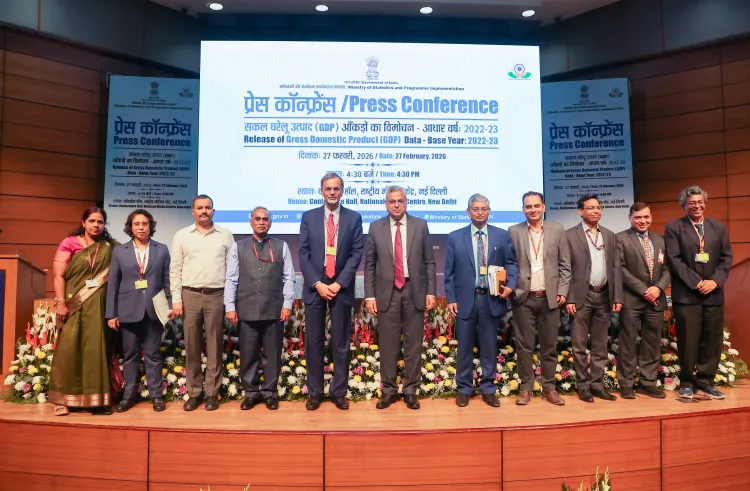
New Delhi, Feb 28 (NationPress) The Indian economy is poised for robust and sustained growth, with real GDP projected to increase by 7.6% in FY 2025–26, as per an official announcement. This substantial performance reinforces India's growth trajectory towards the vision of ‘Viksit Bharat’, characterized by enhanced productivity, resilience, and inclusive progress.
The revision of the GDP base year to 2022–23 signifies a pivotal move to align India's national accounts with the dynamics of a rapidly evolving economy.
According to the statement, “By adopting improved data sources, refining methodological frameworks, broadening the coverage of burgeoning sectors, and increasing transparency through the SUT framework, the new series delivers a more precise, consistent, and comprehensive evaluation of economic activities.”
The Indian statistical system is advancing towards higher benchmarks of accuracy, comparability, and global alignment. Collectively, these initiatives enhance the credibility of official statistics, reinforcing their role as a solid foundation for informed policy-making and sustainable economic planning.
The statement also highlighted that India compiles its GDP estimates in accordance with the 2008 System of National Accounts (SNA 2008), the globally recognized statistical framework. With the United Nations Statistical Division transitioning to SNA 2025, expected to be globally adopted around 2029–30, India aims to align with the updated standard in its forthcoming base year revision.
Additionally, as a participant in the IMF’s Special Data Dissemination Standard (SDDS), India adheres to globally acknowledged standards of statistical quality and transparency. The revised GDP series is fully compliant with international statistical norms.
With the GDP base year updated to 2022-23, the Consumer Price Index (CPI) base year updated to 2024, and the Index of Industrial Production (IIP) updated to 2022-23, India’s statistical framework is experiencing thorough modernization.
To maintain this momentum, the base year revision of the Wholesale Price Index (WPI) is also underway. Until the new WPI data is released, the current WPI will continue to serve as a deflator.
“Moreover, the Ministry of Statistics and Programme Implementation (MoSPI) intends to integrate the Producer Price Index (PPI) soon, which measures the rate of price changes for goods and services purchased and sold by producers,” the statement concluded.
Point of View
It's clear that the recent revisions to India's GDP estimates reflect a strategic enhancement in our statistical framework. Aligning with international standards not only boosts credibility but also fosters a more robust economic planning environment, paving the way for sustainable growth.
NationPress
19 Sept 2026
Frequently Asked Questions
What is the revised GDP growth rate for India?
The revised GDP growth rate for India is projected at 7.6% for FY 2025-26.
What does the revision of the GDP base year signify?
The revision of the GDP base year to 2022-23 helps align India's national accounts with the realities of a rapidly evolving economy.
How does the updated GDP series enhance data quality?
The updated GDP series integrates better data sources, strengthens methodologies, and increases transparency, providing a more comprehensive measure of economic activity.
What is the significance of aligning with SNA 2025?
Aligning with SNA 2025 ensures that India's statistical practices remain consistent with global standards, enhancing international comparability.
What other statistical updates are in progress?
In addition to the GDP revision, the CPI and IIP base years are being updated, and a revision of the WPI is also underway.