Will India Become an Upper Middle-Income Country by 2030?
Synopsis
India is on track to achieve a per capita income of $4,000 by 2030, potentially classifying it as an upper middle-income nation. A recent SBI Research report highlights India's rapid economic growth and the factors influencing its journey towards this milestone.
Key Takeaways
India is projected to reach $4,000 per capita income by 2030.
It will join China and Indonesia in the upper middle-income classification.
The country achieved $3 trillion in 2021.
Continuous reforms are essential for sustained growth.
Historical growth rates support the feasibility of reaching these targets.
New Delhi, Jan 19 (NationPress) India is projected to reach a per capita income of $4,000 by 2030, marking its transition to an upper middle-income country, alongside China and Indonesia in the current classification, according to a report from SBI Research released on Monday.
It took India 60 years post-independence to reach the milestone of $1 trillion, and just another seven years to achieve $2 trillion in 2014.
The nation reached $3 trillion in 2021, with projections suggesting it will achieve $4 trillion by 2025.
"India is expected to hit the $5 trillion mark within the next two years. The country achieved $1,000 in per capita income in 2009, 62 years after independence. It reached $2,000 in 2019 and is likely to hit $3,000 by 2026," stated Dr. Soumya Kanti Ghosh, Group Chief Economic Advisor at State Bank of India.
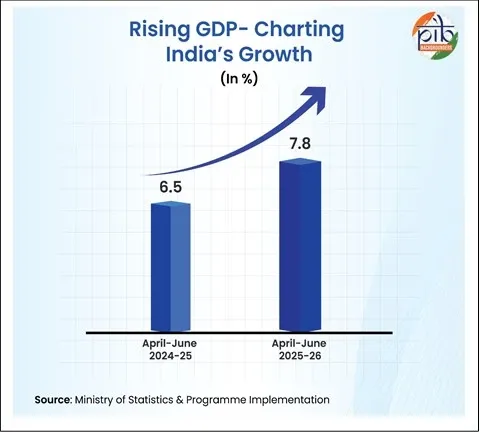
Over the past decade, India's ranking in the cross-country distribution of average real GDP growth has risen from the 92nd percentile to the 95th percentile, indicating a significant improvement in its global growth standing.
"To meet the high-income country threshold of $13,936 by 2047, India’s per capita GNI must grow at a CAGR of 7.5%. Given that India's per capita GNI has grown by 8.3% over the past 23 years, this target seems attainable," Ghosh elaborated.
However, if the high-income threshold rises to $18,000, India would need to achieve a CAGR of approximately 8.9% over the next 23 years to attain that status by 2047.
The report projects that with an average population growth of 0.6% and an average deflator of 2% from economies like China, Japan, the UK, the US, and the Euro area, nominal GDP growth in dollar terms is estimated to be around 11.5% for the next 23 years.
"India must continue its reform initiatives to secure the necessary incremental growth needed to enter the high-income category," the report advised.
Clearly, India can and is likely to transition to an upper middle-income country, with the threshold for this being around $4,500 in per capita GNI.
The required nominal GDP growth of about 11.5% is feasible, as historical growth rates were close to 11% prior to the pandemic (FY04-FY20) and around 10% during FY04-FY25.
Point of View
It's crucial to recognize that India's economic trajectory is not just a statistic; it's a reflection of ongoing reforms and resilience. The journey to becoming an upper middle-income nation is a testament to India's potential and determination. We must stay informed and engaged as this narrative unfolds.
NationPress
23 Sept 2026
Frequently Asked Questions
What is the current per capita income of India?
As of now, India's per capita income is projected to reach $4,000 by 2030.
When did India achieve its $3 trillion economy status?
India achieved its $3 trillion economy status in 2021.
What is the expected growth rate for India's GNI to become a high-income country?
India's per capita GNI must grow at a CAGR of 7.5% to reach the high-income threshold of $13,936 by 2047.
What reforms are necessary for India's economic growth?
India needs to continue its reform agenda to secure incremental growth essential for entering the high-income bracket.
How does India's GDP growth compare globally?
India's percentile rank in global GDP growth has increased from the 92nd to the 95th percentile over the last decade.