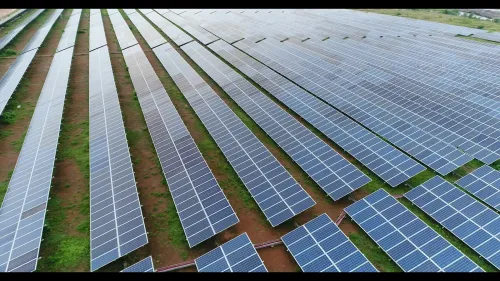
India's Sovereign Green Bonds Steady Amid Market Changes

Synopsis
A recent report reveals that India continues to rely heavily on sovereign green bonds, amidst modest overall sustainable bond issuance. Despite challenges, India is on track to meet its renewable energy goals ahead of schedule.
Key Takeaways
$180 billion in sustainable bonds from Asia-Pacific set to mature in 2026 .
Sovereign green bonds dominate India's sustainable bond market.
India's sustainable bond issuance fell to $2 billion in 2025 .
Annual investment of $250 billion needed until 2047 for climate goals.
Challenges faced by Reserve Bank of India noted.
New Delhi, Feb 26 (NationPress) Approximately $180 billion in sustainable bonds issued across the Asia-Pacific region during the market surge of 2020-2021 are projected to mature in 2026, according to a recent report. In India, the issuance is expected to remain modest, with sovereign green bond tranches continuing to dominate the market amid limited corporate involvement.
India's sustainable bond issuance, already on the smaller side, fell to $2 billion in 2025, with green bonds accounting for a substantial 62 percent of the total. The remaining issuance comprised social bonds, as highlighted in the S&P 'Global Sustainable Bonds Outlook Report'.
“Instruments labeled as green stand to gain from the nation’s climate objectives, which necessitate an annual investment of $250 billion until 2047, as outlined in the Framework of India's Climate Finance Taxonomy,” the report states.
On the other hand, social bonds, which focus on themes like financial inclusion and women's empowerment, are anticipated to remain niche investments, perceived as more intricate by investors.
The government has introduced further tranches of Indian rupee-denominated sovereign green bonds, strengthening the national green yield curve and drawing interest from institutional investors.
Sovereign issuances represented 94 percent and 58 percent of the nation’s green bond and overall sustainable bond markets, respectively, in 2025.
However, the Reserve Bank of India encountered challenges, such as the cancellation of a green bonds auction in June due to heightened yield demands.
India achieved its target of having 50 percent of its installed renewable energy capacity by 2025, five years ahead of schedule.
“We anticipate a stable to slightly increasing issuance range of $170 billion-$200 billion in 2026 across the Asia-Pacific region. Significant maturities in 2026-2027, thriving local-currency debt capital markets, and regulatory initiatives will support this issuance,” the report indicates.
Nevertheless, economic unpredictability and shifting trade policies, driven by geopolitical tensions, are likely to hinder the potential for growth in issuance, the report concluded.
Point of View
The report underscores India's ongoing commitment to sustainable finance, particularly through sovereign green bonds. Despite facing challenges and a modest issuance landscape, the early achievement of renewable energy goals showcases the nation's dedication to climate initiatives.
NationPress
30 Sept 2026
Frequently Asked Questions
What are sovereign green bonds?
Sovereign green bonds are debt securities issued by a government to raise funds for projects with positive environmental impacts.
Why are green bonds important for India?
Green bonds are crucial for India as they help finance the country's ambitious climate goals and renewable energy projects.
What is the expected trend for sustainable bonds in 2026?
The report anticipates a stable to slightly increasing issuance of $170 billion-$200 billion in sustainable bonds across the Asia-Pacific in 2026.
How much investment does India need annually for its climate goals?
India requires an annual investment of $250 billion until 2047 to meet its climate goals.
What challenges does the Reserve Bank of India face regarding green bonds?
The Reserve Bank of India has faced challenges such as the cancellation of a green bonds auction due to high yield demands.