India's immersive tech market to hit $7.82 bn by 2030, fastest-growing in Asia Pacific
Synopsis
India's immersive technology market is on track to reach $7.82 billion by 2030, growing at nearly 30% annually — the fastest clip in Asia Pacific. With ₹250 crore allocated for creator labs in schools and colleges, a National Centre of Excellence partnering with Google, Meta, and Netflix, and a gaming sector heading toward $9.2 billion by FY29, India is making a serious structural bet on XR as its next digital-economy frontier.
Key Takeaways
India's immersive technology market is projected to reach $7.82 billion by 2030 at a CAGR of 29.8% .
India is positioned as the fastest-growing immersive tech market in Asia Pacific .
The Indian Institute of Creative Technologies (IICT) has launched 18 courses with over 135 students enrolled as of March 2026 .
Union Budget 2026–27 allocated ₹250 crore for AVGC Content Creator Labs in 15,000 schools and 500 colleges .
India's gaming sector is separately projected to grow from $3.8 billion (2024) to $9.2 billion by FY29 .
IICT collaborates with Google , Meta , Adobe , and Netflix to build creative and XR talent pipelines.
India's immersive technology market is projected to reach $7.82 billion by 2030, expanding at a compound annual growth rate (CAGR) of 29.8%, according to an official factsheet released on Monday, 26 October 2026. The figures position India as the fastest-growing regional market in the Asia Pacific, driven by a maturing digital ecosystem, a rapidly expanding middle class, and surging e-commerce adoption.
What Immersive Technology Covers
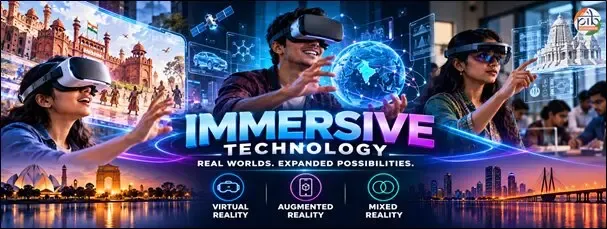
Immersive technologies encompass an emerging suite of tools designed to create interactive, engaging, and highly realistic digital experiences. Unlike conventional digital media, these platforms engage multiple senses simultaneously, generating a heightened sense of presence.
The three most prevalent forms are virtual reality (VR), augmented reality (AR), and mixed reality (MR) — collectively labelled extended reality (XR). Their applications are expanding rapidly across education, manufacturing, healthcare, and the creative industries.
Government Push: AVGC-XR and Budget Allocations
The Indian government has placed immersive technologies at the centre of its digital economy agenda through the Animation, Visual Effects, Gaming, Comics and Extended Reality (AVGC-XR) ecosystem. The Indian Institute of Creative Technologies (IICT), established as a National Centre of Excellence, collaborates with global technology majors including Google, Meta, Adobe, and Netflix to advance creative education and skills development.
As of March 2026, IICT had launched 18 courses across AVGC-XR domains, with more than 135 students enrolled. The Union Budget 2026–27 further committed ₹250 crore for AVGC Content Creator Labs in 15,000 secondary schools and 500 colleges across the country — a structural investment in pipeline talent.
Gaming Sector Adds Momentum
Immersive technology's growth story is amplified by India's gaming sector, which is separately projected to scale from $3.8 billion in 2024 to $9.2 billion by FY29, according to a parallel industry report. The two segments are increasingly convergent, with XR and gaming sharing infrastructure in hardware, content pipelines, and developer communities.
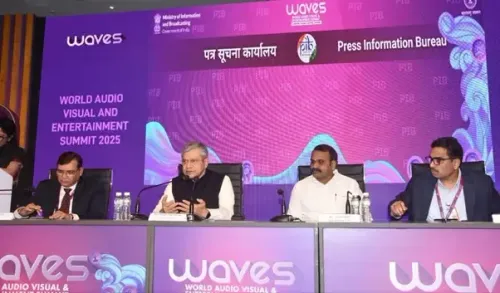
National showcases such as the WAVES summit are already presenting India's creative and immersive media capabilities to a global audience, signalling a deliberate push to attract foreign investment and co-production partnerships.
Digital Infrastructure as a Foundation
Analysts and officials point to India's existing digital public infrastructure — including UPI, Aadhaar, DigiLocker, UMANG, and BHASHINI — as a foundational layer upon which immersive experiences can be built. As these platforms become more widespread, the next frontier, the factsheet noted, is to make digital interactions more visual, interactive, and experiential rather than transactional.
Rapid advances in artificial intelligence (AI), high-speed connectivity, and edge computing are accelerating that transition. Building stronger capabilities in research, startups, talent development, content creation, and indigenous technologies will be critical for India to shape the next generation of immersive experiences and entrench its position in the global digital economy, the factsheet added.
What Comes Next
With budget allocations in place, institutional frameworks active, and private-sector partnerships deepening, India's immersive technology ambitions are now backed by both policy intent and capital. Whether execution keeps pace with projections — particularly in talent supply and content localisation — will determine how much of the $7.82 billion market opportunity India actually captures by 2030.
Point of View
But India has a history of technology market projections that outpace actual delivery — the gap between a TAM estimate and captured value is where policy really gets tested. The ₹250 crore budget line for creator labs is meaningful only if curriculum quality and industry absorption rates hold up; 135 students enrolled at IICT is a thin base for a $7.82 billion ambition. The real question is whether India can build a content and IP layer atop its XR infrastructure, or whether it remains primarily a services market executing foreign-originated IP — the same trap it has yet to fully escape in software.
NationPress
26 Oct 2026
Frequently Asked Questions
What is India's immersive technology market size projection for 2030?
India's immersive technology market is projected to reach $7.82 billion by 2030, expanding at a compound annual growth rate of 29.8%, according to an official factsheet released on 26 October 2026. This makes India the fastest-growing immersive tech market in the Asia Pacific region.
What are immersive technologies and what forms do they take?
Immersive technologies are tools that create interactive, realistic digital experiences engaging multiple senses simultaneously. The three primary forms are virtual reality (VR), augmented reality (AR), and mixed reality (MR), collectively referred to as extended reality (XR).
What is the Indian government doing to develop the immersive tech sector?
The government has established the Indian Institute of Creative Technologies (IICT) as a National Centre of Excellence under the AVGC-XR framework, partnering with Google, Meta, Adobe, and Netflix. The Union Budget 2026–27 also allocated ₹250 crore for AVGC Content Creator Labs in 15,000 secondary schools and 500 colleges.
How big is India's gaming sector and how does it relate to immersive tech?
India's gaming sector is projected to grow from $3.8 billion in 2024 to $9.2 billion by FY29, according to a separate industry report. Gaming and XR are increasingly convergent, sharing hardware infrastructure, content pipelines, and developer talent pools.
What digital infrastructure supports India's immersive technology growth?
Platforms such as UPI, Aadhaar, DigiLocker, UMANG, and BHASHINI form the foundational digital layer. Advances in AI, high-speed connectivity, and edge computing are enabling a transition from transactional digital access to richer, more experiential interactions.